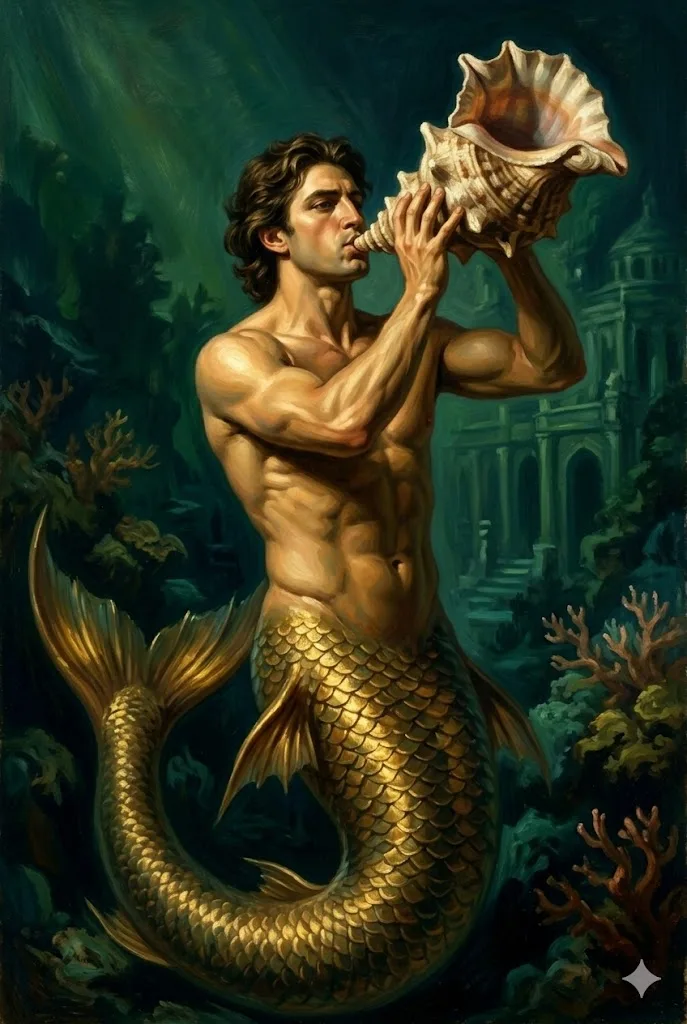
Son of the Sea
Triton was a sea god, the son of Poseidon and the sea goddess Amphitrite. He was depicted as a merman with the upper body of a man and the lower body of a fish, a form that influenced virtually every subsequent depiction of merpeople in Western art. He lived with his parents in a golden palace at the bottom of the sea, and his most famous attribute was a conch shell trumpet whose sound could calm or raise the waves at will.
The Conch Shell
Triton's conch shell was one of the most powerful instruments in mythology. When blown softly, it could calm the most violent storms and still the roughest seas. When blown with force, it could raise waves and terrify sea creatures and coastal populations alike. During the great flood that Zeus sent to destroy humanity, it was Triton who blew his conch shell on Poseidon's orders to signal the waters to recede, ending the deluge and allowing Deucalion and Pyrrha to begin repopulating the earth.
The Argonauts
In the myth of the Argonauts, Triton appeared to Jason and his crew when they became stranded in Lake Tritonis in Libya. The Argonauts were lost, unable to find a passage back to the sea. Triton appeared disguised as a local king named Eurypylus and offered them a clod of earth as a gift of hospitality. He then revealed his true form and physically lifted the Argo, carrying it to the Mediterranean Sea. The clod of earth eventually became the island of Thera (modern Santorini), from which the Greek colony of Cyrene was founded.
Legacy
Triton's influence on Western culture is enormous. The concept of the merman derives directly from his imagery. Rome's Trevi Fountain features Tritons guiding Poseidon's chariot. The word triton entered biology as the name for a genus of newts. Disney's The Little Mermaid named Ariel's father King Triton, placing a Greek sea god at the centre of one of the most popular animated films ever made. Neptune's largest moon is also named Triton, continuing the astronomical tradition of naming celestial bodies after mythological figures.
Classical Sources
- 📜 Homer, Iliad & Odyssey (c. 750 BC)
- 📜 Hesiod, Theogony (c. 700 BC)
- 📜 Apollodorus, Bibliotheca (c. 1st-2nd century AD)
- 📜 Ovid, Metamorphoses (8 AD)
Cross-referenced with multiple classical sources for accuracy.
Explore More
Poseidon · Jason · Golden Fleece · Home