Clytemnestra — The Queen Who Took Justice Into Her Own
⚡ Quick Facts
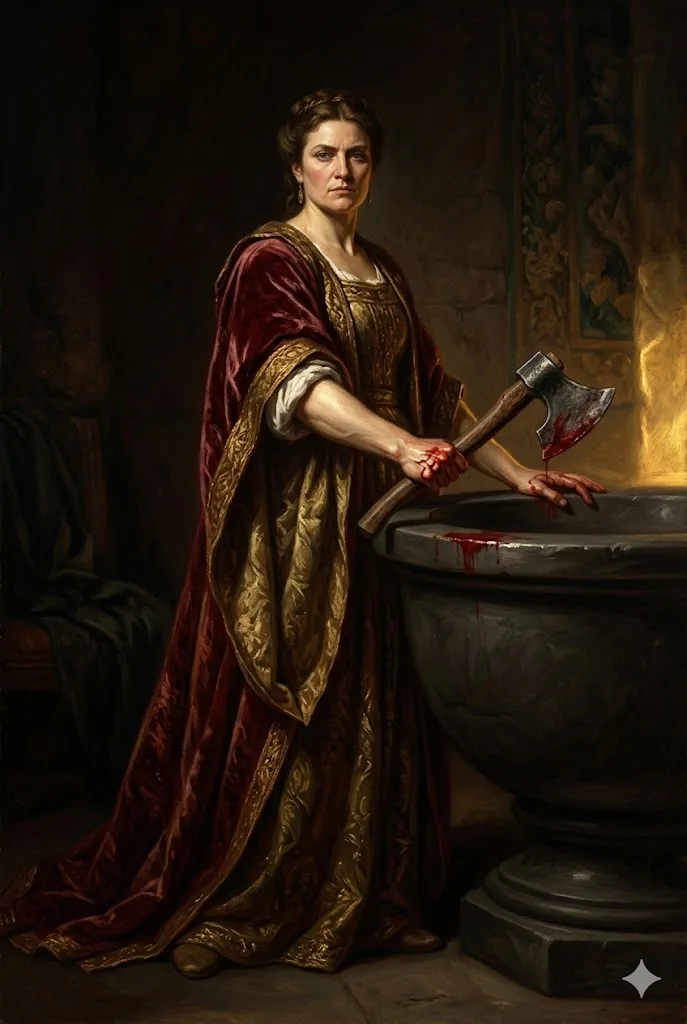
Helen's Forgotten Sister
Clytemnestra was Helen of Troy's twin sister — both daughters of Leda, though their parentage was complicated by Zeus's famous visit in the form of a swan. While Helen became the face that launched a thousand ships, Clytemnestra became something arguably more interesting: a queen who refused to be a victim.
She was first married to Tantalus (not the famous one), who was murdered by Agamemnon along with their infant child so that Agamemnon could take Clytemnestra as his own wife. This first violence is often forgotten but helps explain everything that followed.
The Murder of the King
When Agamemnon sacrificed their daughter Iphigenia to gain favorable winds for Troy, Clytemnestra's hatred crystallized. Over the ten years of the war, she took Aegisthus as her lover and co-ruler, governing Mycenae with an iron hand while her husband fought abroad.
When Agamemnon returned victorious — bringing the Trojan princess Cassandra as his concubine — Clytemnestra welcomed him with false joy. She laid out purple tapestries for him to walk upon, drew him a bath, and then trapped him in a robe and struck him with an axe. She killed Cassandra too.
In Aeschylus' telling, Clytemnestra feels no guilt. She stands over her husband's body and declares herself an instrument of justice — vengeance for Iphigenia and for the corruption of the House of Atreus.
Her Own End
Justice — or vengeance — came full circle when her son Orestes, encouraged by Electra and commanded by Apollo, returned to kill her. Clytemnestra's murder of Agamemnon raised the question that echoes through all of Greek tragedy: when does justice become murder, and when does murder become justice?
Homer's Clytemnestra and the Tragedians'
The queen who swings the axe comes mainly from fifth-century Athenian drama. Homer tells the story differently. In the Odyssey, Agamemnon's murder is a warning repeated again and again, and the main villain is Aegisthus. Nestor tells Telemachus that Clytemnestra at first rejected Aegisthus, "for she had good sense." Agamemnon had left a bard behind to watch over her, and Aegisthus had to take the singer to a deserted island and abandon him before he could win her. In Book 4, Aegisthus kills Agamemnon at a welcome feast "as one slaughters an ox at the manger."
Homer's darkest picture of her comes in Book 11, from Agamemnon's ghost in the Underworld. He says she killed Cassandra beside him, and that as he lay dying she turned away and would not even close his eyes or his mouth. In Book 24 the poem openly sets her against Penelope. Penelope's faithfulness will be a song of praise among men. Clytemnestra's will be a hateful song that shames all women. The Odyssey never mentions the sacrifice of Iphigenia as her motive. Homer may not have known that story at all.
The sacrifice moves to the centre with Pindar, whose Eleventh Pythian ode puts the question openly: did the slaughter of Iphigenia at Euripus drive her to it, or was she led astray by nights in another man's bed? The tragedians answer in different ways:
- Aeschylus, Agamemnon (458 BC): Clytemnestra is the strongest figure on stage. The watchman calls her a woman with a man's counsel in her heart. She plans the chain of beacon fires that brings news of Troy's fall, and afterwards she describes striking the netted king three times, rejoicing in his spattered blood "as the grain rejoices in the rain."
- Aeschylus, Libation Bearers: She dreams that she gives birth to a snake, and when she nurses it, it draws blood along with the milk. Facing Orestes, she bares the breast that fed him, and he wavers until Pylades reminds him of Apollo's command.
- Sophocles, Electra: A harder, more defensive queen. She argues her case for Iphigenia's death against Electra. She dreams that Agamemnon plants his sceptre at the hearth and that it grows into a branch that shades all Mycenae. She openly rejoices at the false news of her son's death.
- Euripides, Electra: She is surprisingly tired and half-regretful. She comes to Electra's poor farmhouse because she believes her daughter has just given birth, and she is killed while doing what a mother would do.
- Euripides, Iphigenia at Aulis: This is the source for the first marriage mentioned above. Clytemnestra reminds Agamemnon that he killed her first husband Tantalus and her baby. She is brought to Aulis by the lie that Iphigenia will marry Achilles.
Family Details Often Left Out
Homer's Iliad gives Agamemnon three daughters, Chrysothemis, Laodice and Iphianassa. Electra and Iphigenia were probably later names for, or additions to, this group. Clytemnestra also had children with Aegisthus. Later mythographers name a son, Aletes, and a daughter, Erigone, and in some versions Erigone brings Orestes to trial for her parents' deaths. Her death also has a sequel. In Aeschylus' Eumenides her ghost appears and rouses the sleeping Furies to hunt her son down. That pursuit ends in the first murder trial at the Areopagus in Athens, where Athena casts the deciding vote to acquit him.
Weapon, Name and Tomb
Sources disagree on how Agamemnon died. Homer speaks of Aegisthus killing him at a feast. Aeschylus puts the killing in the bath, with the king wrapped in a robe like a net and struck by Clytemnestra herself. The axe is clearest in Libation Bearers, where she calls for a "man-slaying axe" when she realises Orestes is at the door. The older spelling of her name is Klytaimestra, without the "n." The name probably comes from mēdomai, "to plan or devise," so it means something like "famous for her plotting." Later copyists turned it into the familiar "Clytemnestra."
Pausanias, visiting Mycenae in the second century AD, reports that Clytemnestra and Aegisthus were buried a little outside the walls, because they were considered unworthy of burial inside, where Agamemnon lay. The great beehive tomb that tourists now visit as the "Tomb of Clytemnestra" got that name from modern excavators. It is a Bronze Age tholos and has no ancient connection to her.
In Art and Later Retellings
A red-figure calyx-krater in Boston by the Dokimasia Painter (about 460 BC) shows Agamemnon caught in a transparent, net-like robe while Aegisthus strikes him and Clytemnestra rushes up behind with an axe. It is close in date to Aeschylus' trilogy. Her later reinventions include Richard Strauss's opera Elektra (1909), where she is a haunted, sleepless woman, and Eugene O'Neill's Mourning Becomes Electra (1931), which moves the whole story of the house to New England after the Civil War.
Ancient sources
- Homer, Odyssey 3, 4, 11 and 24: Aegisthus's seduction of her and the abandoned bard, the murder at a feast, Agamemnon's ghost describing her cruelty, and the contrast with Penelope.
- Pindar, Pythian 11: asks whether Iphigenia's sacrifice or adultery drove her to kill.
- Aeschylus, Oresteia (Agamemnon, Libation Bearers, Eumenides): the beacon speech, the murder in the bath, the snake dream, her death at Orestes' hands, and her ghost rousing the Furies.
- Sophocles, Electra: her quarrel with Electra over Iphigenia and the dream of the sprouting sceptre.
- Euripides, Electra and Iphigenia at Aulis: her death at the farmhouse, and her first marriage to Tantalus and the deception at Aulis.
- Pausanias, Description of Greece 2.16: reports the graves of Clytemnestra and Aegisthus outside the walls of Mycenae.
Frequently asked questions
Why did Clytemnestra kill Agamemnon?
Ancient authors give several reasons. Her own speeches in tragedy point to the sacrifice of Iphigenia. Homer emphasises her affair with Aegisthus. Aeschylus adds Agamemnon's bringing Cassandra home as his concubine, and the old curse on the house of Atreus. Most versions combine more than one of these.
Who killed Clytemnestra?
Her son Orestes, on Apollo's orders, with Electra's support. In Aeschylus his friend Pylades is also present. In Euripides' Electra, Electra herself holds the sword with him.
Was Clytemnestra a daughter of Zeus?
Usually not. The common version makes Helen and Pollux Zeus's children, while Clytemnestra and Castor are children of Leda's mortal husband, Tyndareus. Only some versions say she came from the same egg as Helen.
Was Clytemnestra a villain?
The Odyssey treats her as the model of a treacherous wife. The tragedians give her real arguments, and Aeschylus in particular makes her the most intelligent person on stage. Modern readers often see her as an avenging mother, which is close to how she presents herself in the plays.