Who Was Nemesis?
Nemesis was one of the most feared and respected deities in the Greek pantheon — the goddess of righteous anger, divine retribution, and the punishment of hubris. Her name, which literally means "to give what is due," reveals her essential function: she ensured that no mortal who enjoyed excessive good fortune or committed acts of arrogance escaped the consequences of upsetting the natural balance of the cosmos.
In a world where the gods themselves were capricious and often cruel, Nemesis represented a deeper principle of cosmic justice. She was the force that struck down those who boasted too loudly, who accumulated wealth without gratitude, or who dared to compare themselves to the immortals. The Greeks called this dangerous excess "hubris," and Nemesis was its inevitable answer.
Origins and Nature
Like Thanatos, Nemesis was a child of Nyx (Night), placing her among the primordial forces that existed before the Olympian gods rose to power. Some traditions describe her as a daughter of Oceanus or even of Zeus, but the most widely accepted genealogy traces her to the darkness of Night itself — fitting for a force that operates invisibly, striking when least expected.
Nemesis was closely associated with Tyche, the goddess of fortune and chance. Where Tyche distributed good and bad luck seemingly at random, Nemesis served as the corrective force — ensuring that those who received more than their share of blessings were brought back into balance. The two goddesses were sometimes depicted together, representing the full cycle of fortune's rise and fall.
Nemesis and Narcissus
The most famous myth involving Nemesis concerns the beautiful youth Narcissus. Blessed with extraordinary beauty, Narcissus cruelly rejected every person who fell in love with him, including the nymph Echo, who wasted away from grief until only her voice remained. The rejected lovers prayed to Nemesis for justice, and the goddess answered.
Nemesis led Narcissus to a clear pool of water, where he saw his own reflection for the first time. He fell hopelessly in love with the beautiful face staring back at him, unable to look away or embrace the image he adored. He remained by the pool, gazing at himself, until he withered and died — or, in some versions, was transformed into the flower that bears his name. This myth perfectly illustrates Nemesis's method: the punishment mirrors the crime, turning the sinner's own vice against them.
Worship and Cult
The most important sanctuary of Nemesis was located at Rhamnous, a coastal town in Attica north of Athens. The temple there housed a magnificent statue of the goddess carved by the sculptor Agoracritus, a student of the legendary Pheidias. According to local legend, the marble for this statue was originally brought to Marathon by the invading Persians, who intended to use it to erect a victory monument after conquering Athens. When the Greeks defeated them at the Battle of Marathon in 490 BC, the captured marble was used instead to create the statue of Nemesis — a perfect example of the goddess's own brand of poetic justice.
Symbols and Depictions
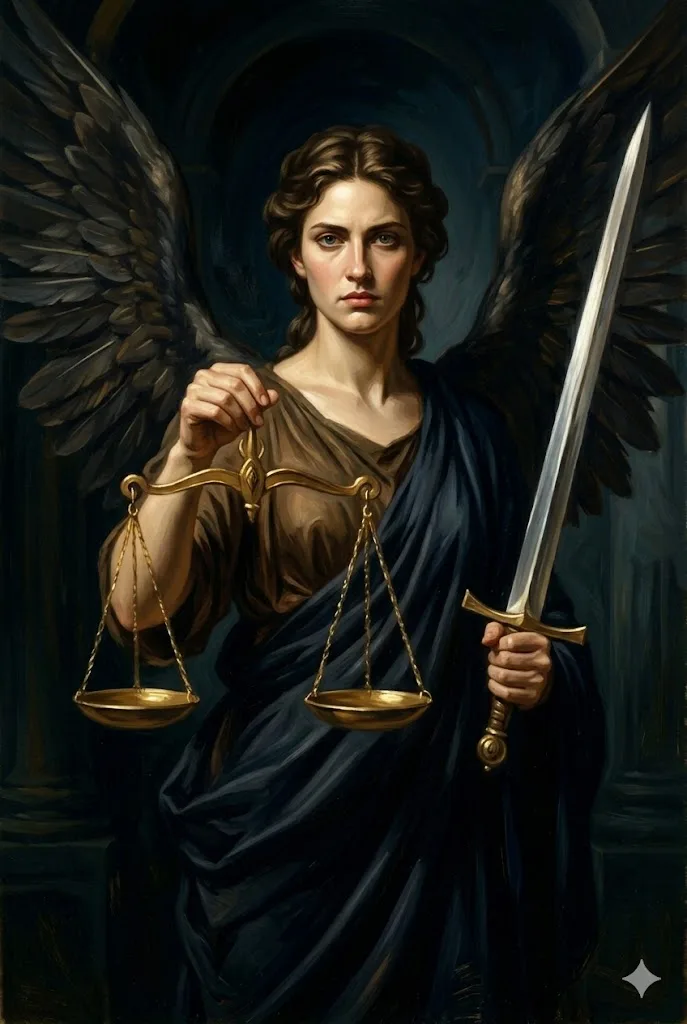
Nemesis was typically depicted as a dignified, stern woman bearing several symbolic objects. She often carried a measuring rod or cubit rule, symbolizing the limits that mortals should not exceed. A bridle represented the restraint she imposed on excessive pride. The wheel of fortune sometimes accompanied her, representing the inevitable turning of fate. In some images, she holds a sword or whip — instruments of punishment for those who transgressed the boundaries she enforced.
Wings were another common attribute, emphasizing that Nemesis could arrive swiftly and without warning. The griffin, a mythical creature combining the king of beasts (the lion) with the king of birds (the eagle), was her sacred animal, and a chariot drawn by griffins was one of her most dramatic visual motifs.
Primary Classical Sources
The mythology of Nemesis is preserved in numerous ancient texts, including:
- 📜 Homer, Iliad & Odyssey (c. 750 BC) — The foundational texts of Greek literature, containing extensive references to the gods and their interventions in mortal affairs.
- 📜 Hesiod, Theogony (c. 700 BC) — The primary source for the genealogy and origins of the Greek gods, including the succession myths and the rise of the Olympians.
- 📜 Homeric Hymns (c. 7th–6th century BC) — A collection of hymns to individual deities providing detailed mythological narratives not found elsewhere.
- 📜 Apollodorus, Bibliotheca (c. 1st–2nd century AD) — The most comprehensive ancient handbook of Greek mythology, systematically cataloguing myths and genealogies.
- 📜 Ovid, Metamorphoses (8 AD) — The Roman poet's masterwork retelling Greek myths with a focus on transformation, preserving many stories that would otherwise be lost.
- 📜 Pausanias, Description of Greece (c. 150 AD) — A detailed travelogue recording temples, cult sites, and local mythological traditions across the Greek world.
All content on this page has been cross-referenced with multiple classical sources and modern scholarly works to ensure accuracy.
Join the Pantheon
Weekly mythology stories & deep dives delivered to your inbox.