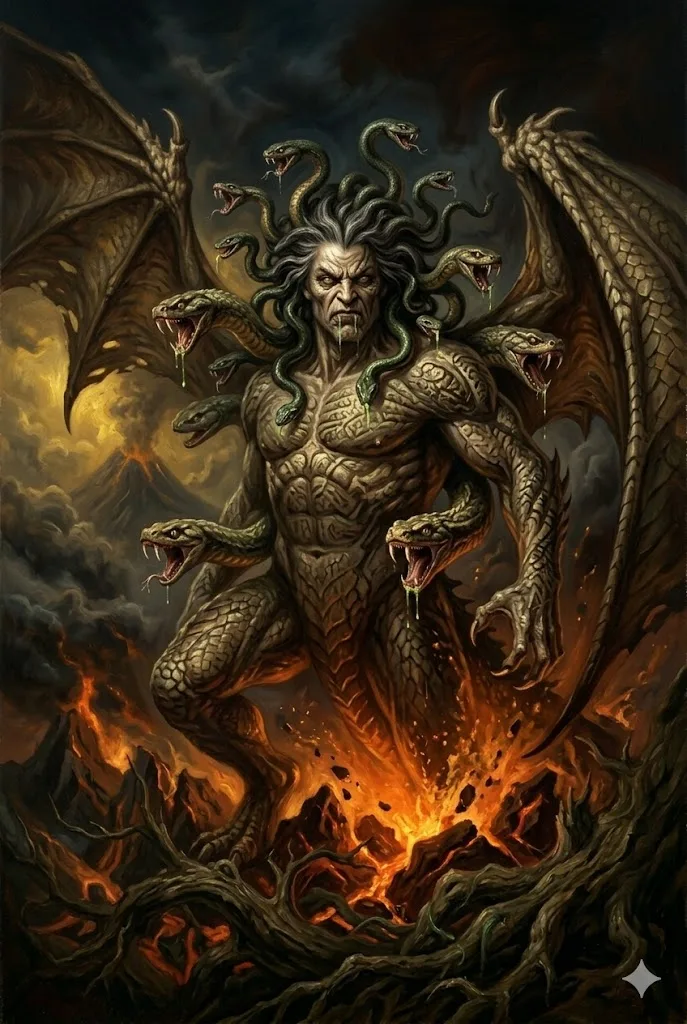
I. What Was Typhon?
Typhon was the most terrifying monster in all of Greek mythology — a colossal storm giant so enormous that his head brushed the stars and his outstretched arms could touch the eastern and western horizons simultaneously. He had a hundred dragon heads sprouting from his shoulders, each one spitting fire and roaring with the sounds of every animal imaginable — lions, bulls, serpents, and dogs. From the waist down, his legs were replaced by massive coiling vipers.
Born of Gaea (Earth) and Tartarus (the Abyss) after the defeat of the Titans and the Giants, Typhon was the earth mother's final, most devastating weapon against Zeus and the Olympians. When Typhon attacked Olympus, the gods were so terrified that they fled to Egypt and disguised themselves as animals. Only Zeus stood to fight.
The battle between Zeus and Typhon was the most cataclysmic conflict in Greek mythology. Zeus hurled thunderbolt after thunderbolt, but Typhon seized the god's weapon — the adamantine sickle — and cut the sinews from Zeus's hands and feet, leaving him helpless. Hermes and Pan rescued Zeus and restored his sinews. In their final confrontation, Zeus buried Typhon under Mount Etna in Sicily, where the monster's fury still causes volcanic eruptions and earthquakes to this day.
With his mate Echidna, Typhon fathered virtually every famous monster in Greek mythology: the Hydra, Cerberus, the Chimaera, the Sphinx, the Nemean Lion, the Colchian Dragon, and the eagle that tortured Prometheus. He is literally the Father of All Monsters.
Classical Sources
Ancient accounts of Typhon appear in:
- 📜 Hesiod, Theogony (c. 700 BC) — Origin and genealogy of mythological creatures.
- 📜 Apollodorus, Bibliotheca (c. 1st–2nd century AD) — Detailed descriptions of monsters and their encounters with heroes.
- 📜 Ovid, Metamorphoses (8 AD) — Vivid retellings of creature myths with emphasis on transformation.
- 📜 Homer, Iliad & Odyssey (c. 750 BC) — Encounters with mythological beasts during the Trojan War cycle.
Cross-referenced with multiple classical sources for accuracy.
Different versions of Typhon's birth
Hesiod's Theogony gives the version most people know: Typhoeus is the last child of Gaia, conceived with Tartarus after the Titans were defeated. The Homeric Hymn to Apollo tells a different story. In it Hera, furious that Zeus had produced Athena without her, strikes the ground with her hand, prays to Earth, Heaven and the Titans, and bears Typhaon on her own. She then gives the infant to the she-dragon at Delphi to raise, "an evil to evil". So the monster has two possible origins: Earth's revenge for her defeated Titan children, or Hera's revenge for her husband's solo childbirth. Both make him the answer of an aggrieved mother to Zeus's power.
The ancient name also varies. Typhoeus, Typhaon, Typhos and Typhon all appear, sometimes in the same author. The Greeks connected the name with smoke and smouldering (typhein), which suits a monster buried under a volcano.
The fight with Zeus
Hesiod's battle is short and cosmic. The earth, sea and sky boil, Hades and the Titans in Tartarus tremble, and Zeus burns all of Typhoeus's heads with his thunderbolts and throws him down into Tartarus. There he becomes the source of the destructive, unpredictable winds, unlike the useful winds born of the gods. In Hesiod the struggle is never in doubt.
Apollodorus tells the dramatic version with the setback. Zeus chases Typhon to Mount Kasios in Syria and grapples with him with an adamantine sickle, but Typhon wrestles the blade away and cuts the sinews from Zeus's hands and feet. He carries the helpless god to the Corycian cave in Cilicia and hides the sinews in a bearskin, guarded by the she-dragon Delphyne. Hermes and Aegipan, a figure often identified with Pan, steal the sinews back. Zeus then chases the monster in a winged chariot. The Fates trick Typhon into eating "ephemeral fruits" that they promise will make him stronger but in fact weaken him. In Thrace he hurls whole mountains, and when they rebound on him, his blood stains Mount Haemus, whose name Apollodorus derives from haima, "blood". Finally Zeus throws Mount Etna on top of him in Sicily. In Nonnus's Dionysiaca, written much later, it is Cadmus disguised as a shepherd who charms Typhon with music and gets the sinews back.
Where the monster ended up depended on the author. Homer's Iliad puts his "bed" in the land of the Arimoi, where Zeus lashes the earth around him. Pindar and Aeschylus put him under Etna, and Pindar adds that he was raised in a Cilician cave. Virgil and Strabo mention the island of Ischia in the Bay of Naples. The pattern is clear: wherever the earth shook or smoked, the Greeks were ready to place Typhon underneath.
Near Eastern parallels and Egyptian links
Scholars have long noticed how closely the Typhon story matches older Near Eastern myths. In the Hittite Song of Ullikummi, a stone giant challenges the storm god, and in the Illuyanka myth a serpent defeats the storm god and takes his heart and eyes, which are later recovered by a trick. That is very close to Apollodorus's stolen sinews. Mount Kasios, where Apollodorus puts the battle, is Mount Zaphon, the home of the Ugaritic storm god Baal. The Greeks themselves linked Typhon with Egypt: Herodotus and later Plutarch identify him with the Egyptian god Seth, which explains why the gods escape to Egypt in disguise in Ovid's and other versions.
The most vivid surviving image is on a Chalcidian black-figure hydria of about 540 BC in Munich. A bearded Zeus aims a thunderbolt at a winged Typhon whose body ends in two coiling serpent tails.
Ancient sources
- Hesiod, Theogony 820–880: Typhoeus born of Gaia and Tartarus, with a hundred serpent heads and the voices of many beasts, defeated by Zeus's thunderbolts, cast into Tartarus and made the source of harmful winds. Lines 306–332 give his union with Echidna and their offspring.
- Homeric Hymn to Apollo: Hera bears Typhaon without a father in anger over Athena's birth and gives him to the Delphic serpent to raise.
- Homer, Iliad 2.781–783: the earth groans under the army as it does when Zeus lashes the ground around Typhoeus among the Arimoi.
- Pindar, Pythian 1: Typhos, raised in a Cilician cave, lies pinned under Etna and spews fire.
- Apollodorus, Library 1.6.3: the full narrative with the severed sinews, the Corycian cave, Delphyne, Hermes and Aegipan, the Fates' fruit, Mount Haemus and Etna.
- Ovid, Metamorphoses 5.321–358: in the song of the Pierides the gods flee to Egypt in animal forms, and Calliope's reply describes Typhoeus straining beneath Sicily.
Frequently asked questions
Is Typhon the father of Cerberus and the Hydra?
Yes, in Hesiod, who makes him and Echidna the parents of Orthus, Cerberus and the Hydra. Hesiod gives the Sphinx and the Nemean Lion to Orthus instead, so later writers such as Apollodorus widened Typhon's role.
Is Typhon the same as the Giants?
No. Apollodorus tells the Typhon story right after the Gigantomachy, as Gaia's next attack. The two are separate wars, though they were sometimes confused in later tradition.
Does the word "typhoon" come from Typhon?
Partly. The English word seems to blend the Greek name, used for whirlwinds since antiquity, with Arabic and Asian words for great storms. Hesiod's description of Typhoeus as the father of destructive winds made the association natural.
Was Typhon the strongest enemy Zeus faced?
In the myths he is the only opponent who comes close to beating Zeus single-handed. Apollodorus's version has Zeus beaten and maimed before help comes, which no other enemy achieves.
Explore More Mythology
Get weekly deep dives into the gods, heroes, and myths of ancient Greece.