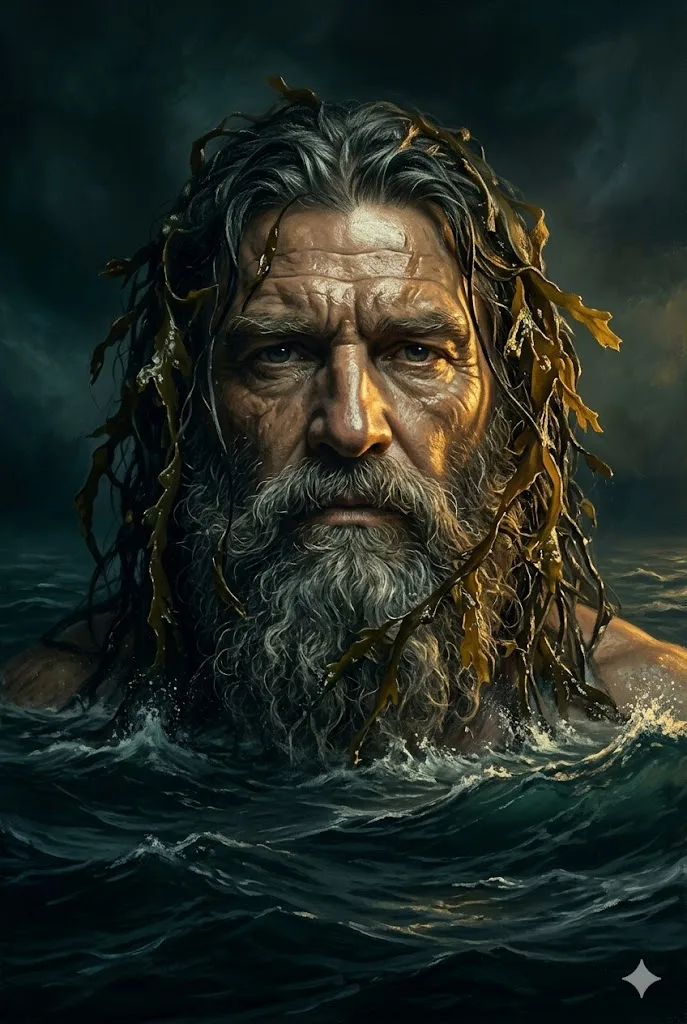
The Primordial Ocean
Before Poseidon ever lifted his trident, before the Olympians were even born, the sea already had a god. Pontus was the primordial deity of the sea, born from Gaia (Earth) without a father in the earliest moments of creation. He was not a god who commanded the waves — he was the sea itself, the vast, dark, primeval ocean that surrounded the ancient world. While later myths would give dominion over the oceans to Poseidon, the Greeks never forgot that the sea itself was older than the Olympians, older than the Titans, older than almost everything.
Creation and Origins
According to Hesiod's Theogony, Gaia first bore Uranus (the Sky) to be her equal and cover her completely. Then, without any partner, she produced Pontus — the barren, fruitless deep with its raging swell. This parthenogenic birth emphasized Pontus's primordial nature: he was not created through union but emerged directly from the Earth itself, as fundamental as the mountains and the sky. In some traditions, Pontus and Gaia together produced the earliest sea deities and monsters, establishing the vast underwater realm that would later be inherited by younger gods.
Monstrous Offspring
Pontus fathered some of the most important sea figures in Greek mythology. With Gaia, he produced Nereus, the gentle Old Man of the Sea who was famed for his truthfulness and gift of prophecy. They also created Thaumas (the wonder of the sea), Phorcys (guardian of the deep), Ceto (the sea monster), and Eurybia (the power of the sea). These children went on to produce the Nereids, the Graeae, the Gorgons, Iris the rainbow goddess, and countless other marine deities and creatures. In this way, Pontus was the ultimate ancestor of virtually every sea creature and deity in Greek mythology.
Legacy
Unlike the Olympians who demanded temples and sacrifices, Pontus received little direct worship. He was too ancient, too elemental for the personal relationship Greeks sought with their gods. But his presence was felt in every wave, every storm, every sailor's prayer. The very word 'Pontus' became a geographical term — the Pontus Euxinus (the Black Sea) carried his name for millennia. He represented the ancient Greek understanding that the sea was not merely Poseidon's kingdom but a primal force that predated all the gods they knew.
Classical Sources
- 📜 Hesiod, Theogony (c. 700 BC)
- 📜 Apollodorus, Bibliotheca (c. 1st-2nd century AD)
- 📜 Hyginus, Fabulae (c. 1st century AD)
Cross-referenced with multiple classical sources for accuracy.
Explore More
Poseidon · Gaia · Triton · Home
Pontus, Oceanus and Thalassa: Three Different Seas
Greek had several words for the sea, and its mythology keeps them apart. Oceanus, a Titan son of Gaia and Uranus, was the great river that flowed in a circle around the edge of the flat earth, the source of all rivers and springs. Pontus was the sea within that ring, the Mediterranean and the waters sailors actually crossed. Thalassa, the common everyday word for the sea, was sometimes personified as a goddess in her own right. Homer and Hesiod use pontos for the open sea in its most poetic sense, the "unharvested" deep that yields no crops, the "wine-dark" sea of the epics. Hesiod's description of Pontus at his birth, "the barren deep with its raging swell," uses exactly that language of a place where nothing grows.
Genealogies outside Hesiod complicate the picture. In the preface to his Fabulae, the Roman mythographer Hyginus makes the races of fish the offspring of Pontus and Thalassa, a tidy way of explaining the creatures of the sea. Other late writers name additional children of Pontus, but none of them gained wide currency. Hesiod's version, in which Pontus is son and then partner of Gaia, remained the standard one, repeated almost unchanged by Apollodorus.
The Grandchildren of the Sea
Pontus is easiest to understand through his descendants, because almost every strange or wondrous thing that came from the water traces back to him. His five children with Gaia each founded a line:
- Nereus married the Oceanid Doris and fathered the fifty Nereids, among them Thetis, mother of Achilles, and Amphitrite, wife of Poseidon. This makes Pontus the great-grandfather of Achilles and the grandfather-in-law of Poseidon.
- Thaumas married the Oceanid Electra; their children were Iris, the rainbow messenger, and the storm-swift Harpies.
- Phorcys and Ceto, brother and sister, produced the darkest line of all: the Graeae, the three grey-haired sisters who shared one eye; the Gorgons, including Medusa; and the serpent who guarded the golden apples, usually identified as Ladon. Whether Echidna belongs to this pair or to Medusa's brood is ambiguous in Hesiod's wording, and later sources split on it.
- Eurybia married the Titan Crius and bore Astraeus, Pallas and Perses, linking the sea family with the Titans. Through Pallas, Eurybia was grandmother of Nike and Kratos.
The family logic is striking. Nereus represents the sea's truthfulness and calm wisdom, Thaumas its wonders, Phorcys and Ceto its hidden dangers, Eurybia its brute strength. Hesiod is in effect breaking the sea into its different faces and giving each its own lineage.
A Sea God Without Stories
Unlike his son Nereus, who wrestles Heracles and shifts shape to avoid answering questions, Pontus himself has no adventures. He does not fight in the Titanomachy, he is not overthrown, and he does not have a palace. He is a cosmic region given a name and a family. This is typical of the primordial generation in Hesiod: Ourea, the Mountains, born from Gaia at the same moment, are equally inactive. The drama of Greek myth begins only when the Titans and then the Olympians start competing for power.
In art Pontus barely exists. Greek vase painters show Nereus often, but almost never a figure labelled Pontus. Roman mosaics frequently feature a bearded head with crab-claw horns emerging from the water, which modern books sometimes caption as Pontus, but such heads are generally identified as Oceanus.
Pontus on the Map
The Black Sea's Greek name evolved from Pontus Axeinos, the "inhospitable sea," to Pontus Euxeinos, "the hospitable sea," a euphemism Strabo comments on. The southern coast of the Black Sea in northern Anatolia was called simply Pontus, and it gave its name to the Kingdom of Pontus, whose most famous ruler, Mithridates VI, fought Rome in three wars in the first century BC. The word lives on in Greek as pontos and in the scholarly label "Pontic" for the Black Sea region.
Ancient sources
- Hesiod, Theogony 131–132 — Gaia bears Pontus, the barren sea with its raging swell, without union in love.
- Hesiod, Theogony 233–239 — Pontus and Gaia's children: Nereus, Thaumas, Phorcys, Ceto and Eurybia.
- Apollodorus, Library 1.2.6–7 — repeats the children of Pontus and Ge and traces their descendants.
- Hyginus, Fabulae, preface — a Roman genealogy that pairs Pontus with Thalassa as parents of the fish.
- Strabo, Geography 7.3 — explains the change from Axeinos to Euxeinos in the Black Sea's name.
Frequently asked questions
Is Pontus older than Poseidon?
Much older. Pontus was born from Gaia at the start of creation, two generations before Poseidon's parents Cronus and Rhea. Poseidon's wife Amphitrite was Pontus's granddaughter.
What is the difference between Pontus and Oceanus?
Oceanus is the world-encircling river and a Titan; Pontus is the inner sea and a primordial god. They are uncle and nephew, since Oceanus is a son of Gaia and Uranus.
Who is Pontus's wife?
In Hesiod, his own mother Gaia, with whom he fathered five children. Hyginus pairs him with Thalassa instead.
Is Pontus the father of Medusa?
No, her grandfather. Medusa's parents were Phorcys and Ceto, both children of Pontus and Gaia.