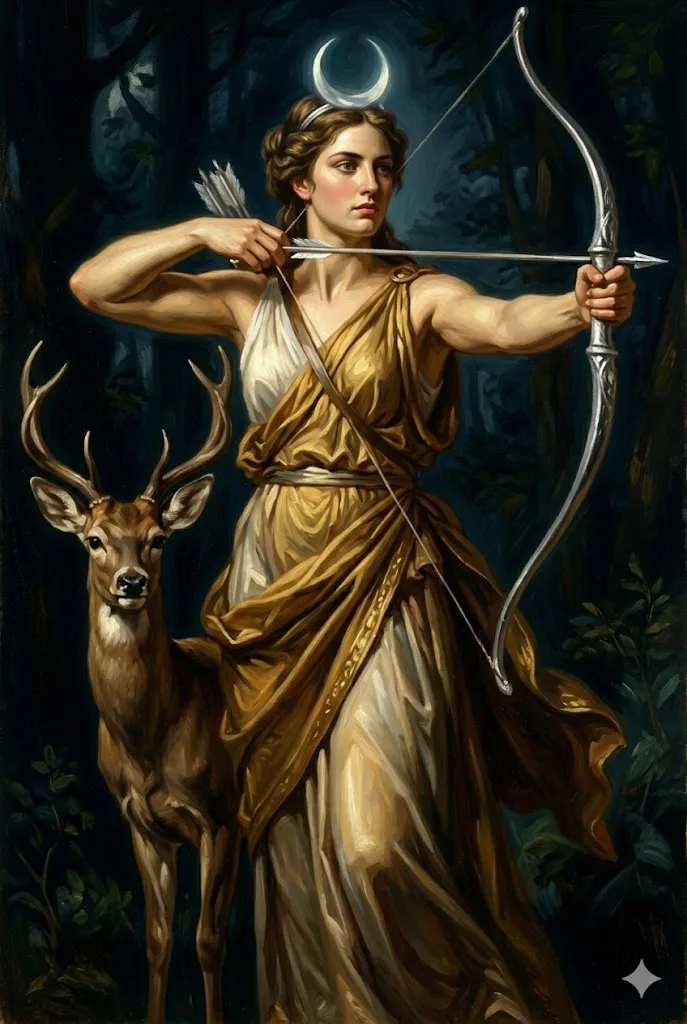
I. Who Was Artemis?
Artemis was the fierce virgin goddess of the hunt, wilderness, wild animals, the moon, and chastity. Twin sister of Apollo and daughter of Zeus and the Titaness Leto, she was born on the island of Delos and immediately assisted her mother in delivering her brother. From that moment, she was associated with childbirth and the protection of young women — a paradox for a goddess who swore never to marry.
She roamed the forests and mountains of Greece with a band of devoted nymphs, all of whom had sworn vows of chastity. Armed with her silver bow and arrows (gifts from the Cyclopes), she was a huntress of unmatched skill — swift, deadly, and fiercely independent. She was also protector of young girls and women in transition, particularly at the thresholds of marriage and childbirth.
Artemis was as vengeful as she was protective. Those who violated her sanctity or disrespected her vows faced terrible punishments. The hunter Actaeon, who stumbled upon her bathing, was transformed into a stag and torn apart by his own hounds. The giant Orion, her only true companion, was killed through trickery — some say by Artemis herself, deceived by Apollo into shooting him from afar.
II. The Protector and the Punisher
Artemis demanded absolute devotion from her followers. When the nymph Callisto broke her vow of chastity (seduced by Zeus in disguise), Artemis banished her from the group. In some versions, Artemis herself transformed Callisto into a bear; in others, it was Hera's jealousy that caused the transformation. Either way, Zeus eventually placed Callisto among the stars as the constellation Ursa Major — the Great Bear.
At the start of the Trojan War, Artemis becalmed the Greek fleet at Aulis because King Agamemnon had boasted of being a better hunter than her. She demanded the sacrifice of his daughter Iphigenia before she would allow the winds to blow. In most versions, Artemis substituted a deer at the last moment and spirited Iphigenia away to serve as a priestess — but the damage to Agamemnon's family was already done.
III. Worship & Legacy
Artemis's most famous temple was the Temple of Artemis at Ephesus, one of the Seven Wonders of the Ancient World. As Diana, her Roman counterpart, she remained one of the most widely worshipped goddesses in the ancient world. Her association with the moon complemented Apollo's association with the sun, and together the twins represented the celestial balance between day and night.
Childhood, birth and the Callimachus hymn
The sources do not even agree on where Artemis was born. The Homeric Hymn to Apollo greets Leto as the mother who bore "her in Ortygia, him in rocky Delos". Ortygia was later sometimes treated as another name for Delos and sometimes placed elsewhere, including near Ephesus and at Syracuse. The most vivid portrait of her youth comes from Callimachus's Hymn to Artemis. As a small child on Zeus's knee she asks for eternal virginity, as many names as her brother Apollo, a bow and arrows, a short hunting tunic, sixty Oceanid nymphs as dancers and twenty more to look after her hounds and boots, and all the mountains as her territory. Zeus laughs and gives her more: thirty cities and a share of many others. She gets her bow from the Cyclopes, working at Hephaestus's forge, and her hounds from Pan in Arcadia.
Homer's Artemis is formidable, but on Olympus she can look almost childish. In Iliad 21, when the gods fight each other, Hera grabs her wrists, boxes her ears with her own bow, and sends her off in tears to Zeus's lap. In the same passage Homer calls her potnia theron, "mistress of animals", a title that goes back to Bronze Age images of a goddess holding beasts on either side.
More myths of her anger
- Niobe's children: when Niobe boasted that she had more children than Leto, Apollo shot her sons and Artemis her daughters. Homer tells the story in Iliad 24, and Ovid's version in the Metamorphoses is the most detailed.
- The Calydonian Boar: King Oeneus of Calydon left her out when he offered the first fruits of the harvest, so she sent a huge boar to ruin his land. The hunt for it brought together Atalanta, Meleager and many other heroes (Iliad 9).
- The Aloadae: the giant twins Otus and Ephialtes threatened to pile mountains to reach heaven and to take Hera and Artemis as wives. Apollodorus says Artemis turned into a deer and ran between them on Naxos, and each threw his spear at her and killed the other.
- Actaeon: the bathing story belongs mainly to Ovid. Earlier versions give other reasons. Stesichorus, as Pausanias reports, said Artemis threw a deerskin over Actaeon to stop him marrying Semele, and in Euripides' Bacchae he is killed for boasting that he was a better hunter than the goddess.
Cult and epithets
Artemis had more local cults than almost any other Greek deity, and each epithet points to a different side of her. As Agrotera, "of the wilds", she received a famous vow before Marathon in 490 BC. The Athenians promised a goat for every Persian killed, and when there were far too many, they settled on five hundred goats a year, a sacrifice Xenophon says was still being made in his time. At Brauron in eastern Attica, young Athenian girls served her as "bears" (arktoi) before marriage, a rite the chorus of Aristophanes' Lysistrata remembers taking part in. Its origin myth told of a tame bear killed after it hurt a girl. At Sparta, Artemis Orthia was the scene of the diamastigosis, the whipping of youths at her altar, which in Roman times became a spectacle for tourists with its own amphitheatre.
The Artemis of Ephesus was a different kind of goddess, an Anatolian mother deity whom the Greeks identified with their huntress. Her cult statue was covered on the chest with rounded objects that have been read as breasts, eggs, or bull's testicles, and none of these readings is certain. Her temple, one of the Seven Wonders, was burned by Herostratus in 356 BC, on the night, Plutarch says, that Alexander the Great was born. The Acts of the Apostles records the riot of silversmiths in Ephesus shouting "Great is Artemis of the Ephesians!" against Paul's preaching. On Aegina, the goddess Aphaia was linked with her through the Cretan nymph Britomartis (see Aphaia).
One common misconception is that she was a moon goddess from the start. In Homer and Hesiod the moon is Selene, and Artemis has no lunar role. Her identification with the moon, like Apollo's with the sun, grew from the fifth century BC on and became standard only in Hellenistic and Roman times, helped along by the Roman Diana.
Ancient sources
- Callimachus, Hymn 3, To Artemis: her childhood requests to Zeus, her bow from the Cyclopes, her hounds from Pan, and a survey of her cities and companions, including Britomartis.
- Homer, Iliad 21.470–496: called "mistress of animals", then humiliated by Hera in the battle of the gods.
- Homer, Iliad 9 and 24: the Calydonian boar sent against Oeneus, and the killing of Niobe's children.
- Homeric Hymns to Apollo and to Artemis (Hymn 27): her birth to Leto and her portrait as a huntress who returns to Delphi to lead the dances of the Muses and Graces.
- Euripides, Hippolytus and Iphigenia in Tauris: her devoted follower Hippolytus, and the Tauric cult in which Iphigenia serves as her priestess.
- Pausanias, Description of Greece 3.16.7–11: the cult image of Artemis Orthia at Sparta and the origin of the whipping rite.
Frequently asked questions
Did Artemis ever fall in love?
She stayed a virgin in every major tradition. Her closeness to Orion is the nearest thing to a romance, and Hellenistic and Roman writers made more of it, but even there ancient versions differ on whether she killed him herself.
Why was Artemis a goddess of childbirth if she never had children?
Greek tradition said she helped Leto deliver Apollo right after her own birth, and she watched over girls through the dangerous step into marriage and motherhood. Women in labour called on her as Eileithyia or Lochia, and her arrows were also used to explain sudden deaths of women.
What animals were sacred to Artemis?
The deer above all, along with the bear (especially at Brauron), the hunting dog and the wild boar. The quail was linked with Ortygia, whose name means "quail island".
Was Artemis worshipped with human sacrifice?
Myth suggests it, as with Iphigenia at Aulis and the Taurian cult where strangers were sacrificed. Historical rites usually replaced it with symbolic acts, such as the drop of blood drawn from a man's throat at Halai in Euripides, and the whipping at Sparta.
Explore More Mythology
Get weekly deep dives into the gods, heroes, and myths of ancient Greece.