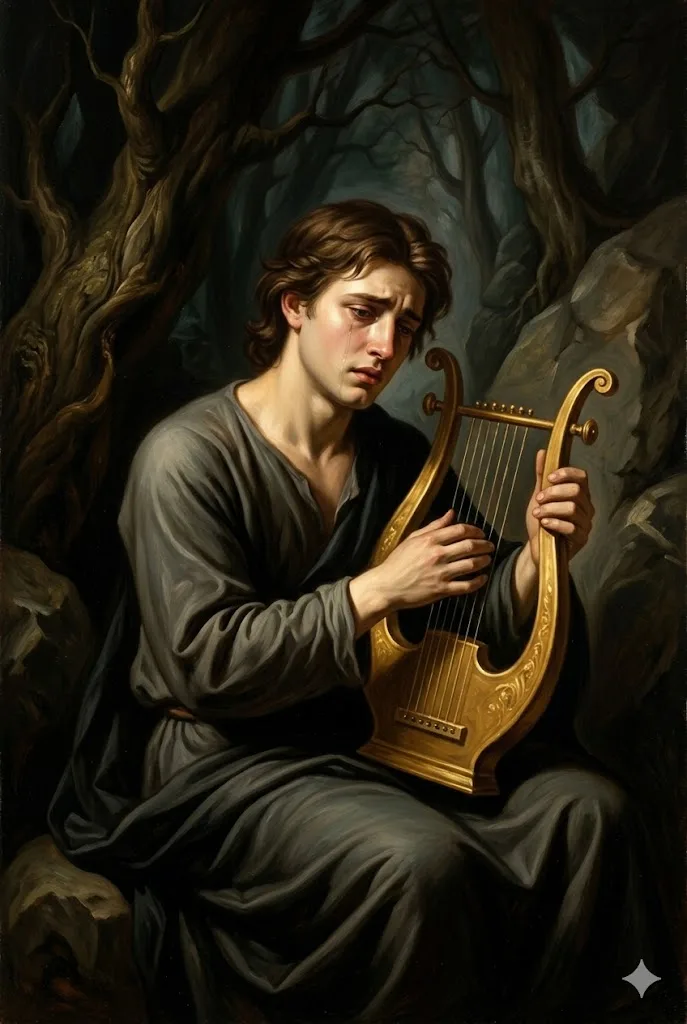
I. Who Was Orpheus?
Orpheus was the greatest musician and poet the world had ever known — a son of Apollo (or the Thracian king Oeagrus) and the Muse Calliope. His music was so beautiful that it could charm wild animals, make trees uproot themselves to draw closer, and cause rivers to change their course. He sailed with Jason and the Argonauts, where his lyre drowned out the song of the deadly Sirens and saved the crew from destruction.
But Orpheus is best remembered for the most poignant love story in Greek mythology: his descent into the underworld to rescue his beloved wife Eurydice.
II. The Descent
When Eurydice died from a snakebite on their wedding day, Orpheus was consumed by grief. He resolved to do what no mortal had ever done: enter the underworld and bring her back. Playing his lyre, he charmed Charon into ferrying him across the Styx, lulled Cerberus to sleep, and moved even the Furies to tears. When he reached the throne of Hades and Persephone, he played and sang so beautifully that the entire underworld fell silent. Even Hades wept.
The gods of the dead agreed to release Eurydice — on one condition: Orpheus must walk ahead and not look back until both had reached the surface. He climbed the long, dark passage out of the underworld, hearing Eurydice's footsteps behind him. But at the very threshold of the upper world, overcome by doubt and longing, he glanced back — and watched Eurydice fade forever into shadow. He had lost her a second time, this time for eternity.
III. Legacy
Orpheus wandered the earth in grief, refusing all other companionship. He was eventually torn apart by Maenads — frenzied followers of Dionysus — either because he refused to worship Dionysus or because he scorned their advances. His severed head floated down the river Hebrus, still singing, and was carried to the island of Lesbos, where it continued to prophesy. The Muses gathered his scattered limbs and buried them, and Zeus placed his lyre among the stars as the constellation Lyra.
Parentage, the Argo, and the singer's early fame
The ancient sources name his father more often as Oeagrus, a Thracian king or river-god, than as Apollo; the Apollo version is mostly later, and comes from his link to the lyre, which Apollo was said to have given him. Pindar is the earliest surviving poet to put Orpheus on the Argo. In Pythian 4 he is "the lyre-player, father of songs", sent along by Apollo. Apollonius of Rhodes gives him two large scenes. In Book 1 he calms a quarrel among the crew by singing a cosmogony: earth, sky and sea separated out of one mass, then Ophion and Eurynome ruled before Cronus and Rhea. In Book 4 he plays loud enough to drown out the Sirens. Even so, one Argonaut, Butes, jumps overboard and has to be saved by Aphrodite. Orpheus also urges the crew to be initiated in the mysteries of Samothrace. This is one of many details that tie him to secret rites. For the whole voyage, see the Golden Fleece and Jason.
How the Eurydice story changes from author to author
Much of the familiar version comes from Latin poets, not Greek ones. Virgil's fourth Georgic is the earliest full account we have. In it, Eurydice steps on the snake while running from the beekeeper Aristaeus, who is chasing her. Her death is the reason his bees die. Virgil also gives the backward glance its sharpest pathos: Eurydice calls out "I am carried off, stretching out my strengthless hands to you" and vanishes like smoke. Ovid (Metamorphoses Book 10) tells it with more restraint. His Eurydice dies just after the wedding while walking with Naiads, and when she is lost a second time she does not reproach Orpheus, "for what could she complain of, except that she was loved?"
Some Greek sources may know a happier ending. In Euripides' Alcestis, Admetus wishes he had Orpheus' voice so he could bring his wife back from the dead. That sounds as if the rescue worked. Plato makes the hostile case in the Symposium. There Phaedrus says the gods showed Orpheus only a phantom of his wife, because a soft lyre-player had schemed to enter Hades alive instead of daring to die for love, as Alcestis did. The name Eurydice is not fixed early either. The Hellenistic poet Hermesianax called her Agriope.
Death, the head, and the cult of Orphism
Aeschylus' lost play Bassarids, known through a later summary, gave one cause of his death. Orpheus came to honour the Sun (identified with Apollo) above Dionysus and climbed Mount Pangaion to greet it at dawn. Dionysus then sent his Thracian Bassarids to tear him apart. Pausanias (Book 9) lists other versions: women killed him because he had lured their husbands away, or Zeus struck him with lightning for revealing mysteries to mortals. Macedonian tradition placed his tomb near Dion and Leibethra, under Mount Olympus. Pausanias tells a local story that Leibethra was destroyed by a flood after the column over his bones collapsed. On Lesbos his head was said to have washed up at Antissa. Philostratus says the head gave oracles there until Apollo told it to stop.
His name became attached to a whole religious movement. "Orphic" poems taught a different theogony, in which Dionysus Zagreus, child of Zeus and Persephone, was dismembered by the Titans, and humans were born from the Titans' soot. The Derveni papyrus, found near Thessaloniki in 1962, contains a 4th-century BC commentary on an Orphic theogony. Gold leaves buried with the dead in southern Italy, Thessaly and Crete tell initiates how to answer the guardians of the underworld: "I am a child of Earth and starry Sky." A collection of 87 Orphic Hymns from the Roman period also survives. Plato and others speak of "Orpheus' books" sold by wandering priests, which shows the name was used as a seal of authority more than as an author.
Orpheus in art and later culture
Athenian vase painters of the 5th century BC liked two subjects: Orpheus playing to Thracian men in fur cloaks, and the Thracian women attacking him with spits, axes and stones. A marble relief of around 420 BC, known from Roman copies in Naples, Paris and Rome, shows Hermes, Eurydice and Orpheus at the moment of parting. Roman mosaics across the provinces show him surrounded by animals. Early Christian catacomb painters used the same image for Christ. Opera was more or less born with him: Peri's Euridice (1600), Monteverdi's L'Orfeo (1607) and Gluck's Orfeo ed Euridice (1762). The Gluck adds a happy ending in which Amor restores Eurydice. For the love story itself, see Orpheus and Eurydice.
Ancient sources
- Pindar, Pythian 4: names Orpheus among the Argonauts as the lyre-player sent by Apollo.
- Apollonius of Rhodes, Argonautica Books 1 and 4: his cosmogonic song that ends a quarrel, and his contest with the Sirens.
- Virgil, Georgics 4: the earliest full version of the descent, including Aristaeus' role in Eurydice's death and the singing head on the Hebrus.
- Ovid, Metamorphoses 10–11: the descent, his songs of Ganymede, Hyacinthus and Pygmalion, and his death at the hands of Ciconian women.
- Plato, Symposium 179d: claims the gods gave Orpheus only a phantom because he would not die for love.
- Pausanias, Description of Greece Book 9: competing accounts of his death, and the tomb traditions of Leibethra and Dion.
Frequently asked questions
Why did Orpheus look back?
The ancient poets give different reasons. Virgil calls it a sudden madness born of love. Ovid says Orpheus was afraid she was failing and longed to see her. Neither treats it as plain disobedience, and both make the moment one of tenderness, not arrogance.
Was Orpheus a real person?
Many Greeks believed so, and poems circulated under his name. Aristotle, as reported by Cicero, apparently doubted that Orpheus ever existed. Modern scholars treat him as a legendary figure whose name was attached to religious poetry from the 6th century BC onward.
What is Orphism?
Orphism was a set of religious teachings tied to Orpheus' name. It stressed purification, often avoiding meat, the soul's survival after death, and a special theogony in which humans carry a spark of Dionysus inside Titanic matter.
Who was Orpheus' mother?
Usually Calliope, the Muse of epic poetry, though some sources name another of the Muses, such as Polyhymnia.
Explore More Mythology
Get weekly deep dives into the gods, heroes, and myths of ancient Greece.