Stymphalian Birds — The Bronze-Feathered Flock of Death
⚡ Quick Facts
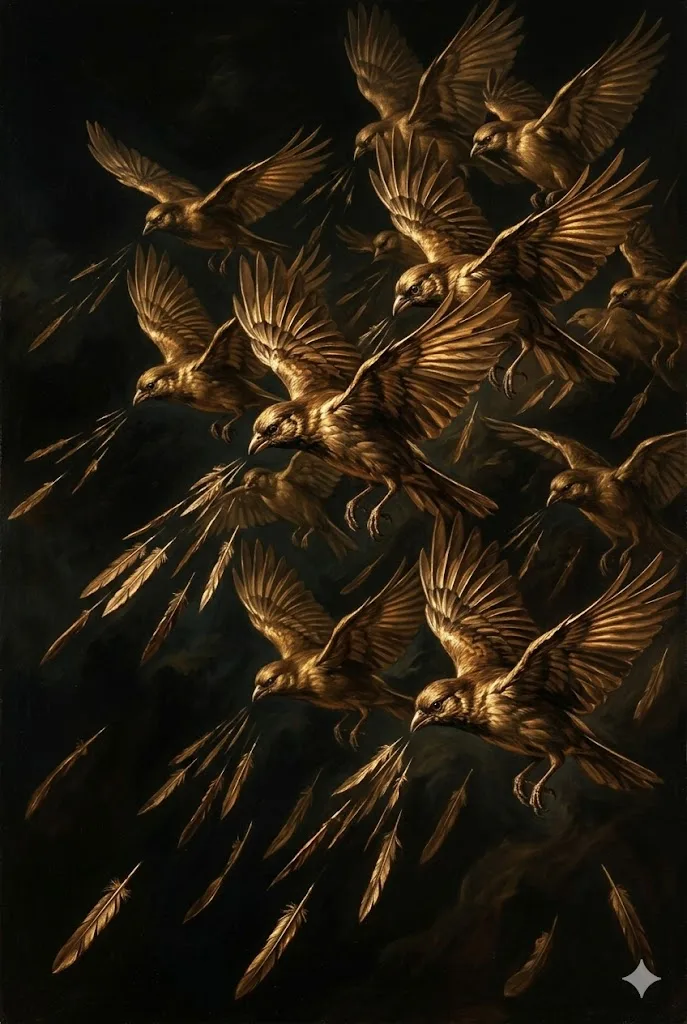
The Plague of Lake Stymphalia
The Stymphalian Birds were a vast flock of man-eating birds that infested the marshes around Lake Stymphalia in the region of Arcadia. Sacred to Ares, these were no ordinary birds — their beaks were made of bronze, capable of piercing armor. Their feathers were metallic and could be launched like arrows at their prey. Their droppings were toxic, poisoning the land and water below.
The birds had originally fled to the lake to escape a pack of wolves, but they multiplied so rapidly that they became a plague upon the entire region, destroying crops, killing livestock, and attacking anyone who ventured near the marshes.
The Sixth Labour
As his sixth labour, Heracles was sent to drive out or destroy the birds. The challenge was that the marsh was too boggy to walk across, and the flock was too vast to fight directly. Athena provided the solution: a special rattle (krotala) forged by Hephaestus.
Heracles climbed a nearby mountain and shook the divine rattle. The tremendous noise startled the entire flock into the air simultaneously. As they rose in a panicked cloud, Heracles shot them down with his arrows, while the survivors fled across the sea to the Black Sea island of Aretias, where the Argonauts later encountered them.
What the ancient writers actually said about the birds
The picture of the Stymphalian Birds most people know today, with bronze beaks, feathers shot like arrows and poisonous droppings, is put together from several sources written centuries apart. Most of it is not in the oldest accounts. Apollodorus gives the plain mythographic version. The birds had taken refuge in the thickly wooded marsh at Stymphalus out of fear of wolves. Heracles could not get at them, so Athena gave him bronze clappers (krotala) made by Hephaestus. He stood on a mountain beside the lake and clashed them, and when the startled birds rose he shot them. Diodorus tells much the same story but puts more weight on the noise: the clashing rattle drove the birds away and freed the farmland they had been ruining.
Arrow-like feathers belong to a different story, the voyage of the Argo. In Apollonius of Rhodes, the Argonauts land on the Island of Ares off the southern Black Sea coast. There, birds attack by dropping sharp feathers that wound like darts. Advised by the prophet Phineus, the heroes put on helmets, lock their shields into a roof and shout and clash their weapons until the flock flies off. Later writers linked these birds with the ones Heracles drove from Arcadia, and that link is the source of the idea that the survivors of the sixth labour fled to the Black Sea. The birds' connection with Ares comes from this island setting, not from the Arcadian story.
Pausanias, who visited Stymphalus in the second century AD, adds another layer. He says there were birds in the Arabian desert also called Stymphalian, as big as cranes and shaped like ibises, with beaks strong enough to pierce bronze or iron armour. He suggests that the birds Heracles fought may have been of this kind. He also says the Arcadian birds were man-eaters.
Stymphalus: the place behind the myth
Lake Stymphalia lies in a closed mountain basin in north-eastern Arcadia, under Mount Kyllene. Its water drains through a natural sinkhole, and Pausanias reports the local belief that it reappeared far to the south-east as the river Erasinos in the Argolid. A marsh with no visible outlet, reed beds and huge numbers of waterbirds makes a natural setting for a story about a flock that could not be reached on foot. The lake still floods and shrinks with the seasons and is an important wetland for migratory birds.
The town honoured the story in its religion. Pausanias describes a temple of Stymphalian Artemis whose roof was decorated with carved figures of the birds. Behind the temple stood statues of maidens with the legs of birds, which modern readers have compared to sirens. He also notes that the Roman emperor Hadrian later piped water from the Stymphalian springs to Corinth.
The labour in Greek art
Artists showed the episode much less often than the Lion or the Hydra, but a few important images survive. An Attic black-figure amphora of the mid-sixth century BC in the British Museum shows Heracles attacking a flock of birds with a sling, not a bow. This suggests the choice of weapon was not fixed early on. The best-known image is one of the twelve metopes of the Temple of Zeus at Olympia (c. 460 BC), where Heracles presents the dead birds to a seated Athena. This version puts the goddess's support at the centre and shows the labour already finished, not the fight.
The rattle often gets less attention than it deserves. In both Apollodorus and Diodorus the problem is reaching the birds, not overpowering them, and the solution is a divine tool for making noise, given by Athena and made by Hephaestus. Like the Augean stables, the labour is about cleverness and help from the gods more than strength. Real bronze krotala were used in ancient Greek music and ritual, so an ancient audience would have pictured something familiar.
Ancient sources
- Apollodorus, Library 2.5.6: the birds shelter in the wooded lake for fear of wolves, Athena gives Heracles bronze clappers made by Hephaestus, and he shoots the birds from a nearby mountain.
- Diodorus Siculus, Library of History 4.13: tells how Heracles drove the birds off with a bronze rattle, freeing the countryside they had laid waste.
- Apollonius of Rhodes, Argonautica 2: the Argonauts on the Island of Ares fend off birds that shoot sharp feathers, using a roof of shields and loud noise.
- Pausanias, Description of Greece 8.22: describes Stymphalus, the lake's underground outflow, the man-eating birds, the Arabian "Stymphalian" birds, and the temple of Artemis with bird figures and bird-legged maidens.
Frequently asked questions
Did Heracles kill all the Stymphalian Birds?
Sources differ. Apollodorus has him shoot them, while Diodorus and others put more weight on driving them away. Later tradition combined the two: some birds were killed and the rest fled, eventually to the Island of Ares, where the Argonauts met them.
Were the birds' feathers really made of bronze?
The oldest accounts do not say so. Feathers used as darts first appear clearly in Apollonius's Argonaut episode, and the bronze-piercing beaks come from Pausanias. The fully metallic bird is a later and especially modern combination of these details.
Which labour was the Stymphalian Birds?
Apollodorus counts it as the sixth, after the Augean stables and before the Cretan Bull. Other ancient lists order the twelve labours differently, but the episode usually falls among the six labours set in the Peloponnese.
Where is Lake Stymphalia today?
In the Corinthia regional unit of the Peloponnese, near the village of Stymfalia. The site of the ancient town and an environment museum about the wetland can both be visited.