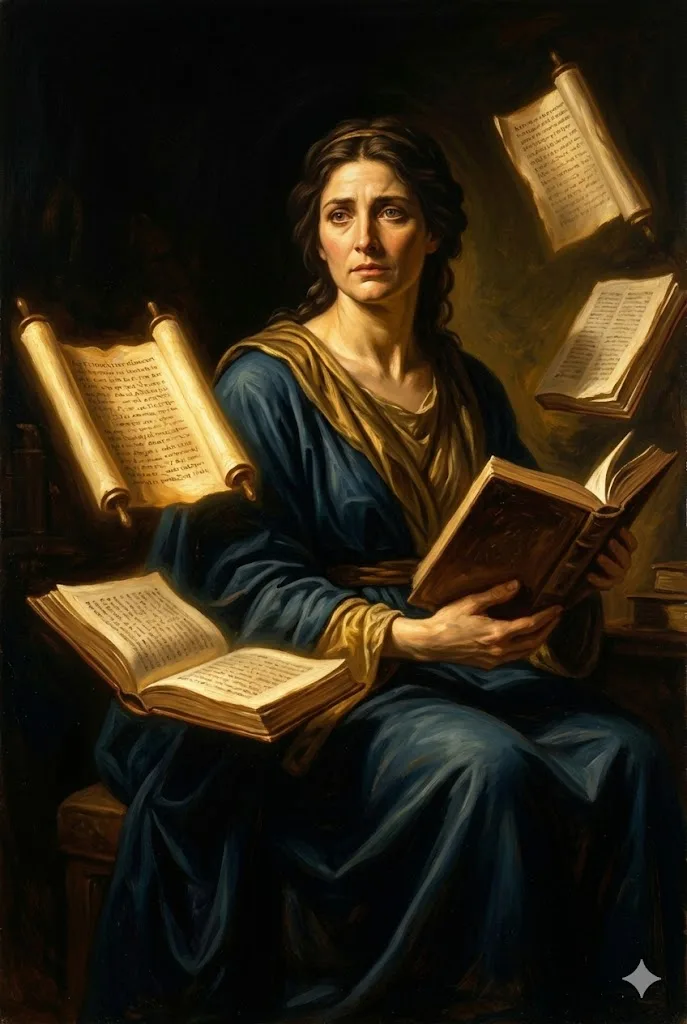
I. Who Was Mnemosyne?
Mnemosyne was the Titaness of memory, remembrance, and the spoken word — one of the twelve original Titans and one of the most quietly powerful figures in Greek mythology. Her name is the root of the English word "mnemonic" (a memory aid), and the Greeks understood her as the force that made all knowledge, history, and storytelling possible. Without memory, there could be no learning, no poetry, no civilization.
Zeus lay with Mnemosyne for nine consecutive nights, and she bore him nine daughters: the Muses. Each Muse presided over a different branch of art and knowledge — Calliope (epic poetry), Clio (history), Erato (love poetry), Euterpe (music), Melpomene (tragedy), Polyhymnia (hymns), Terpsichore (dance), Thalia (comedy), and Urania (astronomy). Together, the Muses were the source of all creative inspiration in the ancient world.
In the underworld, there were said to be two pools: one of Lethe (forgetfulness) and one of Mnemosyne (memory). The dead who drank from the pool of Lethe forgot their earthly lives entirely. But initiates of the Orphic mysteries were instructed to drink instead from the pool of Mnemosyne — preserving their memories and achieving a blessed afterlife. This makes Mnemosyne not merely the goddess of remembering, but a key to escaping the cycle of death and rebirth.
Classical Sources
The mythology of Mnemosyne is preserved in:
- 📜 Hesiod, Theogony (c. 700 BC) — The primary source for Titan mythology, genealogy, and the Titanomachy.
- 📜 Apollodorus, Bibliotheca (c. 1st–2nd century AD) — Comprehensive handbook of Titan genealogies and myths.
- 📜 Aeschylus, Prometheus Bound (c. 5th century BC) — Dramatic portrayal of Titan defiance against Olympian authority.
- 📜 Ovid, Metamorphoses (8 AD) — Roman accounts of Titan mythology and transformations.
Cross-referenced with multiple classical sources for accuracy.
Mnemosyne in Hesiod: memory and forgetting
Hesiod names Mnemosyne among the twelve children of Gaia and Uranus. In the opening of the Theogony he tells how she bore the Muses in Pieria, near Mount Olympus, after Zeus came to her for nine nights away from the other immortals. Hesiod then adds a twist. The Muses, children of Memory, bring lesmosyne, "forgetfulness" of troubles and a rest from cares. Hesiod seems to be playing on the two words on purpose. Memory gives birth to song, and song lets listeners forget their own sorrows while they hear about gods and heroes.
Later in the poem, Mnemosyne is fifth in the list of Zeus's partners, after Metis, Themis, Eurynome and Demeter and before Leto and Hera. Hesiod calls her "of the beautiful hair." Her role makes sense in an oral culture. A singer had to keep genealogies, catalogues and long stories in his head. Asking the Muses for help, which epic poets do at the start of the Iliad and the Odyssey, was also a way of calling on memory.
A common misunderstanding concerns the Muses' fixed specialities. Hesiod gives the nine names, but the neat division of the arts among them (Clio for history, Urania for astronomy and so on) became standard only much later, in Hellenistic and Roman times. Pausanias also records an older tradition from Mount Helicon in Boeotia. According to it, the first Muses were only three: Melete (Practice), Mneme (Memory) and Aoide (Song). In that version, memory is one of the Muses themselves.
The spring of Memory: oracles and gold tablets
The underworld pool of Mnemosyne mentioned above is not only a literary idea. It is known from real objects. Small inscribed gold leaves, buried with the dead in southern Italy, Thessaly and Crete from about the fifth century BC onward, give the deceased directions for the journey below. The tablets from Hipponion and Petelia in southern Italy describe a spring on the left with a white cypress beside it, which the soul must avoid. Further on is the cold water flowing from the lake of Memory, guarded by watchmen. The dead person is to say: "I am a child of Earth and starry Heaven," and ask for a drink. Scholars usually link these texts to Orphic or Bacchic mystery groups, though exactly which group used them is still debated.
A real-world version of the same pair of waters existed at the oracle of Trophonius at Lebadeia in Boeotia. Pausanias, who consulted it himself, explains that people visiting the oracle first drank from a spring called Lethe, to forget everything they had been thinking. Then they drank from the spring of Mnemosyne, so that they would remember what they saw in the underground chamber. Afterwards the priests seated them on a "throne of Memory" and asked them to report what they had seen and heard.
Philosophy, art and modern echoes
Plato makes use of her more than once. In the Theaetetus, Socrates compares the mind to a block of wax and calls it a gift of Mnemosyne, mother of the Muses. Impressions stamped into the wax are remembered for as long as the image lasts. In the Critias, the speaker calls on Mnemosyne before telling the story of Atlantis, since everything depends on remembering it correctly.
Mnemosyne was not a major cult goddess, but she was often honoured together with the Muses. Wherever the Muses had shrines, their mother might be named too. In Roman art she appears in mosaics and on sarcophagi, usually as a thoughtful, closely wrapped woman. Among modern works, Dante Gabriel Rossetti painted her holding a lamp in Mnemosyne (also called The Lamp of Memory). The art historian Aby Warburg named his unfinished atlas of images, which traces visual memory across centuries, the Mnemosyne Atlas. Mnemosyne is also a different figure from Lethe, who is the personification of the river of forgetting in the underworld rather than a Titaness.
Within the family of Zeus, Mnemosyne stands for an important stage. After defeating the Titans, the new king does not only make war. He also fathers the powers of order (the Horae, through Themis) and of culture (the Muses, through Memory). See the wives and partners of Zeus for how these unions fit together.
Ancient sources
- Hesiod, Theogony 53–62, 135 and 915–917: Mnemosyne as a Titaness, the nine nights with Zeus, the birth of the Muses in Pieria, and the Muses as bringers of forgetfulness of ills.
- Pausanias, Description of Greece 9.39 and 9.29: the springs of Lethe and Mnemosyne and the throne of Memory at the oracle of Trophonius, and the three original Muses of Helicon, including Mneme.
- Orphic gold tablets (Hipponion, Petelia and others): instructions to the dead to reject the first spring and ask the guardians for water from the lake of Memory.
- Plato, Theaetetus and Critias: the wax-block image of memory as Mnemosyne's gift, and the appeal to her before the Atlantis story.
- Homeric Hymn to Hermes: the young Hermes, singing his first song on the lyre, honours Mnemosyne first among the gods, because she is the mother of the Muses.
Frequently asked questions
Is Mnemosyne a Titan or a goddess?
Both. She is one of the twelve Titan children of Gaia and Uranus, and so a goddess of the older generation. She sided with Zeus's order and became the mother of the Muses.
What is the difference between Mnemosyne and Lethe?
Lethe is forgetting, a river or spring in the underworld. Mnemosyne is memory. Mystery texts told initiates to avoid the one and drink from the other, and the oracle of Trophonius used both springs in turn.
How many children did Mnemosyne have?
In the standard account, nine: the Muses, all fathered by Zeus. An older tradition from Helicon counted only three Muses.
Where does the word "mnemonic" come from?
From the same Greek root as her name, mnēmē, "memory." The word refers to the faculty she personifies.
Explore More Mythology
Get weekly deep dives into the gods, heroes, and myths of ancient Greece.