Electra — The Daughter Who Refused to Forget
⚡ Quick Facts
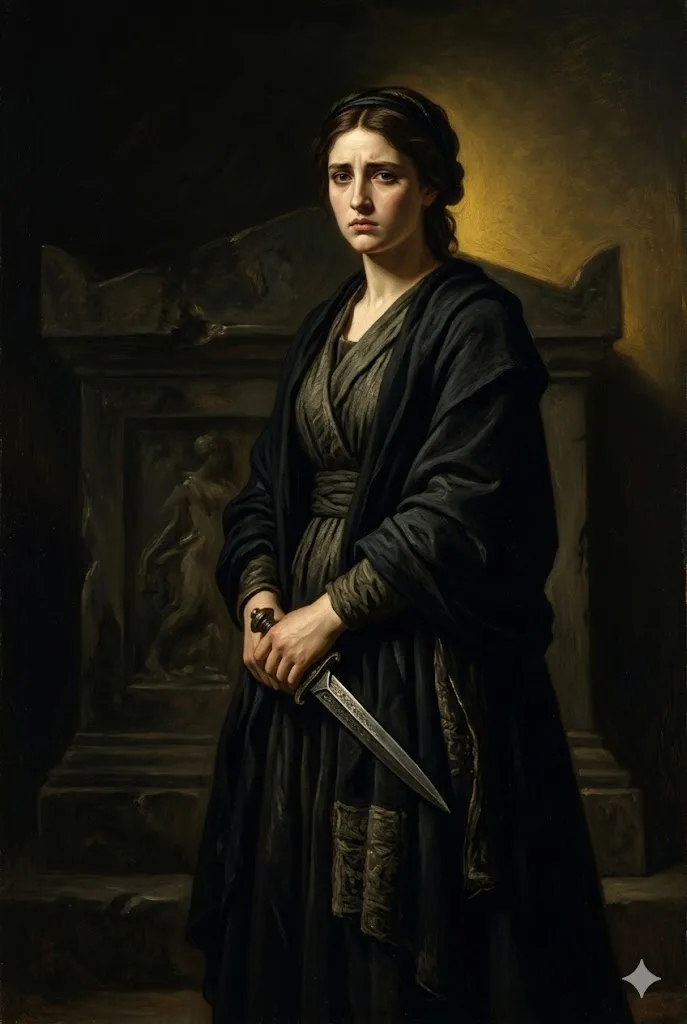
A Princess in Chains
Electra was the daughter of Agamemnon, the king who conquered Troy, and Clytemnestra, the queen who murdered him upon his return. When Clytemnestra and her lover Aegisthus seized power, Electra was reduced from princess to servant in her own home — deliberately humiliated to prevent her from rallying support.
While her sister Chrysothemis accepted the new order and her brother Orestes was smuggled away as a child, Electra alone kept the flame of vengeance alive. She mourned her father openly, publicly shamed her mother, and waited years for the day when Orestes would return to set things right.
The Return of Orestes
Years later, Orestes returned to Mycenae in disguise, accompanied by his friend Pylades. In one of Greek drama's most powerful recognition scenes, Electra — who had received a false report of Orestes' death and was deep in grief — discovers her brother is alive and standing before her. Together, they planned the murders of Clytemnestra and Aegisthus.
The three great tragedians each told this story differently. In Aeschylus, Electra is a supporting figure. In Sophocles, she is the emotional center — fierce, unyielding, and fully committed to justice regardless of cost. In Euripides, she is darker and more psychologically complex, forced to confront the horror of what vengeance actually requires.
The Electra Complex
Sigmund Freud's student Carl Jung named the "Electra complex" after her — the female counterpart to the Oedipus complex, describing a daughter's psychosexual competition with her mother for her father's attention. While this psychological theory has been largely superseded, the name endures as proof of Electra's cultural impact.
Electra represents the impossible choice between justice and family, between memory and moving on. Her story asks whether vengeance can ever truly heal a wound, or whether it only creates new ones.
Where Electra Comes From
Electra is missing from Homer. In Iliad 9, Agamemnon offers Achilles one of his three daughters, and they are named Chrysothemis, Laodice and Iphianassa. Electra is not among them, and the Odyssey tells Orestes' revenge without any sister helping. An ancient explanation survives through the writer Aelian, who cites the early lyric poet Xanthus: Laodice was renamed Electra because Aegisthus would not let her marry, leaving her alektros, "unbedded." That folk etymology may not be correct, but it shows that her unmarried state was part of the character from early on. She seems to have become important in the sixth century in lyric poetry, especially Stesichorus' Oresteia, before the three Athenian tragedians made her famous.
Three Electras: The Plays in Detail
Each tragedian built a different recognition scene and a different woman around it:
- Aeschylus, Libation Bearers. Sent by Clytemnestra to pour offerings at Agamemnon's tomb, Electra finds a lock of hair that matches her own and footprints that fit her feet. Then Orestes shows her a piece of weaving she made for him as a child. Together the siblings and the chorus sing a long invocation calling on their father's spirit. Then Electra goes inside and plays no part in the killings.
- Sophocles, Electra. Orestes' old tutor brings a detailed false report that Orestes died in a chariot crash at the Pythian games. In the play's most famous scene, Electra holds an urn she believes holds her brother's ashes and mourns over it, while Orestes stands beside her unrecognised. When Clytemnestra screams inside the palace, Electra calls out, "Strike, if you have the strength, a second time!" Her sister Chrysothemis is a deliberate contrast: sensible, cautious and unwilling to resist the rulers.
- Euripides, Electra. Aegisthus has married Electra to a poor farmer so that her children cannot threaten him, and the farmer respects her and never sleeps with her. Euripides openly mocks Aeschylus' tokens: Electra points out that a man's hair is not like a woman's, and that his feet would be bigger than hers. Orestes is finally identified by an old scar. Orestes kills Aegisthus at a sacrifice, and Electra lures her mother to the cottage with a false message that she has given birth. Afterwards the Dioscuri appear and order Electra to marry Pylades and leave Argos.
Euripides kept her story going in Orestes (408 BC). Days after the murder, the people of Argos sentence brother and sister to death. Electra helps plan a desperate counterattack: kill Helen and take Helen's daughter Hermione hostage. Apollo has to step in from above to sort out the chaos.
Later Life and Lesser-Known Episodes
The mythographer Hyginus preserves a strange story in which Electra hears a rumour that Orestes has been sacrificed in Tauris. She goes to Delphi and, seeing the priestess there, is about to blind her with a burning brand from the altar. The woman turns out to be her long-lost sister Iphigenia, and Orestes arrives just in time for the recognition. Most traditions agree that Electra married Pylades, Orestes' loyal friend from Phocis. Pausanias names their sons Medon and Strophius and says Electra was buried at Mycenae near Agamemnon's grave, because Pylades had married her with Orestes' approval.
Three other Electras appear in Greek myth and should not be confused with her. One is the Oceanid who was mother of the rainbow goddess Iris and of the Harpies. Another is the Pleiad, daughter of Atlas and mother of Dardanus, ancestor of the Trojan kings. The third, in a tradition Pausanias reports, was a sister of Cadmus, after whom the city's Electran Gate was supposedly named. The Pleiad Electra is sometimes called the "lost" Pleiad, said to have hidden her face when Troy fell.
After Antiquity
Electra may be the most frequently restaged figure from Greek tragedy. Richard Strauss's one-act opera Elektra (1909), with Hugo von Hofmannsthal's libretto, makes her obsessive and unstable, and ends with her dancing herself to death. Jean Giraudoux's Électre (1937), Eugene O'Neill's New England trilogy Mourning Becomes Electra (1931) and Jean-Paul Sartre's Les Mouches (1943) each used her to ask about justice, guilt and freedom. The psychological term mentioned above was coined by Carl Jung in 1913. Freud himself rejected it, preferring to treat girls' development within his own Oedipus framework (see Greek mythology in psychology).
Ancient sources
- Homer, Iliad 9: names Agamemnon's daughters as Chrysothemis, Laodice and Iphianassa, and does not mention Electra.
- Aeschylus, Libation Bearers: the lock of hair, the footprints and the woven cloth at Agamemnon's tomb, and the shared invocation of his spirit.
- Sophocles, Electra: the false report of Orestes' death, the urn scene, the contrast with Chrysothemis, and her cry during the killing of Clytemnestra.
- Euripides, Electra and Orestes: her marriage to a farmer, her trick that lures Clytemnestra to her death, and the later plot against Helen and Hermione.
- Hyginus, Fabulae 122: Electra almost blinds Iphigenia at Delphi before recognising her.
- Pausanias, Description of Greece 2.16: Electra's tomb at Mycenae and her marriage to Pylades.
Frequently asked questions
Did Electra kill her mother?
In Aeschylus and Sophocles, Orestes does the killing while Electra encourages him. In Euripides' Electra she plans the trap and says she held the sword alongside her brother.
Who did Electra marry?
In Euripides she is first married off by Aegisthus to a poor farmer, and the marriage is never consummated. Later she marries Orestes' friend Pylades, and Pausanias names their sons as Medon and Strophius.
Was Electra punished by the Furies?
No. In the surviving plays the Furies pursue only Orestes, who actually shed his mother's blood. In Euripides' Orestes, Electra shares his danger from the Argive court instead.
Which Electra play should I read first?
Sophocles' Electra puts her at the centre of the action and is the version most people mean. Read Aeschylus' Libation Bearers and Euripides' Electra next to see how each play answers the others.