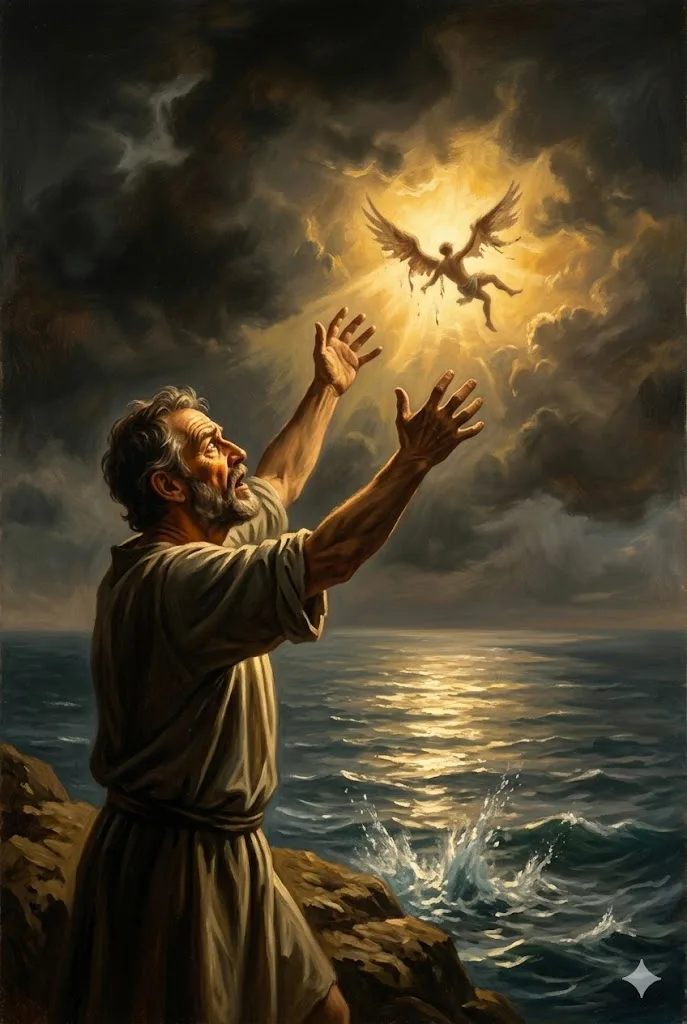
I. Who Was Daedalus?
Daedalus was the greatest inventor, architect, and craftsman in all of Greek mythology — an Athenian genius whose creations included the Labyrinth of Crete (which imprisoned the Minotaur), lifelike statues that could move, and the wax-and-feather wings that allowed him and his son Icarus to fly. His story is one of boundless creativity shackled by the whims of tyrants, and his son's death is one of mythology's most famous cautionary tales about the dangers of reckless ambition.
After building the Labyrinth for King Minos, Daedalus was imprisoned on Crete to prevent him from revealing the maze's secrets. Desperate to escape, he crafted two pairs of wings from bird feathers held together with wax. Before they took flight, Daedalus warned his son: "Fly neither too low, where the sea spray will soak your wings, nor too high, where the sun's heat will melt the wax. Follow my path through the middle."
They leaped from the tower and soared over the sea. But Icarus, intoxicated by the thrill of flight, ignored his father's warning. He flew higher and higher, closer to the blazing sun. The wax melted, the feathers scattered, and Icarus plummeted into the sea and drowned. The sea where he fell was named the Icarian Sea, and the nearby island became Icaria. Daedalus, heartbroken, flew on alone to Sicily, where he lived out his days building temples and engineering marvels — but never again attempted to reach the sky.
The story of Icarus has become the universal metaphor for the danger of overambition — of flying too close to the sun. In art, literature, and common speech, "an Icarus" is someone whose soaring aspirations lead to their downfall.
An Athenian Exile: The Murder of Perdix
Daedalus did not come to Crete as a free man. Ancient writers make him an Athenian of the royal line of Erechtheus. Apollodorus names his father as Metion, and other authors give Eupalamus ("skilled hand"). He fled Athens after a murder. His sister's son, an apprentice called Talos in Apollodorus and Perdix in Ovid, was so gifted that he invented the saw, copying the backbone of a fish, and the compass. Jealous, Daedalus threw the boy from the Acropolis. Ovid adds that Athena, who loves clever minds, caught him as he fell and turned him into a partridge (perdix). The partridge still nests near the ground and avoids heights. Ovid also has the bird watching as Daedalus buries Icarus, clapping its wings with joy. For the murder, Daedalus was tried at the Areopagus and went into exile. That is how Athens lost its greatest craftsman to Crete.
Daedalus on Crete: More Than the Labyrinth
His Cretan work began with something worse than the maze. When Queen Pasiphae was cursed with desire for the white bull Poseidon had sent to Minos, Daedalus built her a hollow wooden cow covered in hide, so that she could hide inside and mate with the animal. The child of that union was the Minotaur, and the Labyrinth was built to contain the problem Daedalus had helped create. He also undid his own design. Apollodorus says it was Daedalus who told Ariadne to give Theseus a ball of thread to mark the way back out. Minos's anger at that betrayal is why the craftsman and his son were locked up (see Theseus and the Minotaur).
The earliest mention of Daedalus anywhere is gentler. In the Iliad, describing the scenes Hephaestus works onto Achilles' shield, Homer compares one of them to the dancing floor that Daedalus once built in broad Knossos for "Ariadne of the lovely hair."
Sicily and the Death of Minos
The story does not end with the fall of Icarus. Daedalus reached Camicus in Sicily and was taken in by King Cocalus. Minos sailed after him with a clever trick. Everywhere he went, he offered a reward to anyone who could pass a thread through a spiral seashell, knowing that only Daedalus could solve it. At Cocalus's court the shell came back threaded: Daedalus had tied the thread to an ant, drilled a hole at the tip of the shell and let the ant walk through the spiral. Minos demanded the fugitive. Cocalus pretended to agree, but his daughters scalded Minos to death in his bath. Herodotus knew a version in which Minos died violently at Camicus and the Cretans later sent an expedition to avenge him. Diodorus credits Daedalus with building works for his Sicilian host. They included a reservoir, a fortress on a rock, a steam room heated by underground fire, and a golden honeycomb dedicated to Aphrodite at Eryx.
Virgil sends him another way. In Aeneid 6, Daedalus lands at Cumae in Italy, dedicates his wings to Apollo and carves the story of Crete on the temple doors. Twice he tries to carve the fall of Icarus, and twice his hands fail him.
Living Statues and Variant Versions
"Daedalus" was the name Greeks gave to the very idea of early sculpture. His statues were said to look so alive that they had to be tied down to stop them running away. Plato jokes about this in the Meno and the Euthyphro, where Socrates, a stonemason's son, calls Daedalus his ancestor. Pausanias saw several old wooden cult images (xoana) in Greece that local people credited to him. Modern art historians use the term "Daedalic" for Greek sculpture of the 7th century BC. That is a label for a style. It does not claim he was a real person.
There was even an ancient attempt to explain the flight in down-to-earth terms. Pausanias reports a version in which father and son escaped Crete in small boats, and Daedalus invented sails to outrun Minos's oared ships. Icarus steered badly, capsized and drowned. In both versions he was buried on the island that bears his name. Apollodorus says Heracles found the body washed ashore and buried it. Readers often assume Ovid's version is the only one, but the dramatic flight with wings is the most poetic of several traditions.
Ancient sources
- Homer, Iliad 18: the earliest mention. Daedalus built a dancing floor for Ariadne at Knossos.
- Apollodorus, Library 3.15 and Epitome 1: the murder of his nephew, the wooden cow, Ariadne's thread, the flight and the shell trick in Sicily.
- Ovid, Metamorphoses 8: the making of the wings, Icarus's fall and the transformation of Perdix into a partridge. Ovid tells the flight again in Ars Amatoria 2.
- Herodotus, Histories 7.169–171: Minos's death at Camicus in Sicily and the Cretan expedition to avenge him.
- Diodorus Siculus, Library of History 4.76–79: Daedalus's career in Athens, Crete and Sicily, including his Sicilian building works.
- Pausanias, Description of Greece: describes wooden statues credited to Daedalus and the rationalised version in which the escape was made by sail.
Frequently asked questions
Why was Daedalus imprisoned on Crete?
Versions differ. Some say Minos kept him to protect the Labyrinth's secret. Others say Minos was punishing him for helping Pasiphae with the wooden cow, or for showing Ariadne how Theseus could escape the maze.
What happened to Daedalus after Icarus died?
He reached Sicily and the court of King Cocalus, whose daughters killed the pursuing Minos. Virgil instead has him land at Cumae in Italy and build a temple to Apollo.
Was Daedalus a real person?
No real Daedalus is known. The name is related to daidallein, "to work with skill," and the Greeks used it for a legendary first master of craft, credited with inventions and statues from many different places.
Who was Perdix?
Perdix was Daedalus's nephew and apprentice. He invented the saw and the compass, and Daedalus pushed him from the Acropolis out of envy. Athena turned him into a partridge. Some sources call him Talos, and he should not be confused with the bronze giant of Crete of the same name.
Explore More Mythology
Get weekly deep dives into the gods, heroes, and myths of ancient Greece.