Penelope — The Queen Who Outwitted a Hundred Suitor
⚡ Quick Facts
Twenty Years Alone
When Odysseus sailed for Troy, Penelope was left to rule Ithaca alone with their infant son Telemachus. The war lasted ten years. The journey home took ten more. For two decades, Penelope held her kingdom together against increasingly aggressive suitors who wanted to marry her, claim Odysseus' throne, and consume his wealth.
Unlike other mythological wives who simply waited, Penelope actively fought to preserve her husband's legacy. She managed the household, raised Telemachus, navigated political threats, and deployed a cunning intelligence that matched her husband's own famous craftiness.
The Weaving Trick
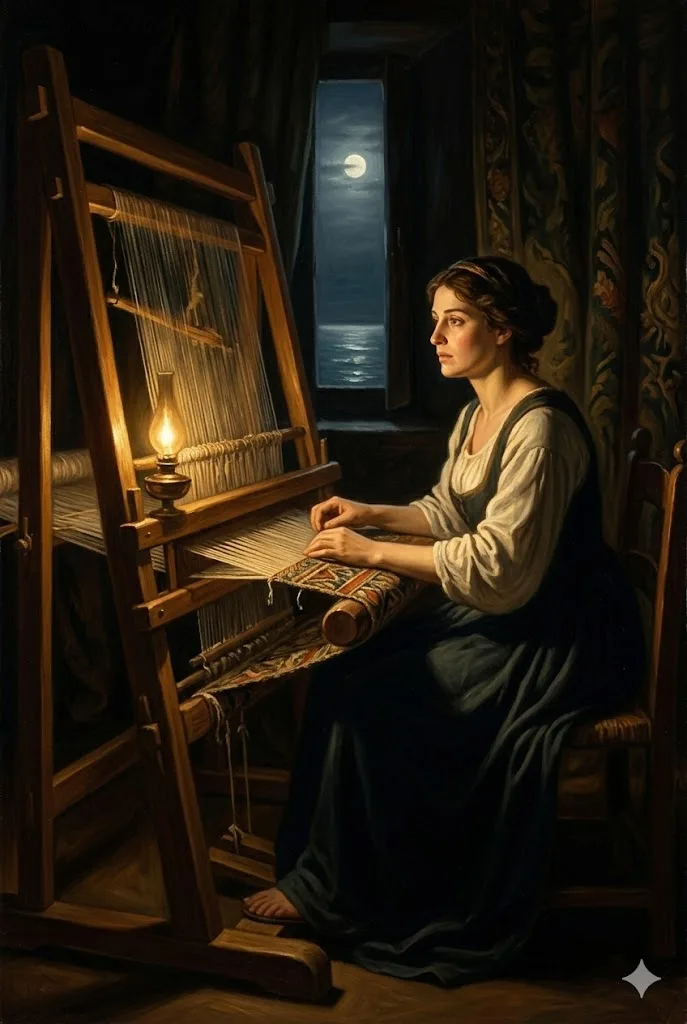
Penelope's most famous stratagem was her weaving. She told the suitors she would choose a husband once she finished weaving a funeral shroud for Odysseus' aged father Laertes. Each day she wove at the loom in full view of the household. Each night she secretly unraveled the day's work by torchlight.
This trick worked for three years — an extraordinary feat of deception that kept over a hundred aggressive men at bay through nothing but patience and intelligence. It was eventually betrayed by a disloyal maid who caught her unweaving and reported to the suitors.
The Test of the Bow
When Odysseus finally returned disguised as a beggar, Penelope devised the contest of the bow: whoever could string Odysseus' great bow and shoot an arrow through twelve axe-handle rings would win her hand. She knew no ordinary man could manage this feat — it was both a delay tactic and a test.
After Odysseus revealed himself by completing the challenge and slaughtering the suitors, Penelope still wasn't convinced. She tested him one final time, ordering a servant to move their bed. Odysseus protested that the bed was unmovable — he had built it himself around a living olive tree. Only then did Penelope embrace him, knowing no impostor could have known that secret.
Legacy
Penelope's name became synonymous with faithfulness in marriage, but she is far more than a symbol of wifely devotion. She is one of the few characters in Greek mythology whose intelligence is genuinely comparable to Odysseus' own. While he used cunning to defeat enemies, she used it to survive within a system designed to strip her of power.
A Spartan bride
Penelope was a niece of Tyndareus and so a first cousin of Helen and Clytemnestra, which makes the contrast between the cousins even sharper. Her father was Icarius, Tyndareus' brother. Apollodorus names her mother as Periboea, a Naiad. One tradition says Tyndareus arranged the match as a reward: Odysseus advised him to make Helen's suitors swear an oath to defend whoever won her, and Tyndareus in return persuaded Icarius to give Penelope to Odysseus. Pausanias tells a story he heard in Sparta. Icarius begged the couple to settle there, and when that failed he followed their chariot, pleading. Odysseus told Penelope to choose between her father and her husband. She said nothing and covered her face with her veil. Icarius understood, let her go, and set up a statue of Aidos (Modesty) on the spot.
What the Odyssey actually shows
Homer gives specific numbers for the suitors. Telemachus counts 108 of them: 52 from Dulichium, 24 from Same, 20 from Zacynthus and 12 from Ithaca itself, plus a herald, a bard and servants. The suitor Antinous is the one who complains about the shroud trick in the Ithacan assembly in Book 2. He says it ran for three years and was exposed in the fourth by "one of the women who knew". The trick is told three times in the poem: by Antinous, by Penelope herself to the disguised Odysseus, and by the ghost of the suitor Amphimedon in the underworld.
Several of her most interesting moments are easy to overlook. In Book 18, inspired by Athena, she appears before the suitors, rebukes them for courting her without giving gifts, and collects robes and jewellery from them. Odysseus, watching in disguise, is delighted. In Book 19 she tells the beggar a dream in which an eagle kills her twenty pet geese, and then the eagle itself explains that it is her husband. She replies that dreams come through two gates, one of horn for those that come true and one of ivory for those that deceive, and that she fears hers came through ivory. Virgil later borrowed the image of the two gates at the end of Aeneid 6.
Whether she recognizes Odysseus before Book 23 is an old critical debate. Some readers think her decision to set up the bow contest the morning after speaking with the beggar suggests she suspects the truth. Amphimedon's ghost in Book 24 says Odysseus told her to set the contest, but that may simply be the suitors' mistaken belief. Homer leaves the question open, and in the end the bed test shows she can out-trick the trickster himself. Agamemnon's shade gives her the poem's final praise, contrasting her with the murderous Clytemnestra and predicting that the gods will make a lovely song in her honour.
Other Penelopes
Outside Homer, her story branches in surprising directions. The lost Cyclic epic Telegony, known from Proclus' summary, has Telegonus, Odysseus' son by Circe, kill his father by mistake. Penelope then marries Telegonus, and Telemachus marries Circe. Pausanias records an Arcadian tradition from Mantinea that Odysseus banished her for welcoming the suitors into the house, and that she died at Mantinea, where a tomb was shown. Herodotus reports that the Greeks considered Pan the son of Hermes and Penelope, and some later writers even made all the suitors fathers of Pan. Ovid's first Heroides is a letter from Penelope to her absent husband, worried that he is delayed by some foreign woman.
Ancient artists preferred her waiting. A red-figure skyphos from Chiusi, which gave its painter the name Penelope Painter, shows her sitting in grief beside her loom while Telemachus stands before her. A seated, head-bowed type of Penelope with crossed legs survives in several Roman marble copies, including one in the Vatican. Modern retellings tend to look at what Homer leaves out. Margaret Atwood's The Penelopiad (2005) gives a voice to the twelve hanged maids, and Claire North's Ithaca (2022) imagines her political maneuvering in detail. For the epic itself, see the Odyssey.
Ancient sources
- Homer, Odyssey Books 2, 18, 19, 21 and 23: the shroud, the gifts from the suitors, the dream of the geese and the two gates, the bow, and the test of the bed.
- Homer, Odyssey 16.245–253 and 24.120–202: the count of suitors by island, Amphimedon's account and Agamemnon's praise of Penelope.
- Pausanias, Description of Greece 3.20.10–11 and 8.12.5–6: the veil and the statue of Aidos at Sparta, and the Mantinean tradition of her exile and tomb.
- Apollodorus, Bibliotheca 3.10.6–9 and Epitome 7: her parentage, the betrothal through Tyndareus, and later traditions about her fate.
- Herodotus, Histories 2.145: the Greek belief that Pan was the son of Penelope and Hermes.
- Ovid, Heroides 1: Penelope's letter to Odysseus.
Frequently asked questions
How many suitors did Penelope have?
Telemachus counts 108 in Odyssey 16, drawn from Dulichium, Same, Zacynthus and Ithaca, along with their attendants.
How long did Penelope keep the shroud trick going?
Three years. The suitors found out in the fourth year, when one of her maids betrayed her.
Did Penelope know the beggar was Odysseus?
The text never confirms it before the bed test in Book 23. Some scholars argue her behaviour in Books 19–21 hints at secret recognition, while others read her final caution literally.
What happened to Penelope after the Odyssey?
Homer does not say. The Telegony married her to Telegonus after Odysseus' death, while a Mantinean tradition had her exiled to Arcadia. For more, see Odysseus.