The Forgotten Champion
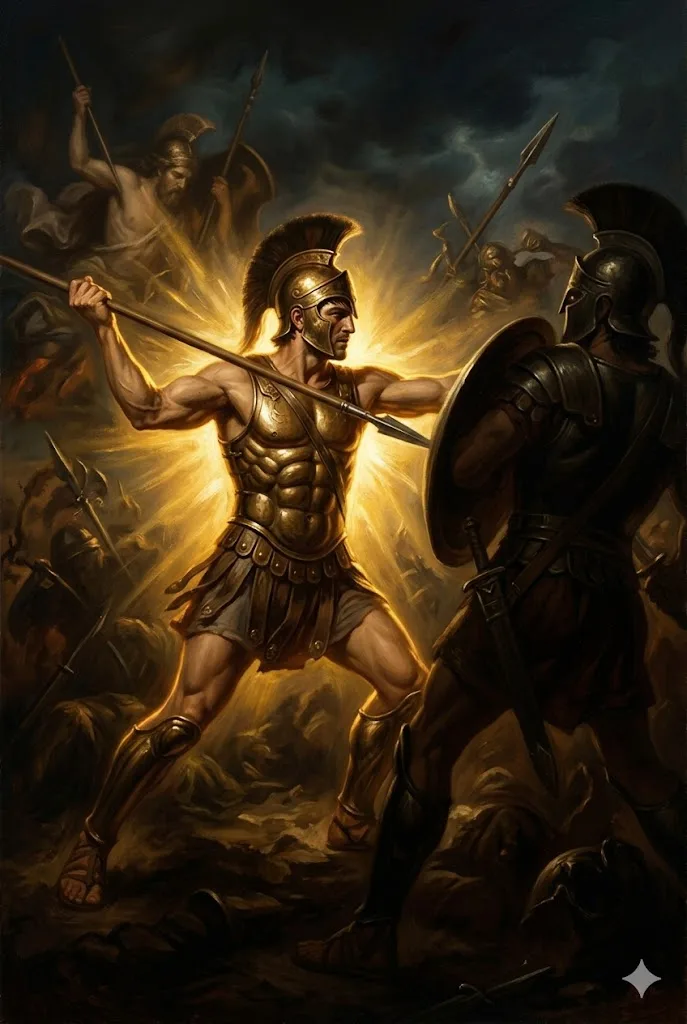
Diomedes is the most underrated hero in Greek mythology. While Achilles sulked in his tent and Ajax held the line, Diomedes went on a rampage in Book 5 of the Iliad that is arguably the most impressive feat of arms in the entire poem. Empowered by Athena, who lifted the mist from his eyes so he could see the gods on the battlefield, Diomedes did what no other mortal ever accomplished: he wounded two Olympian gods in a single day.
Wounding the Gods
When Aphrodite descended to the battlefield to rescue her wounded son Aeneas, Diomedes charged straight at her and slashed her wrist with his spear. Ichor, the golden blood of the gods, flowed from the wound. Aphrodite fled screaming to Olympus where Zeus told her to stay out of war. Then Ares himself, the god of war in full battle fury, attacked Diomedes. With Athena guiding his spear, Diomedes stabbed Ares in the belly. The god of war screamed with the voice of ten thousand men and fled to Olympus to complain to Zeus, who told him he was the most hateful of all gods.
Beyond Troy
Diomedes was also one of the warriors inside the Trojan Horse and helped Odysseus steal the Palladium, the sacred statue of Athena that protected Troy. Unlike most Greek heroes, Diomedes survived the war and the journey home without disaster. He returned safely to Argos, though some traditions say he found his wife unfaithful and eventually sailed to Italy, where he founded several cities. His relatively happy ending is unusual in Greek mythology, perhaps a reward for his unwavering piety toward Athena.
Why He's Forgotten
Diomedes is overshadowed by Achilles because the Iliad is fundamentally Achilles' story. But in terms of pure battlefield performance, Diomedes in Book 5 is arguably more impressive than anything Achilles does. He fights gods and wins. He shows no fear. And unlike Achilles, he doesn't need rage or grief to motivate him. He fights because it's the right thing to do. In a mythology full of flawed heroes, Diomedes comes closest to the ideal.
Classical Sources
- 📜 Homer, Iliad & Odyssey (c. 750 BC)
- 📜 Hesiod, Theogony (c. 700 BC)
- 📜 Apollodorus, Bibliotheca (c. 1st-2nd century AD)
- 📜 Ovid, Metamorphoses (8 AD)
Cross-referenced with multiple classical sources for accuracy.
Explore More
Achilles · Athena · Ares · Trojan War · Home
Son of Tydeus, Conqueror of Thebes
Diomedes arrived at Troy with an inheritance to live up to. His father Tydeus was one of the Seven against Thebes, a small, savage fighter from Calydon who had married Deipyle, daughter of King Adrastus of Argos. Apollodorus tells why Tydeus never became a god. Athena was bringing him a drug of immortality as he lay dying at Thebes, but she turned away in disgust when she found him eating the brains of his enemy Melanippus. Diomedes avoided his father's mistakes. A generation later he marched with the Epigoni, the sons of the Seven, and they took the city their fathers had failed to capture. In Iliad 4, when Agamemnon taunts him as a lesser man than Tydeus, his companion Sthenelus answers with exactly that point: "We claim to be far better than our fathers. We took seven-gated Thebes." Diomedes himself lets the insult pass, which shows his character.
His Other Great Scenes in the Iliad
Book 5 is famous, but Diomedes runs through the whole poem:
- Glaucus and the exchange of armour (Book 6). Before fighting the Lycian Glaucus, Diomedes asks who he is. Glaucus answers with the famous comparison of human generations to leaves, and then with his family history. It turns out their grandfathers were guest-friends, so the two refuse to fight and swap armour. Homer adds a dry comment: Zeus took Glaucus's wits, because he traded gold armour worth a hundred oxen for bronze worth nine.
- Rescuing Nestor (Book 8). When Paris shoots one of old Nestor's horses, Diomedes takes him into his own chariot and charges Hector, until Zeus's thunderbolts turn him back.
- The night raid (Book 10). Diomedes chooses Odysseus as his partner for a scouting mission. They catch the Trojan spy Dolon, get information from him and then kill him. Then they cut down the newly arrived Thracian king Rhesus in his sleep and drive off his famous white horses.
- Wounded by Paris (Book 11). An arrow from Paris pins his foot to the ground. Diomedes mocks him as a "bowman" and "girl-watcher," but has to leave the battle.
- The chariot race (Book 23). At the funeral games for Patroclus he wins the chariot race, driving the horses he had taken from Aeneas in Book 5. They were bred from the immortal horses Zeus gave to Tros.
He is also the leader most willing to speak bluntly. In Book 9, when Agamemnon proposes giving up and going home, Diomedes tells him to go if he wants, but says that he and Sthenelus will stay and fight until Troy falls.
After Troy: Exile in Italy
Homer's Odyssey has Nestor report simply that Diomedes got home to Argos safely. Later traditions are less kind. Aphrodite had not forgotten her wounded wrist, and she drove his wife Aegialeia into an affair (later sources name Cometes, son of Sthenelus) and into plotting against him. Diomedes left Argos and went to southern Italy. There King Daunus welcomed him, and he founded Argyrippa (later Arpi), along with other towns along the Adriatic coast. In Virgil's Aeneid 11, the Latins send ambassadors asking Diomedes to fight Aeneas. He refuses. He has fought Trojans enough, he says, and he has already paid for wounding a goddess, because his companions were turned into birds. Ovid tells this transformation too. Those "birds of Diomedes" were said to live on the Diomedean Islands (the modern Tremiti), welcoming Greeks and attacking strangers.
Not every author ends his story in exile. Pindar says in the Tenth Nemean ode that Athena made Diomedes an immortal god. He received hero cult in Argos and in a number of places along the Adriatic. At Argos, according to Callimachus' Bath of Pallas, a statue of Athena was carried to the river each year to be bathed, along with the shield of Diomedes.
The Palladium and Lemnos
Diomedes and Odysseus are a regular pair in the Trojan cycle. Besides stealing the Palladium together, they appear in versions in which the two sail to Lemnos to bring back Philoctetes and the bow of Heracles, which Troy could not be taken without. Sophocles' surviving Philoctetes replaces Diomedes with Neoptolemus. A later story says Odysseus tried to kill Diomedes on the way back from the Palladium raid, and Diomedes saw the sword's glint in the moonlight and drove him back to camp at sword point. This was said to be the origin of the proverb "Diomedean necessity."
Ancient sources
- Homer, Iliad 4–11 and 23: his aristeia in Book 5, the meeting with Glaucus in Book 6, the night raid in Book 10, his wounding by Paris and the chariot race.
- Homer, Odyssey 3: Nestor reports that Diomedes returned safely to Argos.
- Apollodorus, Library 3.6–7 and Epitome 5–6: Tydeus's lost chance at immortality, the Epigoni, the Palladium, and his wife's betrayal after the war.
- Pindar, Nemean 10: says Athena made Diomedes an immortal god.
- Virgil, Aeneid 11: Diomedes in Italy refuses to fight the Trojans again and tells how his companions became birds.
- Ovid, Metamorphoses 14: the transformation of Diomedes' companions into birds.
Frequently asked questions
Is Diomedes the same as the king with the man-eating horses?
No. The Diomedes of the eighth of the Twelve Labours was a Thracian king, a son of Ares, who fed his mares on human flesh. The Trojan War hero is Diomedes son of Tydeus, from Argos. They are different people with the same name.
Which gods did Diomedes wound?
Aphrodite and Ares, both in Iliad Book 5, with Athena's help. He also charged Apollo three times while Apollo was protecting Aeneas, and backed off only when the god warned him not to make himself equal to the gods.
Did Diomedes survive the Trojan War?
Yes. Homer has him return home safely. Later authors add that his wife's betrayal drove him to Italy, where he founded cities. Pindar says he became immortal.
Who was stronger, Diomedes or Achilles?
Homer never pits them against each other. The Greeks treat Achilles as the best of the Achaeans, but while Achilles stays out of the fighting, Diomedes is the one who fills that role, so much so that the Trojans say they fear him more than they ever feared Achilles (Iliad 6).