Empousai — Hecate's Beautiful, Blood-Drinking Demon
⚡ Quick Facts
Ancient Greek Vampires
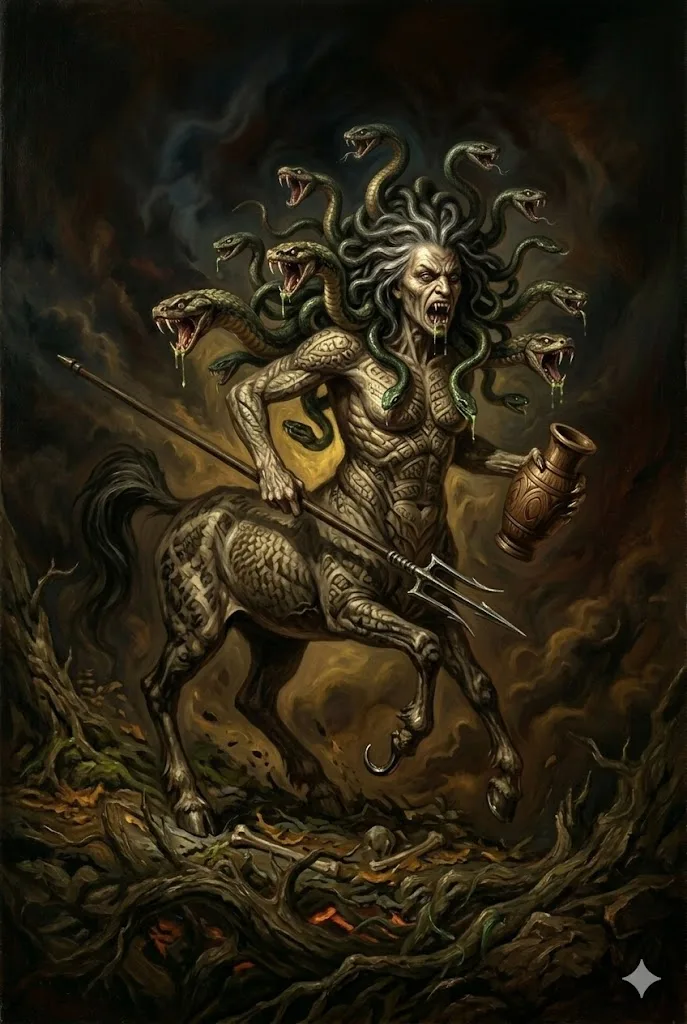
The Empousai were among the most disturbing creatures in Greek mythology — beautiful women who appeared to travelers at night, seduced them, and then fed on their blood and flesh. They served Hecate, the goddess of witchcraft and crossroads, and haunted lonely roads and dark places. Classical sources mostly speak of a single Empusa; the idea of many Empousai comes from later writers, and calling them "daughters of Hecate" is largely a modern invention.
In their true form, the Empousai had one leg of bronze and one leg of a donkey, with flaming hair and eyes that glowed in the darkness. But they were master shape-shifters who could assume the form of any beautiful woman — a wife, a lover, a courtesan — to lure victims close enough to strike.
Encounters in Myth
The most famous Empousai encounter comes from the philosopher Apollonius of Tyana, who exposed one that had taken the form of a beautiful Phoenician woman and seduced his student Menippus. She had created an elaborate illusion of wealth and luxury, complete with a grand house and servants, but when confronted by Apollonius, the illusion dissolved and she was revealed in her true, monstrous form.
In Aristophanes' comedy The Frogs, Dionysus and his slave Xanthias encounter an Empousa on their journey to the Underworld. The creature rapidly shifts shape — from a cow, to a mule, to a beautiful woman, to a dog — terrifying Dionysus, who hides behind his slave.
Protection
The Greeks believed the Empousai could be driven away by insults. Shouting abuse at them supposedly caused them to flee screaming. This unusual weakness reflects the Greek belief in the power of language and the vulnerability of supernatural beings to human defiance.
One Empusa or Many?
In most classical Greek texts the creature is a single figure, Empusa, not a band of Empousai. Aristophanes, Demosthenes and early lexicographers all speak of "the Empusa," a single night-terror like Mormo, Gello or Lamia. Ancient commentators on Aristophanes, collected in the scholia and in Byzantine lexicons such as the Suda, offer several explanations. Some say Empusa was a phantom sent by Hecate to frighten people. Others say she appeared to people performing rites to Hecate, or was simply another name for Hecate herself. The plural empousai becomes common in later writers, especially Philostratus, who uses the word as a general category alongside lamiai and mormolykiai. The idea of a sisterhood of Empousai who are Hecate's daughters is mostly modern, built from these scattered notes.
The donkey's leg comes from the same commentary tradition. Ancient explanations connect Empusa with the epithet onoskelis, "donkey-legged," and some add that she hopped on one leg, which a few ancient scholars linked to her name. Aristophanes himself gives a different and cruder pair of legs.
Aristophanes' Empusa, Line by Line
The scene in Frogs is built on stage fright. As Dionysus and Xanthias cross the dark marsh towards the underworld, Xanthias claims to see a monster that keeps changing shape: first an ox, then a mule, then a very beautiful woman, then a dog. Asked to describe it, he says its whole face blazes with fire and one leg is bronze while the other is made of dung. Dionysus, the god of the theatre, pales, runs to his own priest in the front row of the audience for protection, and finally hides behind his slave. Then Xanthias announces that the danger has passed. Aristophanes probably never meant the monster to be seen at all. Its terror lies in the frightened description.
Empusa also appears briefly in Aristophanes' Assemblywomen, where a young man compares a hideous old woman, apparently covered in sores, to an Empusa. Demosthenes, attacking his rival Aeschines in On the Crown, claims that Aeschines' mother was nicknamed "Empusa" because she "did and suffered everything," taking on every shape. That joke only works if the audience knew the Empusa as a shapeshifter.
Philostratus and the Bride of Corinth
The two stories in Philostratus' Life of Apollonius of Tyana are the source of most modern ideas about Empousai. Early in the work, as Apollonius travels toward India, an empusa appears to his party by moonlight, changing from one form to another. Apollonius abuses it loudly and tells his companions to do the same, and the phantom flees, shrieking. That is the scene behind the belief that insults drive Empousai away.
The better-known episode is set near Corinth. Menippus, a handsome twenty-five-year-old from Lycia, is courted by a rich foreign woman and agrees to marry her. At the wedding feast Apollonius declares the bride an empusa. Her gold and silver plate and her servants vanish under his questioning, and she finally confesses that she was fattening Menippus with pleasures in order to eat him, because she preferred young, beautiful bodies whose blood was pure. Philostratus says the creature goes by several names: empusa, lamia and mormolyke. The modern labels "vampire" and "succubus" overstate how fixed these categories were.
A Long Afterlife in Literature
Robert Burton retold the Menippus story in The Anatomy of Melancholy (1621), and John Keats used Burton's version as the source for his narrative poem Lamia (1820). In Keats the serpent-woman Lamia is a sympathetic figure destroyed by the philosopher's cold gaze. Goethe brings Empusa onto the stage in the Classical Walpurgis Night of Faust, Part Two, where she greets Mephistopheles as a cousin because he too has a horse's foot. All of these works draw on Philostratus and Aristophanes, which helps explain why the Empusa is so much better known now than any cult evidence would suggest. There is no evidence of worship or sanctuaries. She belonged to folklore, fear and comedy, not to temple religion. For a broader ranking of such figures, see the scariest Greek monsters.
Ancient sources
- Aristophanes, Frogs 285–308: the shapeshifting Empusa seen by Xanthias, with a face of fire, one bronze leg and one of dung.
- Aristophanes, Assemblywomen: a brief comparison of a hideous old woman to an Empusa.
- Demosthenes, On the Crown 130: Aeschines' mother allegedly nicknamed Empusa for taking every shape.
- Philostratus, Life of Apollonius of Tyana 2.4 and 4.25: the empusa driven off by abuse, and the unmasking of Menippus' bride at Corinth.
- Suda and scholia on Aristophanes' Frogs: later notes linking Empusa to Hecate and to the "donkey-legged" Onoskelis.
Frequently asked questions
Are the Empousai vampires?
Philostratus' empusa wants to eat her victim and prizes pure young blood, so the comparison is understandable. Still, she belongs to a loose family of Greek bogeys, alongside Lamia and Mormo, rather than to the later European vampire tradition.
What did an Empusa look like?
Aristophanes gives her a fiery face, one bronze leg and one leg of dung, and constant changes of shape. Later commentators describe a donkey's leg, and Philostratus shows her as an attractive woman.
How do you drive off an Empusa?
In Philostratus, by abusing it loudly: Apollonius and his companions shout insults and it flees, shrieking.
Was Empusa related to Hecate?
Ancient commentators linked her to Hecate as a phantom sent by the goddess, or even as one of Hecate's own forms. No early literary source makes the Empousai Hecate's daughters. See also Hecate.