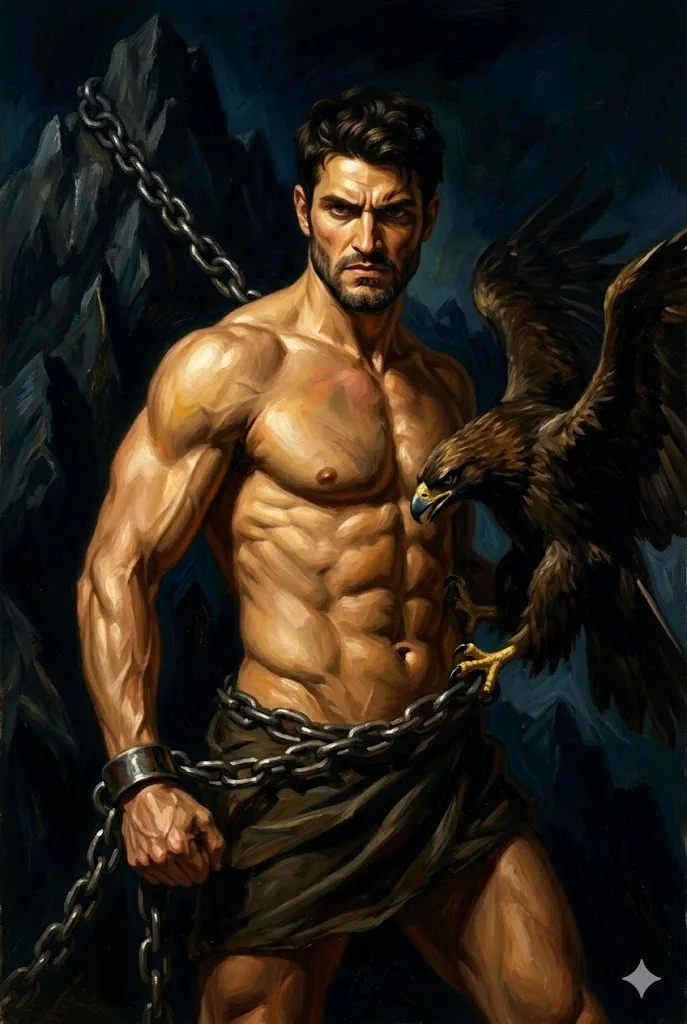
I. Who Was Prometheus?
Prometheus was one of the most important figures in Greek mythology — a Titan whose name means "Forethought" and whose defiance of Zeus shaped the destiny of the entire human race. While other Titans fought against the Olympians in the Titanomachy, Prometheus sided with Zeus, using his gift of foresight to predict the outcome. For this he was initially rewarded — but his ultimate loyalty was not to the gods, but to humanity.
According to some traditions, Prometheus created mankind itself, molding the first humans from clay. At the very least, he was humanity's greatest champion among the immortals — the one god who believed mortals deserved more than a brutish existence in the dark. When Zeus decided to withhold fire from humanity — leaving them cold, unable to cook food, work metal, or see at night — Prometheus made the fateful decision that would define his eternity.
II. The Theft of Fire
Prometheus stole fire from the forge of Hephaestus on Mount Olympus (or, in some versions, from the chariot of the sun) and hid it inside a hollow fennel stalk. He brought it down to earth and presented it to humanity — not merely as warmth, but as the spark of civilization itself. With fire came cooking, metalwork, pottery, navigation by the stars, and eventually writing, science, and all the arts. Fire was the foundation upon which human culture was built.
But Prometheus had also tricked Zeus at the feast of Mecone, where the distribution of sacrifices between gods and mortals was decided. He divided an ox into two portions: one pile of bones wrapped in glistening fat (which looked appetizing), and one pile of prime meat hidden beneath the ox's stomach (which looked unappealing). Zeus chose the attractive-looking pile and was furious to discover only bones — from that point on, mortals burned bones and fat as sacrifices while keeping the meat for themselves.
III. The Punishment
Zeus's retaliation was merciless and twofold. First, he punished humanity by creating Pandora — the first woman, fashioned by Hephaestus and gifted by each of the gods with irresistible charms. Pandora carried a jar (often mistranslated as "box") containing every evil and disease that would plague the human race. When she opened it, suffering flooded into the world — only Hope remained inside.
Second, Zeus punished Prometheus directly. He had the Titan chained to a rock in the Caucasus Mountains, where each day a giant eagle (or vulture) descended to tear open his abdomen and devour his liver. Being immortal, Prometheus's liver regenerated overnight, and the torment began again each dawn. This punishment was designed to last for eternity — but after thousands of years, the hero Heracles shot the eagle with an arrow dipped in Hydra venom and shattered Prometheus's chains, freeing the Titan at last.
IV. Legacy
Prometheus became the archetype of the rebel against unjust authority — the figure who suffers for the benefit of others. The Romantic poets (Shelley, Byron, Goethe) embraced him as a symbol of human creativity and resistance against tyranny. Mary Shelley subtitled her novel Frankenstein as "The Modern Prometheus." In philosophy, the "Promethean" spirit represents the drive to push beyond natural limits, seek forbidden knowledge, and advance civilization at any cost.
Classical Sources
The mythology of Prometheus is preserved in:
- 📜 Hesiod, Theogony (c. 700 BC) — The primary source for Titan mythology, genealogy, and the Titanomachy.
- 📜 Apollodorus, Bibliotheca (c. 1st–2nd century AD) — Comprehensive handbook of Titan genealogies and myths.
- 📜 Aeschylus, Prometheus Bound (c. 5th century BC) — Dramatic portrayal of Titan defiance against Olympian authority.
- 📜 Ovid, Metamorphoses (8 AD) — Roman accounts of Titan mythology and transformations.
Cross-referenced with multiple classical sources for accuracy.
Hesiod's two versions
The oldest surviving accounts of Prometheus are by Hesiod, and he tells the story twice with different emphasis. In the Theogony, the order of events is clear. The trick at Mecone comes first. Zeus, angered by it, refuses to give fire to mortals. Prometheus then steals it back in a hollow fennel stalk (narthex). Zeus answers with "a beautiful evil," a woman made by Hephaestus and dressed by Athena. She is not named, and there is no jar. She is simply the ancestor of the "race of women." In Works and Days, the woman is named Pandora, each god adds a gift, Epimetheus accepts her even though his brother warned him never to take gifts from Zeus, and she opens the storage jar that releases evils into the world. Hesiod's point in both poems is that Zeus cannot be outwitted. Prometheus's cleverness only makes things worse for humans.
Hesiod's punishment also differs from later versions. Prometheus is bound with chains driven through a pillar, and an eagle eats his immortal liver, which grows back each night. He is freed when Heracles kills the eagle, "not without the will of Zeus," who wanted his son's fame to grow. In Hesiod's version, his release is a favour Zeus grants, not a defeat for Zeus.
Aeschylus: the defiant Titan
The rebellious Prometheus admired by the Romantics comes mostly from Prometheus Bound, traditionally attributed to Aeschylus (some scholars doubt the attribution). The play opens with Kratos and Bia forcing an unwilling Hephaestus to nail Prometheus to a cliff at the edge of the world. Here Prometheus's mother is Themis, whom the play identifies with Gaia. From her he knows a secret that threatens Zeus's rule. He boasts at length of his gifts to humanity, which go well beyond fire: counting, writing, taming animals, sailing, medicine, divination and mining. He also says he gave mortals "blind hopes" so they would stop staring at their death.
Visitors come one by one: the Oceanid chorus, Oceanus offering to make peace, and Io, wandering in the form of a heifer. He predicts Io's travels and says that one of her descendants, thirteen generations later, will free him. The secret is the prophecy that a certain goddess will bear a son greater than his father. In other sources, such as Pindar's Isthmian 8, this goddess is Thetis. When Prometheus refuses to tell, Hermes threatens him, and the play ends with the Titan sinking into the earth in a storm. The sequels, Prometheus Unbound and Prometheus the Fire-Bearer, survive only in fragments, but they seem to have ended in reconciliation with Zeus.
Other traditions: clay, Chiron, Deucalion and a ring
- Maker of humans. Hesiod does not say that Prometheus created mankind. This idea is first clearly attested later. Apollodorus says he moulded humans from water and earth, and Ovid has the "son of Iapetus" shape them in the image of the gods. Pausanias was shown clay-coloured stones at Panopeus in Phocis that smelled like human skin, said to be left over from Prometheus's work.
- Plato's version. In the Protagoras, Epimetheus hands out all the natural defences to the animals and leaves humans with nothing. Prometheus steals fire and craft-skill from the workshop of Athena and Hephaestus. Even so, humans keep destroying each other until Zeus sends Hermes to give everyone a sense of justice and shame.
- Chiron. Apollodorus says that the centaur Chiron, incurably wounded by one of Heracles' arrows, wanted to die, and that his immortality was handed over to Prometheus as part of the Titan's release.
- Deucalion. Prometheus's son Deucalion survived Zeus's flood because his father told him to build a chest and stock it with provisions.
- The ring. Roman writers, including Pliny the Elder, explain the first ring as a reminder of his chains: Prometheus wore a ring of iron set with a piece of the rock he had been bound to.
Worship and art
Prometheus had a real cult in Athens, where craftsmen honoured him together with Hephaestus and Athena. Pausanias saw his altar in the Academy, the starting point of torch races run in his honour. Runners had to keep their torches lit all the way to the city, and the Prometheia festival included such a race. On a Laconian cup in the Vatican from the mid-sixth century BC, the eagle attacks Prometheus while his brother Atlas holds up the sky beside him. Rubens and Frans Snyders' Prometheus Bound (Philadelphia Museum of Art) gave the scene its best-known baroque form. In Greek sources the bird is an eagle, the bird of Zeus, not a vulture. And Apollodorus is the source that clearly places the rock in the Caucasus. For the fire theft in more detail, see Prometheus and the gift of fire.
Ancient sources
- Hesiod, Theogony 507–616: Prometheus's family, the trick at Mecone, the theft of fire in a fennel stalk, the first woman, the eagle, and Heracles' rescue with Zeus's consent.
- Hesiod, Works and Days 42–105: the hidden fire, Pandora named and given gifts by the gods, Epimetheus's mistake and the jar of evils.
- Aeschylus (attrib.), Prometheus Bound: the binding by Kratos, Bia and Hephaestus, the list of gifts to humanity, Io's visit, and the secret about Zeus's fall.
- Plato, Protagoras 320c–322d: Epimetheus's distribution of abilities and the theft of fire and craft-skill.
- Apollodorus, Library 1.7.1–2 and 2.5.11: Prometheus shapes humans from earth and water, advises Deucalion, is freed by Heracles in the Caucasus, and takes Chiron's immortality.
- Pausanias, Description of Greece 1.30.2 and 10.4.4: the altar and torch race in the Academy, and the clay stones of Panopeus.
Frequently asked questions
Why did Zeus hate Prometheus?
In Hesiod, because of the trick at Mecone and then the theft of fire. In Aeschylus, also because Prometheus refused to reveal the prophecy of the goddess whose son would overthrow his father.
How long was Prometheus chained?
The sources do not agree. Aeschylus speaks of thousands of years, and some later writers give a figure of thirty thousand. In every version he is eventually freed by Heracles.
Did Prometheus create humans?
Some later authors say so, among them Apollodorus, Ovid and Pausanias's local guides. Hesiod presents him only as humanity's protector and trickster, not its maker.
Was Prometheus worshipped?
Yes. He had an altar in the Athenian Academy and a festival with torch races, and he was especially honoured by potters and other craftsmen.
Explore More Mythology
Get weekly deep dives into the gods, heroes, and myths of ancient Greece.