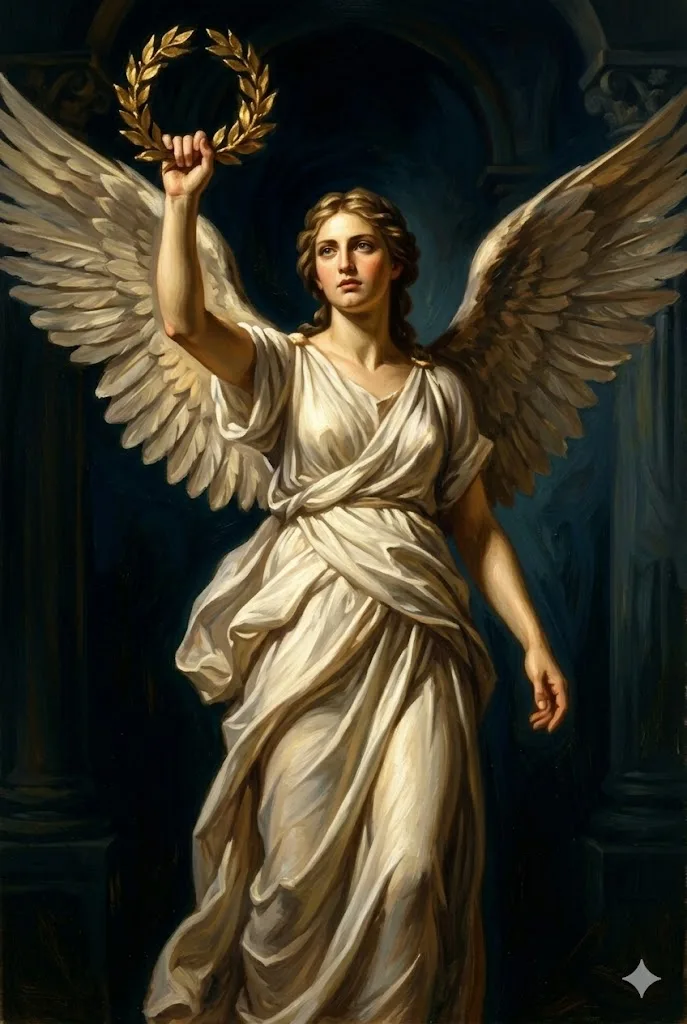
Who Was Nike?
Nike was the divine personification of victory in Greek mythology. She presided over every form of triumph — from athletic competitions to military conquests and artistic achievements. Wherever success was celebrated, Nike was believed to be present, bestowing her favor upon the worthy.
Depicted as a beautiful woman with magnificent wings, Nike could move swiftly between the mortal and divine realms, carrying the laurel wreath of victory to those chosen by the gods. She became one of the most frequently represented figures in ancient Greek art, from coins and pottery to monumental sculpture.
Origins and Family
Nike was the daughter of the Titan Pallas and the Oceanid Styx, the goddess of the great underworld river. Her siblings were equally formidable personifications: Zelus represented zeal and rivalry, Kratos embodied strength and power, and Bia personified force and raw energy. Together, these four siblings served as the attendants and enforcers of Zeus himself.
When the Olympian gods went to war against the Titans in the great conflict known as the Titanomachy, Styx brought her four children to fight alongside Zeus. This was a crucial alliance, and Zeus rewarded them by keeping them eternally at his side on Olympus. Nike in particular became his constant companion, standing or flying beside his throne as a symbol of his invincible authority.
Nike and Athena
Nike shared a deep connection with Athena, the goddess of wisdom and strategic warfare. In Athens, Nike was frequently worshipped alongside Athena under the combined title "Athena Nike" — Athena the Victorious. A beautiful Ionic temple dedicated to Athena Nike still stands on the Acropolis in Athens, perched on a bastion overlooking the city.
According to one Athenian tradition, the statue of Athena Nike in this temple was depicted without wings — a unique departure from Nike's usual iconography. The Athenians called her "Apteros Nike" (Wingless Victory), claiming they had removed her wings so that Victory could never fly away from their city. This charming folk legend reveals how deeply the ancient Greeks valued the concept of lasting triumph.
The Winged Victory of Samothrace
The most famous ancient depiction of Nike is the breathtaking marble sculpture known as the Winged Victory of Samothrace, created around 190 BC. Standing over eight feet tall atop the prow of a stone ship, this masterpiece captures Nike at the moment of landing, her wings spread wide, her garments pressed against her body by the sea wind. It now stands at the top of the grand staircase in the Louvre Museum in Paris and is considered one of the greatest sculptures ever created.
The sculpture was originally erected on the island of Samothrace to commemorate a naval victory. Despite the loss of its head and arms, the Winged Victory remains extraordinarily powerful — a testament to the enduring artistic legacy of Nike's image.
Nike in the Modern World
Nike's influence extends far beyond the ancient world. The world's most recognizable sportswear company, Nike Inc., takes its name directly from the Greek goddess. The company's famous "Swoosh" logo is said to represent the wing of Nike, and the brand's association with athletic victory perfectly mirrors the goddess's ancient domain. The connection between the ancient deity and the modern brand demonstrates how Greek mythology continues to shape contemporary culture, commerce, and identity.
Symbols and Attributes
Nike is most commonly identified by her great feathered wings, which allowed her to descend swiftly to the mortal world to bestow victory. She typically carries a laurel wreath — the traditional prize awarded to victors in the ancient Olympic Games and other competitions. In some depictions, she holds a palm branch, another ancient symbol of triumph. She is also shown bearing a small statue of herself or a trophy, and occasionally carries a lyre or kithara, reflecting her patronage of musical victories as well.
Worship and Legacy
Nike was honoured throughout the Greek world, particularly in Athens and Olympia. At the great sanctuary of Olympia, where the Olympic Games were held, a magnificent gold and ivory statue of Nike was placed in the hand of the colossal statue of Zeus — one of the Seven Wonders of the Ancient World. This gesture symbolized that all victory ultimately flowed from the king of the gods.
Athletes, generals, and cities all invoked Nike before competitions and battles. Her image appeared on countless coins throughout the Greek and later Roman world, serving as both a religious symbol and a statement of political power. To possess the image of Nike was to claim divine favor and the promise of triumph.
Primary Classical Sources
The mythology of Nike is preserved in numerous ancient texts, including:
- 📜 Homer, Iliad & Odyssey (c. 750 BC) — The foundational texts of Greek literature, containing extensive references to the gods and their interventions in mortal affairs.
- 📜 Hesiod, Theogony (c. 700 BC) — The primary source for the genealogy and origins of the Greek gods, including the succession myths and the rise of the Olympians.
- 📜 Homeric Hymns (c. 7th–6th century BC) — A collection of hymns to individual deities providing detailed mythological narratives not found elsewhere.
- 📜 Apollodorus, Bibliotheca (c. 1st–2nd century AD) — The most comprehensive ancient handbook of Greek mythology, systematically cataloguing myths and genealogies.
- 📜 Ovid, Metamorphoses (8 AD) — The Roman poet's masterwork retelling Greek myths with a focus on transformation, preserving many stories that would otherwise be lost.
- 📜 Pausanias, Description of Greece (c. 150 AD) — A detailed travelogue recording temples, cult sites, and local mythological traditions across the Greek world.
All content on this page has been cross-referenced with multiple classical sources and modern scholarly works to ensure accuracy.
Explore More
Zeus · Athena · Ares · The Trojan War · Home
Join the Pantheon
Weekly mythology stories & deep dives delivered to your inbox.