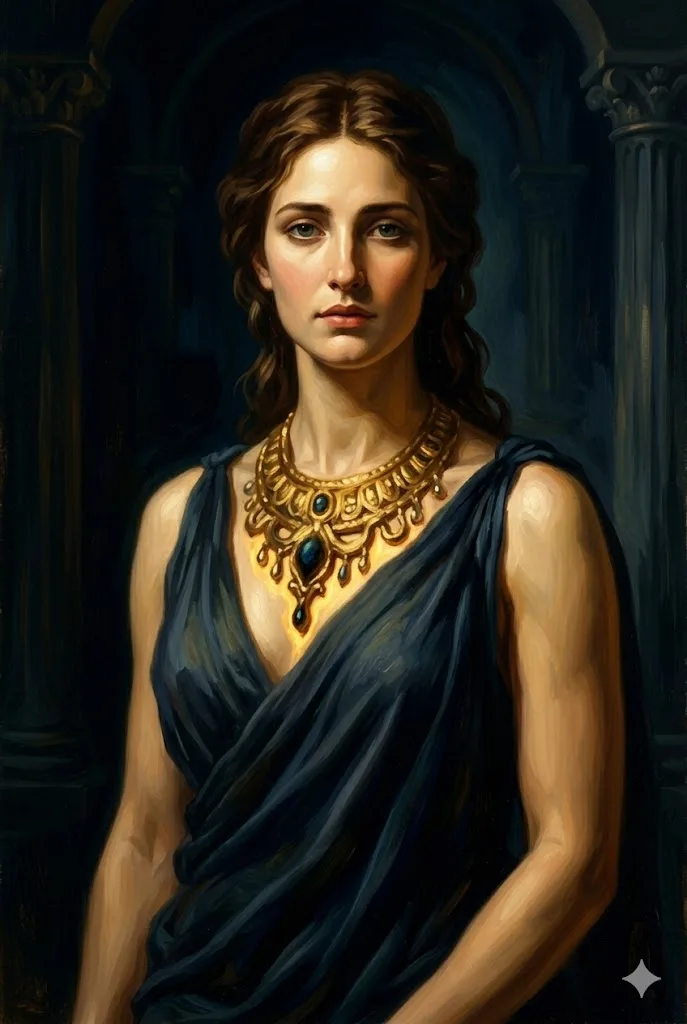
Daughter of Opposites
Harmonia was the goddess of harmony and concord, and her parentage was the most symbolically perfect in Greek mythology. She was the daughter of Ares (War) and Aphrodite (Love), making her the literal offspring of the two most opposing forces in the cosmos. The Greeks understood that true harmony is not the absence of conflict but the balance between opposing forces. Peace without passion is stagnation. Passion without peace is destruction. Harmonia is what exists when the two are held in perfect tension.
The Wedding
Harmonia married Cadmus, the legendary founder of Thebes, in a wedding almost as famous as that of Peleus and Thetis. All the gods attended and brought gifts. But Hephaestus, who had been cuckolded by Ares and Aphrodite, gave Harmonia a cursed wedding gift: a magnificent golden necklace that brought misfortune and death to every woman who possessed it. Some say the necklace was crafted with bitterness woven into its gold, Hephaestus's revenge for his wife's affair.
The Curse
The Necklace of Harmonia became one of the most dangerous objects in Greek mythology. It passed through generations, bringing ruin to every owner. It descended through the royal house of Thebes to Polynices, son of Oedipus, who used it as a bribe. Eriphyle, who betrayed her husband for it, owned it. The necklace was eventually dedicated at the Temple of Apollo at Delphi, where it presumably could cause no more harm. The curse of the necklace drove much of the mythological cycle of Thebes, one of the most tragic storylines in all of Greek myth.
Transformation
In old age, after witnessing the destruction of the family they founded in Thebes, Cadmus and Harmonia were transformed by the gods into serpents. This transformation, unlike most in Greek mythology, was not a punishment but a mercy. They slithered away from human suffering together, still a couple, still in harmony, escaping the cycle of curse and violence that had consumed their descendants.
Classical Sources
- 📜 Homer, Iliad & Odyssey (c. 750 BC)
- 📜 Hesiod, Theogony (c. 700 BC)
- 📜 Apollodorus, Bibliotheca (c. 1st-2nd century AD)
- 📜 Ovid, Metamorphoses (8 AD)
Cross-referenced with multiple classical sources for accuracy.
Explore More
Ares · Aphrodite · Hephaestus · Oedipus · Home
Two different Harmonias
The familiar version of Harmonia comes from Hesiod. In the Theogony, Aphrodite bears Ares three children: Phobos and Deimos, who throw ranks of men into confusion, and Harmonia, whom Cadmus took as his wife. A separate tradition, linked to the island of Samothrace and recorded by Diodorus of Sicily, gives her a completely different family. There she is the daughter of Zeus and the Pleiad Electra, and sister of Dardanus (ancestor of the Trojan kings) and of Iasion. Cadmus meets her on Samothrace while searching for his sister Europa, and the island's Mysteries were connected with their wedding.
The name also had a life apart from the Theban story. The philosopher Empedocles used "Harmonia" as one of his names for Love, the force that joins the elements. In Euripides' Medea, the chorus sings that "golden-haired Harmonia" once gave birth to the nine Pierian Muses in Athens. That is an unusual genealogy and clearly a different idea of her from the Theban queen.
The wedding and where the necklace came from
The wedding of Cadmus and Harmonia at Thebes was one of only two mortal weddings that the gods were said to have attended. The other was that of Peleus and Thetis. Pindar's third Pythian recalls the Muses singing at both. The elegiac poet Theognis preserves the line the Muses are supposed to have sung at the Theban wedding: "What is beautiful is dear; what is not beautiful is not dear." Pausanias was shown the spot in the Theban marketplace where the Muses sang. He also describes three ancient wooden statues of Aphrodite at Thebes, under the titles Urania, Pandemos and Apostrophia, which the Thebans said Harmonia had dedicated, carved from the figureheads of Cadmus' ships.
Ancient authors disagree about who made the necklace and why. Apollodorus says that Cadmus gave Harmonia a robe and the necklace made by Hephaestus. He then reports that some said Hephaestus gave it to Cadmus, while the early mythographer Pherecydes said it came from Europa, who had received it from Zeus. In Diodorus' Samothracian version it is a gift from Athena. The idea that Hephaestus cursed it out of spite against Aphrodite and Ares is developed most fully by the Roman poet Statius in the Thebaid, which describes the necklace being forged with dark emblems and evil charms.
The necklace's later travels are well documented. Polynices took it from Thebes to Argos and used it to bribe Eriphyle into sending her husband Amphiaraus on the doomed expedition of the Seven against Thebes. Her son Alcmaeon killed her for it. The necklace then passed through his two wives, Arsinoe (or Alphesiboea) and Callirhoe, and helped bring about his own murder. In the end Callirhoe's sons dedicated it at Delphi, together with the robe. Through her daughters Ino, Semele, Agave and Autonoe, Harmonia was grandmother to Dionysus, Pentheus, Actaeon and Melicertes, a list that is mostly a catalogue of disasters.
The serpents and the journey west
The serpent transformation is described in some detail. At the end of Euripides' Bacchae, Dionysus prophesies that Cadmus and Harmonia will become serpents and lead a barbarian army against Greek cities, and that Ares will finally rescue them and settle them in the land of the blessed. Apollodorus says they left Thebes for the Encheleans in Illyria, where Cadmus became king and a son, Illyrius, was born. Afterwards Zeus turned them into serpents and sent them to the Elysian Fields. Ovid's Metamorphoses (Book 4) adds a moving scene in which Cadmus changes first and Harmonia begs to share his fate, embracing him until she too becomes a serpent. Pindar's second Olympian counts Cadmus among those living in the Isles of the Blessed. So in several versions the transformation is a step towards Elysium, not simply an escape. For the later Theban tragedies the necklace fed into, see Oedipus and Thebes.
Ancient sources
- Hesiod, Theogony 933–937 and 975–978: Harmonia born to Ares and Aphrodite, married to Cadmus, mother of Ino, Semele, Agave, Autonoe and Polydorus.
- Pindar, Pythian 3: the Muses sing at the weddings of Cadmus and of Peleus.
- Euripides, Bacchae (final scene): the prophecy of the serpent transformation and the journey to the land of the blessed.
- Apollodorus, Bibliotheca 3.4–3.7: the wedding gifts, the rival accounts of the necklace's maker, the Illyrian exile, and the necklace's passage to Eriphyle and on to Delphi.
- Diodorus Siculus, Library 5.48–49: the Samothracian tradition making Harmonia daughter of Zeus and Electra.
- Ovid, Metamorphoses 4.563–603: Cadmus and Harmonia transformed into serpents in Illyria.
Frequently asked questions
Who were Harmonia's children?
Hesiod names four daughters, Ino, Semele, Agave and Autonoe, and a son, Polydorus. Apollodorus adds Illyrius, born during the exile in Illyria.
Who made the Necklace of Harmonia?
Most often Hephaestus, but Pherecydes said Zeus gave it to Europa, and Diodorus makes it a gift from Athena. The curse is clearest in later sources, especially Statius.
What happened to the necklace in the end?
The sons of Alcmaeon dedicated it at Delphi, together with Harmonia's robe.
Is Harmonia the same as Concordia?
Romans sometimes compared them, but Concordia was a Roman personification of civic agreement with her own temple in the Forum. Harmonia is a mythological queen of Thebes with a family and a story.
Books to read next
Links go to Bookshop.org, which supports independent bookstores. We earn a small commission if you buy, at no extra cost to you.