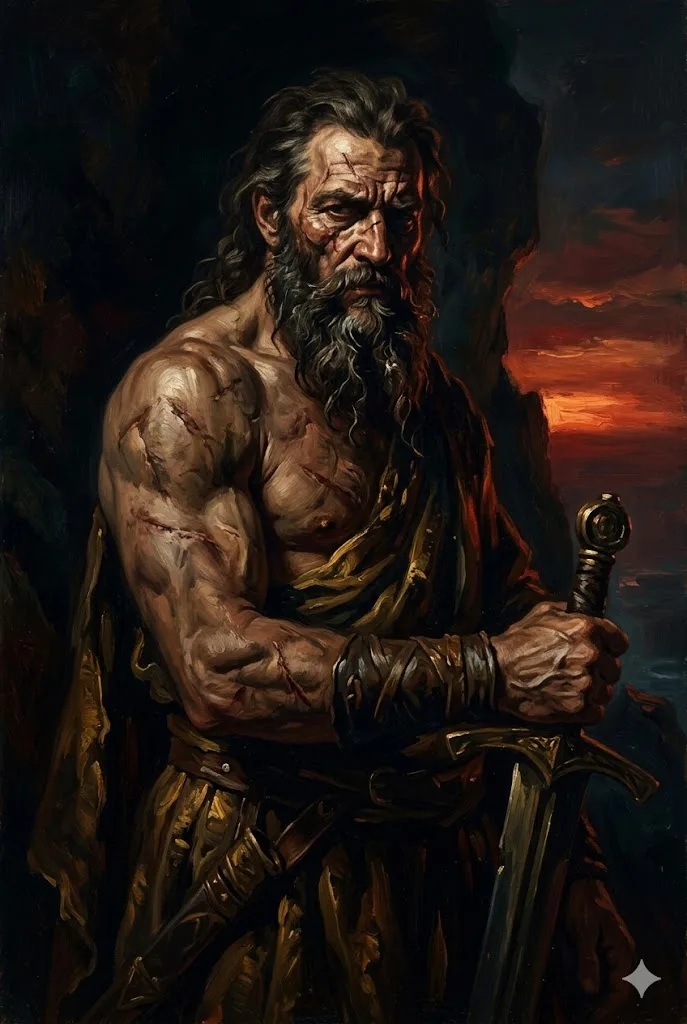
The Piercer
Iapetus — 'The Piercer' — was one of the four Titan brothers who held Uranus at the corners of the earth while Cronus castrated their father. He held the western corner, a position later inherited by his son Atlas, who would hold up the entire sky.
As a first-generation Titan, Iapetus's importance lies less in his own myths and more in his extraordinary sons, each of whom shaped humanity's relationship with the gods.
Four Sons, Four Fates
Prometheus (Forethought) — The most famous of Iapetus's sons stole fire from the gods and gave it to humanity, suffering eternal punishment chained to a mountain.
Atlas — Led the Titan forces in the Titanomachy and was condemned to hold the celestial sphere on his shoulders for eternity.
Epimetheus (Afterthought) — The slow-witted brother who accepted Pandora as a gift from Zeus despite Prometheus's warnings, unleashing suffering upon humanity.
Menoetius — The most violent brother, struck down by Zeus's thunderbolt for his arrogance and hurled into Tartarus.
The Ancestor of Humanity
Through Prometheus (who created humans from clay in some traditions) and Epimetheus (who married Pandora), Iapetus was essentially the grandfather of the human race. His son Deucalion (Prometheus's son) survived the great flood and repopulated the earth, much like Noah in Hebrew tradition.
The Greeks saw Iapetus as the ancestor of all mortals, which is why he was called the Titan of Mortality. His very name may connect to the Hebrew Japheth, one of Noah's three sons, suggesting ancient cross-cultural connections.
Quick Facts
Domain: Mortality, the West, the Human Lifespan
Consort: Clymene (or Asia) — an Oceanid
Sons: Prometheus, Atlas, Epimetheus, Menoetius
Fate: Imprisoned in Tartarus
Legacy: Grandfather of the human race
Iapetus in Homer and Hesiod
Iapetus has only a handful of ancient appearances, but each is revealing. In the Iliad (book 8), Zeus tells Hera that he does not care about her anger even if she goes to the lowest limits of earth and sea, "where Iapetus and Cronus sit and have no joy in the rays of Helios Hyperion or in the winds, and deep Tartarus is all around." This is the oldest picture of the imprisoned Titans, and it pairs Iapetus with Cronus as the chief representatives of the older order.
Hesiod's Theogony lists Iapetus among the twelve children of Uranus and Gaia and then devotes a long section to his family: he married the Oceanid Clymene, "of the beautiful ankles," who bore him four sons. Hesiod describes them together as a set of warnings: stout-hearted Atlas, the overbearing Menoetius, the clever and scheming Prometheus, and the foolish Epimetheus, "who was from the first a mischief to men who eat bread." Menoetius is struck by Zeus's thunderbolt and sent down to Erebus "because of his wickedness and excessive pride." Hesiod regularly calls Prometheus by the patronymic "son of Iapetus" (Iapetionides), especially in the story of the sacrifice at Mecone and the theft of fire.
Variant Wives and Family Lines
The wife of Iapetus changes from author to author. Hesiod names Clymene. Apollodorus calls her Asia, another daughter of Ocean, and later Greeks connected her name with the continent. Aeschylus's Prometheus Bound takes a more radical line: there Prometheus says his mother was Themis, "Earth, one form with many names," who foretold how the war with Zeus would be won. If Themis is the mother, Iapetus's son inherits his prophetic knowledge from her, which is central to the play's plot (see Themis).
Through his sons, Iapetus appears on both sides of the first human family. Prometheus's son Deucalion married Pyrrha, daughter of Epimetheus and Pandora; together they survived the flood sent by Zeus, and their son Hellen gave his name to the Hellenes, the Greeks. Iapetus is therefore great-grandfather of the eponymous ancestor of the Greek people on both sides. Through Atlas's daughter Maia, he is also great-grandfather of Hermes, and through Atlas's daughter Electra, an ancestor of the royal house of Troy. Calypso, the Pleiades and the Hyades are his granddaughters.
A Byword for Antiquity
Because he belonged to the oldest generation of gods, Iapetus's name became shorthand for something ancient and outdated. In Aristophanes' Clouds, a young man is told not to call his father "Iapetus," that is, an old fossil, and the same comic usage appears elsewhere in Greek. Roman poets used the name for his son: Horace in his Odes (1.3) speaks of "the bold son of Iapetus" who brought fire to mankind by wicked deceit, a phrase meant to summarise human daring (see Prometheus and the theft of fire).
No temple or festival of Iapetus is known, and he is rare in art. His importance is structural: he is the Titan whose family most directly shapes the human condition, giving the world a giver of fire, a bearer of the sky, a husband for the first woman and a son destroyed for pride.
Names, Meanings and Misconceptions
The meaning of Iapetus is uncertain. The traditional gloss "piercer" or "wounder" connects the name with a Greek verb meaning to hurl or strike, but the link is not secure, and other scholars consider the name pre-Greek. A resemblance to Japheth, son of Noah in Genesis, has been noted since the seventeenth century, especially because both figures stand at the head of a lineage of nations after a flood. This is an intriguing parallel, but there is no proof that the names are related, and it should be treated as speculation.
Modern titles such as "Titan of mortality" or "Titan of the west" are also modern constructions. Hesiod does not assign Iapetus a domain; the western association comes from his son Atlas, who stands at the western edge of the world. The idea that four Titans held down Uranus at the corners of the earth while Cronus attacked him is not found in Hesiod, whose Cronus acts alone with the sickle while his brothers hold back in fear.
Saturn's third-largest moon, discovered by Giovanni Cassini in 1671, is named Iapetus. It is famous for its two-toned surface, one hemisphere dark and the other bright, and for a ridge running along its equator (see planet and moon names from mythology).
Ancient sources
- Homer, Iliad book 8 — Zeus describes Iapetus and Cronus sitting in Tartarus at the farthest limits of earth and sea.
- Hesiod, Theogony — Iapetus's marriage to Clymene, the characters of his four sons and the fate of Menoetius.
- Apollodorus, Library book 1 — Iapetus's sons by Asia and the flood of Deucalion and Pyrrha.
- Aeschylus, Prometheus Bound — Prometheus as son of Themis, implying a different consort for Iapetus.
- Aristophanes, Clouds — "Iapetus" used as a comic insult for an old-fashioned father.
Frequently asked questions
Who are the children of Iapetus?
Atlas, Prometheus, Epimetheus and Menoetius, born to the Oceanid Clymene (or Asia, in Apollodorus).
What happened to Iapetus?
The Iliad places him in Tartarus with Cronus, far from sunlight and wind, after the Titans' defeat in the Titanomachy.
Is Iapetus the same as Japheth from the Bible?
The names look similar and both stand at the head of a family line, but no ancient source connects them and the link is unproven.
Why is Iapetus considered an ancestor of humans?
His grandchildren Deucalion and Pyrrha repopulated the earth after the flood, and their son Hellen was the ancestor of the Greeks.