Ladon — The Sleepless Dragon Who Guarded Immorta
⚡ Quick Facts
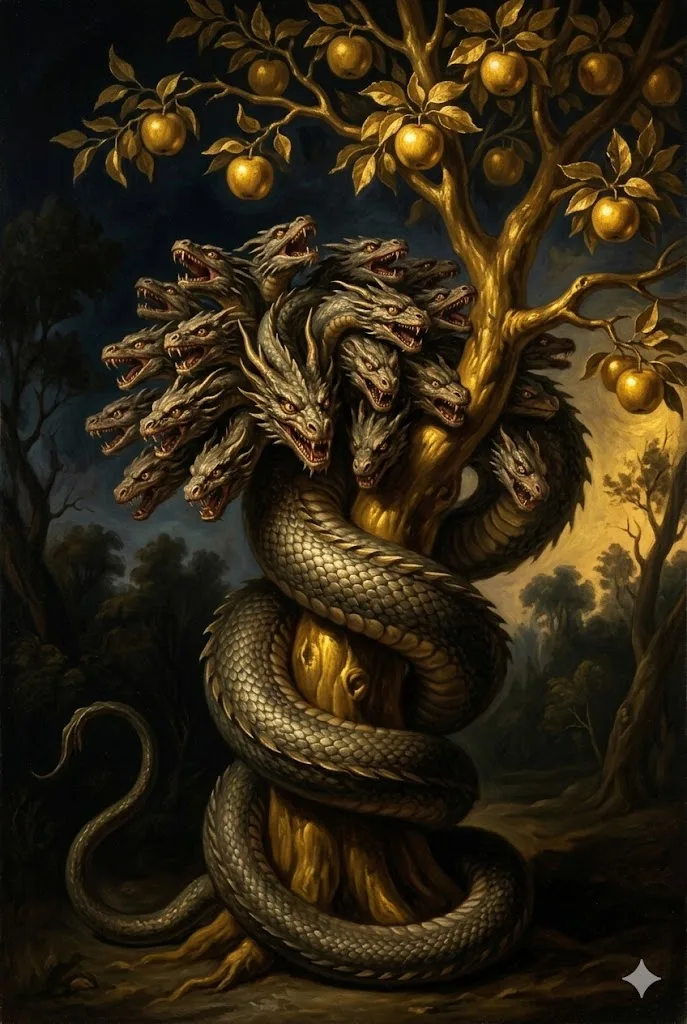
Guardian of the Golden Apples
At the western edge of the world grew a garden tended by the Hesperides, nymphs of the evening. In this garden stood a tree that bore golden apples — a wedding gift from Gaia to Hera when she married Zeus. These were no ordinary fruit; they granted immortality to whoever ate them.
Coiled around the tree was Ladon, a dragon with a hundred heads, each speaking in a different voice. He never slept, his countless eyes always watching, his many mouths always hissing warnings. Even the gods rarely dared approach.
The Eleventh Labour
For his eleventh labour, Heracles was tasked with retrieving three golden apples. In one version, he killed Ladon with arrows tipped in the poison of the Hydra. In another, he convinced Atlas to retrieve the apples while Heracles held the sky in Atlas' place.
After Ladon's death, Hera placed his image in the stars as the constellation Draco, which wraps around the northern celestial pole — forever coiling through the night sky as he once coiled around the tree of golden fruit.
A serpent with several family trees
The guardian serpent first appears without a name. In Hesiod's Theogony, Ceto bears Phorcys her youngest child: a terrible snake that guards the all-golden apples in the secret places of the dark earth at its great bounds. This makes the serpent a sibling of the Gorgons and the Graeae. Apollodorus gives a different family: he makes the dragon a child of Typhon and Echidna, which puts it alongside the Hydra, Cerberus and the Chimera. He describes it as immortal, with a hundred heads that speak with many different voices. The name Ladon is most clearly attested in Apollonius of Rhodes, who calls it the "earth-born snake Ladon."
The location of the garden also varied. Hesiod puts the Hesperides beyond Ocean in the far west, close to where Atlas holds up the sky. Apollodorus says the apples were not in Libya, as some claimed, but on Atlas among the Hyperboreans in the far north. Apollonius, in contrast, sets the garden in Libya near Lake Triton.
The Argonauts arrive one day late
One of the most vivid scenes involving Ladon has no fight in it at all. In the fourth book of the Argonautica, the Argonauts, stranded in the Libyan desert and dying of thirst, stumble into the sacred garden the day after Heracles has passed through. Ladon lies dead by the apple tree. Only the tip of his tail still twitches, and flies wither in the poisoned wounds left by Heracles' arrows, which had been dipped in the venom of the Hydra. The Hesperides are grieving over him. When Orpheus prays to them, they turn into trees, a poplar, an elm and a willow, and then take their own forms again to show the heroes a spring that Heracles had kicked out of a rock. Euripides also mentions the killing in his Heracles, where the chorus praises the hero for slaying the tawny-backed serpent that guarded the golden fruit.
Atlas, Prometheus and returning the apples
Ancient authors did not agree on how Heracles got the apples. In the version Apollodorus prefers, Prometheus advises Heracles not to go into the garden himself but to send Atlas, holding the sky in his place. Atlas returns with three apples and offers to deliver them to Eurystheus himself. Heracles pretends to agree, asks Atlas to take the sky back for a moment while he adjusts a pad on his head, and then walks off with the fruit. Apollodorus adds that "some say" Heracles picked the apples himself after killing the serpent. A metope from the Temple of Zeus at Olympia shows the Atlas version: Heracles holds up the sky with Athena's help while Atlas brings him the apples.
The apples did not stay with Eurystheus. According to Apollodorus, they were given to Athena, who carried them back to the garden because it was not lawful for them to be anywhere else. Their origin is told as well: they were Gaia's wedding present to Hera, which is why Hera set the serpent to guard them. Hyginus says that after the serpent's death it was placed among the stars as the constellation Draco, and that the kneeling figure next to it, later identified as Hercules, is shown with one foot on its head (see constellation myths).
Things often misunderstood
Popular retellings often say that the golden apples gave immortality, but ancient sources do not clearly say so. Their value lay in being divine, Hera's property kept at the end of the world. Ladon should also not be confused with the dragon that guarded the Golden Fleece in Colchis, which Medea put to sleep. Nor should he be confused with Ladon the river god of Arcadia, who in some versions is the father of Daphne (see Apollo and Daphne). Finally, the golden apples Hippomenes used to win his race against Atalanta are sometimes said to come from this garden. Ovid, however, says Venus picked them in her own sacred field at Tamasus on Cyprus.
Ancient sources
- Hesiod, Theogony 333–335: the unnamed serpent, youngest child of Phorcys and Ceto, guarding the golden apples at the ends of the earth.
- Apollonius of Rhodes, Argonautica 4: names the serpent Ladon and describes the Argonauts finding it dead the day after Heracles' visit, with the Hesperides turned into trees.
- Apollodorus, Library 2.5.11: the hundred-headed, many-voiced dragon born of Typhon and Echidna, the Atlas trick, and Athena returning the apples.
- Euripides, Heracles: the chorus lists the killing of the serpent among Heracles' deeds.
- Hyginus, Astronomica 2: the serpent placed among the stars as Draco, next to the kneeling Hercules.
Frequently asked questions
Did Heracles kill Ladon?
In some versions, yes. Apollonius and Euripides have him kill the serpent with arrows. In the version Apollodorus prefers, Atlas fetches the apples and the serpent's fate is not described, although Apollodorus notes that some said Heracles killed it.
Who were Ladon's parents?
Hesiod makes the serpent the youngest child of Phorcys and Ceto. Apollodorus makes it a child of Typhon and Echidna.
Is Ladon the constellation Draco?
Ancient astronomical writers such as Hyginus identified Draco with the Hesperides' serpent, although other stories explained the constellation in different ways.
Where was the Garden of the Hesperides?
Accounts differ. Hesiod places it beyond Ocean in the far west, Apollonius in Libya and Apollodorus among the Hyperboreans in the north.