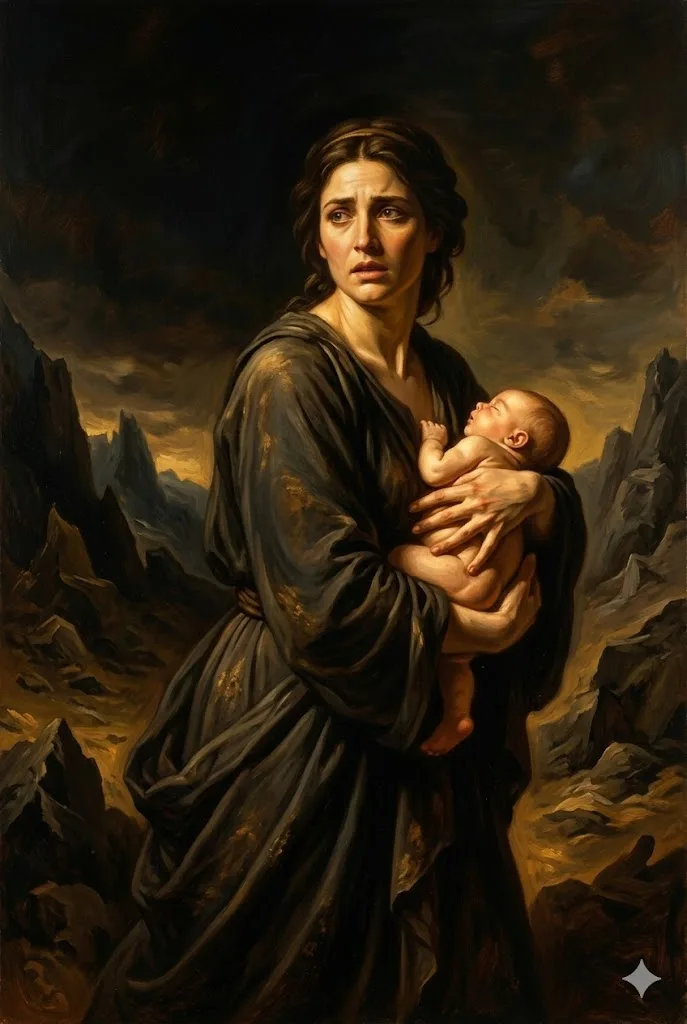
I. Who Was Leto?
Leto was a second-generation Titaness, daughter of Coeus and Phoebe, and one of Zeus's earliest consorts. She is best known as the mother of two of the most important Olympian gods: Apollo (god of the sun, music, and prophecy) and Artemis (goddess of the hunt and the moon). Her story is defined by persecution, endurance, and the fierce devotion of a mother who would endure anything for her children.
When Hera discovered that Leto was pregnant with Zeus's children, she unleashed her full wrath. She forbade every land on earth — every island, every continent — from giving Leto shelter to give birth. She also sent the serpent Python to pursue Leto across the world. Exhausted and desperate, Leto finally found refuge on the tiny, barren, floating island of Delos — which, not being fixed to the earth, was technically not bound by Hera's decree.
On Delos, Leto endured nine days of agonizing labor. Hera had also forbidden Eileithyia, the goddess of childbirth, from attending. The other goddesses finally bribed Hera's daughter with a golden necklace, and Eileithyia came to Delos. Artemis was born first and immediately helped her mother deliver Apollo. When Apollo was born, the barren island burst into golden light and flowers — and Delos became one of the holiest sites in the Greek world.
Leto was worshipped as a goddess of motherhood and protectiveness. She was gentle and beloved — but fiercely dangerous when her children were threatened. When the mortal queen Niobe boasted of having more children than Leto, Apollo and Artemis killed all fourteen of Niobe's children with arrows in a single day.
Classical Sources
The mythology of Leto is preserved in:
- 📜 Hesiod, Theogony (c. 700 BC) — The primary source for Titan mythology, genealogy, and the Titanomachy.
- 📜 Apollodorus, Bibliotheca (c. 1st–2nd century AD) — Comprehensive handbook of Titan genealogies and myths.
- 📜 Aeschylus, Prometheus Bound (c. 5th century BC) — Dramatic portrayal of Titan defiance against Olympian authority.
- 📜 Ovid, Metamorphoses (8 AD) — Roman accounts of Titan mythology and transformations.
Cross-referenced with multiple classical sources for accuracy.
The wandering before Delos
The fullest early account of Leto's search for a birthplace is the Delian half of the Homeric Hymn to Apollo. It runs through a long list of places that turned her away, from Crete and Athens to Aegina, Euboea, Samos, Lesbos and Chios, and explains that they refused because they were afraid of the son she carried. Delos does not take her in out of simple kindness. The island bargains. It worries that a god as powerful as Apollo will despise a rocky, poor place and kick it back into the sea, so Leto swears by the water of Styx that Apollo's temple and altar will stand there for all time. Only after the oath does Delos agree.
The same hymn names the goddesses who waited with her through nine days and nights of labour: Dione, Rhea, Themis, Amphitrite and others. Hera, on purpose, stays on Olympus and keeps Eileithyia with her. The goddesses send Iris to fetch the birth-goddess with a huge necklace of gold and amber. When Eileithyia arrives, Leto throws her arms around a palm tree, kneels on the soft meadow, and Apollo springs into the light. Visitors to Delos were shown the sacred palm, and the circular Sacred Lake nearby was linked to the birth.
The versions disagree on several points. The Hymn says Artemis was born on Ortygia and Apollo on Delos, as if these were two places. Later writers often treat Ortygia simply as an old name for Delos. The idea that Artemis was born first and acted as midwife to her twin is found in Apollodorus, not in the Hymn. Callimachus, in his Hymn to Delos, has Hera set Ares and Iris to watch the land and sea. He also has the unborn Apollo speak from the womb, and swans fly seven times around the island at the birth. Callimachus also identifies Delos with Leto's sister Asteria, who leapt into the sea to escape Zeus and became a drifting island. That gives a family reason why Delos alone would shelter her. Delos itself was later made ritually pure: no one was allowed to give birth or die there.
Other episodes: Tityos, the Lycian frogs and the Trojan War
Leto's children defend her more than once. The giant Tityos, a son of Gaia (or of Zeus and Elara), tried to rape her as she travelled to Pytho through Panopeus. Apollo and Artemis shot him dead. In the Odyssey, Odysseus sees him in the underworld, stretched over nine acres while two vultures tear at his liver. The killing of the serpent Python at Delphi is sometimes told the same way, as revenge for its hunting of Leto. Hyginus connects the serpent's pursuit directly to Hera's jealousy.
Ovid tells a story set in Lycia (Metamorphoses 6). Carrying her newborn twins, a thirsty Leto stopped at a small lake to drink. Local peasants muddied the water and jeered at her. She cursed them to live in the pond forever, and they became frogs, still croaking insults from the water.
In the Iliad, Leto is on the Trojan side together with Apollo and Artemis. With Artemis she heals the wounded Aeneas inside Apollo's temple on the citadel of Pergamos. In the battle of the gods in Book 21, Hermes politely refuses to fight her, saying it is risky to trade blows with a wife of Zeus. She quietly picks up the bow and arrows Hera has knocked out of Artemis's hands.
The Niobe story also has variants on the main page's figure. Homer gives Niobe twelve children, six sons and six daughters. Ovid and many later writers give fourteen. Other authors give still other totals.
Worship: Delos, the Lycian Letoon and Crete
Leto had a temple on Delos, but her most important sanctuary was the Letoon in Lycia, near Xanthos in south-west Turkey. It was the religious centre of the Lycian League, with temples to Leto, Artemis and Apollo side by side. A famous trilingual inscription in Lycian, Greek and Aramaic, dating to the fourth century BC, was found there. Many scholars think a local mother goddess was merged with the Greek Leto in Lycia. That would fit the Lycian setting of Ovid's frog story and Apollo's title Lykios, though the details are still debated.
At Phaistos in Crete, Leto was worshipped as Leto Phytia, "the one who makes grow." Antoninus Liberalis tells how she changed a girl named Leucippus into a boy, and connects the change with a local festival, the Ekdysia. At Argos, Pausanias saw a statue of Leto by Praxiteles. In art she usually appears as a dignified, veiled matron standing beside her children. Vase-painters liked the Tityos attack and the Python episode, and sometimes show Leto fleeing with the infant twins in her arms.
Common misunderstandings
Leto is often called Zeus's wife, and Hesiod does place her in the list of his unions before Hera. But she had little to do with Olympian government. Her importance comes almost entirely from motherhood. The "floating" Delos is a later poetic idea: Pindar describes four pillars rising from the sea floor to anchor the island at the moment of the birth. In Latin poetry she is Latona, and Apollo and Artemis are often simply called the Latonian twins. For her parents, see Phoebe; for her twins, Apollo and Artemis.
Ancient sources
- Homeric Hymn to Apollo (Delian section): Leto's wandering, the bargain with Delos and the oath by Styx, the nine-day labour, Iris and the necklace, and the birth beside the palm.
- Hesiod, Theogony 404–410 and 918–920: Leto is the daughter of Phoebe and Coeus, "dark-robed and always gentle," and the mother of Apollo and Artemis by Zeus.
- Homer, Iliad 5, 21 and 24; Odyssey 11: Leto heals Aeneas, faces Hermes in the battle of the gods, the Niobe story with twelve children, and Tityos punished for assaulting her.
- Callimachus, Hymn to Delos: Hera's watchers, Asteria as the wandering island, the swans, and Apollo prophesying from the womb.
- Ovid, Metamorphoses 6: Niobe's boast and punishment, and the Lycian peasants turned into frogs.
- Apollodorus, Library 1.4.1: Hera hounds Leto across the earth, Artemis is born first and helps deliver Apollo, and Tityos is killed.
Frequently asked questions
Why did no land let Leto give birth?
Later accounts say Hera forbade it. In the Homeric Hymn, though, the places refuse because they fear Apollo's power. Delos agrees only after Leto swears an oath that the god will honour it.
Were Apollo and Artemis born in the same place?
Not in every version. The Homeric Hymn puts Artemis's birth on Ortygia and Apollo's on Delos. Later writers often merge the two, or say Artemis was born first and helped with Apollo's delivery.
What is Leto the goddess of?
She has no large domain. She was honoured above all as a mother and protector of the young, and in Lycia as a major regional goddess whose Letoon was a federal sanctuary.
Who are Leto's parents and siblings?
She is the daughter of the Titans Phoebe and Coeus. Her sister Asteria was the mother of Hecate.
Explore More Mythology
Get weekly deep dives into the gods, heroes, and myths of ancient Greece.