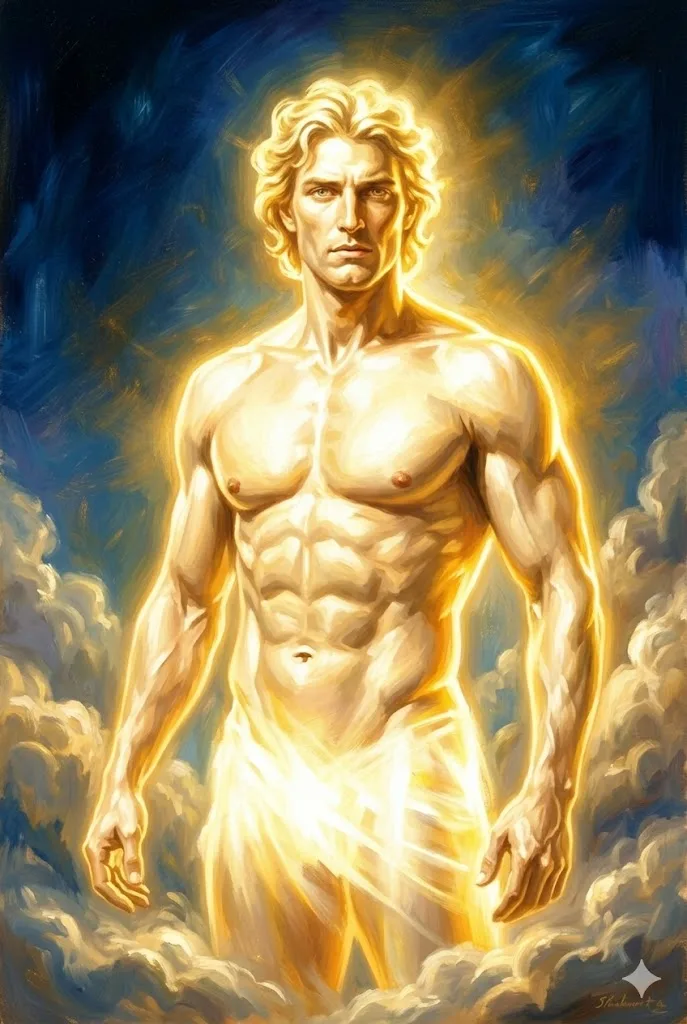
I. Who Was Hyperion?
Hyperion was one of the twelve original Titans, son of Uranus (Sky) and Gaea (Earth), and the god of heavenly light — the light of the sun, moon, and dawn that illuminated the ancient world. His name means "He Who Goes Above" or "The High One," referring to the celestial bodies that traversed the sky above the earth. He was the Titan of watchfulness, wisdom, and the light of heaven.
With his sister-wife Theia, Hyperion fathered three of the most important celestial deities: Helios (the Sun), who drove his golden chariot across the sky each day; Selene (the Moon), who rode her silver chariot through the night; and Eos (the Dawn), who opened the gates of heaven for her brother each morning. Through these children, Hyperion's legacy illuminated every hour of every day.
During the Titanomachy, Hyperion was one of the four Titans stationed at the corners of the earth to hold Uranus in place while Cronus castrated him. After the Olympians defeated the Titans, Hyperion was cast into the pit of Tartarus along with his brothers. His domain of heavenly light was inherited by his son Helios and, eventually, by Apollo.
Classical Sources
The mythology of Hyperion is preserved in:
- 📜 Hesiod, Theogony (c. 700 BC) — The primary source for Titan mythology, genealogy, and the Titanomachy.
- 📜 Apollodorus, Bibliotheca (c. 1st–2nd century AD) — Comprehensive handbook of Titan genealogies and myths.
- 📜 Aeschylus, Prometheus Bound (c. 5th century BC) — Dramatic portrayal of Titan defiance against Olympian authority.
- 📜 Ovid, Metamorphoses (8 AD) — Roman accounts of Titan mythology and transformations.
Cross-referenced with multiple classical sources for accuracy.
Hyperion in Hesiod and the Homeric Hymns
Hyperion's role in early poetry is almost entirely genealogical. Hesiod's Theogony lists him among the twelve children of Uranus and Gaia, and later says that Theia, "subject in love to Hyperion," bore great Helios, bright Selene and Eos, who shines for all on earth and for the immortal gods. Hesiod tells no story in which Hyperion acts.
The Homeric Hymn to Helios (Hymn 31) gives a slightly different genealogy: Hyperion married Euryphaessa, "wide-shining," his own sister, who bore him the same three children. Many scholars take Euryphaessa to be another name or title for Theia, whose name means "divine" and who is praised by Pindar in his fifth Isthmian ode as "Theia of many names," mother of the Sun, through whom gold has its power.
Hyperion as a Name of the Sun
A point often missed is that in Homer, Hyperion is not clearly a separate figure at all. The Odyssey's opening lines describe the companions of Odysseus who ate the cattle of "Helios Hyperion," and elsewhere the epic uses Hyperion alone as a name for the Sun. Ancient readers already debated whether the word was a title, meaning "the one going above," or a patronymic, "son of Hyperion" (the poems also use the form Hyperionides). The Homeric Hymn to Demeter calls Helios "the bright son of Hyperion" when he reveals to Demeter who took her daughter. It looks as though the sun's epithet and the Titan father developed side by side, and the genealogy may partly be a way of explaining the epithet.
This is why Hyperion is described as a god of light, watchfulness or heavenly fire in modern references: he is essentially the sun's own dignity personified one generation back. Because he has no independent myths, his family position is his identity.
Rationalising Accounts in Diodorus
The Sicilian historian Diodorus, writing in the first century BC, records two attempts to explain Hyperion historically. In book 5 he says Hyperion was the first to understand through careful observation the movements of the sun, moon and stars and the seasons they produce, and that this is why he was called father of those bodies. In book 3, repeating an account he attributes to the people of North Africa, he tells a darker story: Basileia, a queen who succeeded Uranus, married her brother Hyperion and bore Helios and Selene; Hyperion's jealous brothers murdered him and drowned the young Helios in the river Eridanus, after which Selene threw herself from a roof. Their mother, in a dream, saw Helios promise that the two would become the sun and moon. This version is unique to Diodorus and should not be mistaken for mainstream Greek myth, but it shows how Hellenistic writers tried to turn gods into kings.
Hyperion is generally assumed to have been among the Titans who fought Zeus in the Titanomachy and were confined in Tartarus, but no ancient account describes his part in the war. His children, by contrast, kept their offices under the Olympians, which is one reason his line was never seen as hostile.
Hyperion After Antiquity
Modern culture has given Hyperion more personality than ancient sources ever did. In Hamlet (Act 1, Scene 2) Shakespeare's prince compares his dead father to his uncle as "Hyperion to a satyr," using the Titan as a model of radiant nobility. John Keats wrote two unfinished epics, Hyperion and The Fall of Hyperion, in which the Titan is the last of his generation still in power, anxious as the young Apollo rises to replace him. Friedrich Hölderlin's novel Hyperion borrowed the name for a modern Greek hero. A moon of Saturn, irregular and sponge-like in appearance, was named Hyperion after its discovery in 1848, alongside its Titan siblings (see Greek mythology in planet names). Dan Simmons's science-fiction novel Hyperion takes its title partly from Keats.
Ancient sources
- Hesiod, Theogony — Hyperion among the twelve Titans and, with Theia, father of Helios, Selene and Eos.
- Homeric Hymn 31, To Helios — Hyperion and his sister Euryphaessa as parents of the Sun, Moon and Dawn.
- Homer, Odyssey — "Helios Hyperion" and Hyperion used as a name of the Sun itself.
- Homeric Hymn to Demeter — Helios addressed as the son of Hyperion when he tells Demeter about Persephone.
- Pindar, Isthmian 5 — praise of Theia, mother of the Sun.
- Diodorus of Sicily, Library of History books 3 and 5 — Hyperion as the first observer of the heavens, and the story of Basileia.
Frequently asked questions
What is Hyperion the Titan of?
Modern references call him the Titan of heavenly light or watchfulness. Ancient poets mainly present him as father of the Sun, Moon and Dawn, and Homer uses his name as a title of the Sun.
Is Hyperion the same as Helios?
In Hesiod they are father and son. In Homer, Hyperion can be another name for Helios, so the two overlap in the earliest sources.
Who was Hyperion's wife?
His sister Theia, according to Hesiod. The Homeric Hymn to Helios calls her Euryphaessa.
What does the name Hyperion mean?
It is usually explained as "he who goes above" or "the one on high," from the Greek hyper, "over, above."
Explore More Mythology
Get weekly deep dives into the gods, heroes, and myths of ancient Greece.