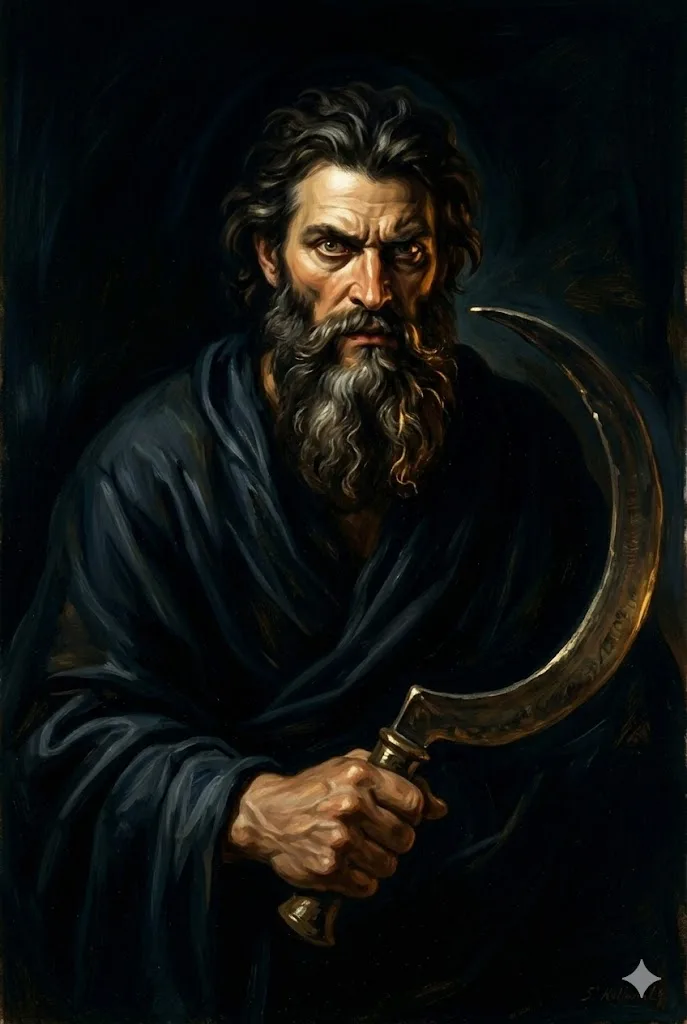
I. Who Was Cronus?
Cronus was the youngest and most ambitious of the twelve original Titans, and for an age he was the supreme ruler of the cosmos. His reign was known as the Golden Age — a mythical era of peace and abundance when mortals lived without toil, sorrow, or old age. Yet beneath this idyllic surface, Cronus was haunted by a prophecy: just as he had overthrown his father Uranus, one of his own children would one day overthrow him.
Driven by this fear, Cronus devoured each of his children — Hestia, Demeter, Hera, Hades, and Poseidon — the moment they were born. His wife Rhea, desperate to save her last child, hid the infant Zeus on the island of Crete and substituted a stone wrapped in swaddling clothes. Cronus swallowed the stone without noticing the deception.
II. The Fall of the Titans
When Zeus reached maturity, he returned and forced Cronus to regurgitate his siblings. The freed gods, led by Zeus, declared war on Cronus and the Titans in the cataclysmic Titanomachy — a ten-year conflict that shook the foundations of the earth. With the help of the Cyclopes and the Hundred-Handed Ones, Zeus and the Olympians prevailed. Cronus and the Titans were cast into the abyss of Tartarus, imprisoned forever in the deepest pit beneath the underworld.
His Roman counterpart Saturn gave his name to Saturday (Saturn's Day) and the planet Saturn. The festival of Saturnalia — the most popular holiday in the Roman calendar — commemorated the Golden Age of Cronus/Saturn with feasting, gift-giving, and temporary social equality. Many of its customs were later absorbed into Christmas celebrations.
Classical Sources
The mythology of Cronus is preserved in:
- 📜 Hesiod, Theogony (c. 700 BC) — The primary source for Titan mythology, genealogy, and the Titanomachy.
- 📜 Apollodorus, Bibliotheca (c. 1st–2nd century AD) — Comprehensive handbook of Titan genealogies and myths.
- 📜 Aeschylus, Prometheus Bound (c. 5th century BC) — Dramatic portrayal of Titan defiance against Olympian authority.
- 📜 Ovid, Metamorphoses (8 AD) — Roman accounts of Titan mythology and transformations.
Cross-referenced with multiple classical sources for accuracy.
The Sickle and the Castration of Uranus
Cronus's rise is told most fully in Hesiod's Theogony. Uranus hated his children and kept them pressed down inside the body of Gaia, who groaned under the strain. She fashioned a great sickle of grey adamant and asked her sons to punish their father. Only Cronus, "the youngest, wily-minded, most terrible of her children," agreed. He lay in ambush, and when Uranus came at night to lie with Earth, Cronus reached out and cut off his father's genitals, throwing them behind him.
The violence was fertile. From the drops of blood that fell on the earth sprang the Erinyes, the Giants and the ash-tree nymphs called Meliae; from the severed parts carried on the sea, foam gathered and Aphrodite was born, coming ashore at Cythera and Cyprus. Uranus cursed his sons with the name Titans, "strainers," and warned that vengeance would follow. The sickle became Cronus's attribute in art and was later associated with harvest, which helped the Romans identify him with their agricultural god Saturn.
The Stone, the Cave and the Omphalos
Hesiod says Cronus learned from Gaia and Uranus that he was destined to be overcome by his own son, so he swallowed each child as it came from the womb. Rhea, pregnant with Zeus, went to her parents for advice; they sent her to Lyctus on Crete, where she hid the newborn in a cave and gave Cronus a stone wrapped in swaddling clothes. Later accounts place the cave on Mount Dicte or Mount Ida, add the goat or nymph Amalthea who nursed the child, and describe the Curetes clashing spears on shields so that Cronus would not hear the baby cry. Apollodorus adds that Zeus enlisted Metis, who gave Cronus a drug that made him vomit up first the stone and then the swallowed children.
Hesiod says Zeus set the stone at Pytho, under Parnassus, as a sign and wonder for mortals. In the second century AD Pausanias saw a small stone above the temple at Delphi which, he was told, was the very one given to Cronus; it was anointed daily with oil and covered with unworked wool at festivals. This is distinct from, though often confused with, the carved omphalos stone shown to modern visitors.
Cronus also fathered children outside his marriage. Apollodorus says he lay with the Oceanid Philyra in the form of a horse, which is why their son Chiron was born a centaur.
Two Very Different Afterlives for Cronus
Ancient sources disagree sharply about what happened to Cronus after his defeat in the Titanomachy. In the Iliad and in Hesiod's Theogony, he is confined with Iapetus in Tartarus. But in Hesiod's Works and Days, in lines that some editors think were added later, the race of heroes lives on the Isles of the Blessed beside Ocean, where Cronus is their king, released by Zeus. Pindar's second Olympian ode similarly describes the "tower of Cronus" on the Isles of the Blessed, where Rhadamanthys is his assessor. Orphic poetry told yet another version: Zeus made his father drunk on honey and bound him while he slept.
The golden age is linked to Cronus in the Works and Days, where the first, golden race lived "when Cronus was king in heaven," without labour or old age. Plato develops the theme in the Statesman and Laws, imagining a reign of Cronus in which divine spirits governed humans directly. Virgil, in Aeneid book 8, says that Saturn, fleeing Jupiter, came to Italy and hid there, giving Latium its name from latere, "to hide," and taught its people farming and law.
Festivals, Cult and Misunderstandings
The Athenians held a festival called the Kronia in the summer month of Hekatombaion, at which, according to the historian Philochorus as quoted by Macrobius, masters and slaves feasted together, a Greek parallel to the Roman Saturnalia. At Olympia the hill overlooking the sanctuary was called the Hill of Cronus, and Pausanias reports that priests called Basilai ("kings") sacrificed to Cronus on its summit at the spring equinox. Greek writers also identified Cronus with foreign gods who received harsh rites, such as the chief god of Carthage, which shaped his later reputation as a child-devouring deity.
Two confusions are worth correcting. First, Cronus (Kronos) is not Chronos, the personification of Time; the names are different words, though ancient writers, including Stoic philosophers cited by Cicero, already played on the resemblance, which is why Cronus is shown with an hourglass as "Father Time" in later art. Second, the iconic images of Cronus eating his children, Rubens's Saturn in the Prado and Goya's dark mural Saturn Devouring His Son, show him tearing flesh, whereas Hesiod's Cronus swallows his children whole. That is why they could later be disgorged alive.
Ancient sources
- Hesiod, Theogony — the castration of Uranus with the adamant sickle, the swallowing of the children, Rhea's stone, and the stone set up at Pytho.
- Hesiod, Works and Days — the golden race under Cronus, and Cronus ruling the Isles of the Blessed.
- Pindar, Olympian 2 — the tower of Cronus on the Isles of the Blessed.
- Apollodorus, Library book 1 — Metis's emetic, the Curetes and Amalthea, and the birth of Chiron from Cronus and Philyra.
- Pausanias, Description of Greece books 6 and 10 — sacrifices to Cronus on the hill at Olympia and the stone at Delphi.
- Virgil, Aeneid book 8 — Saturn's flight to Latium and his golden-age rule in Italy.
Frequently asked questions
Is Cronus the same as Chronos, the god of time?
No. Cronus is the Titan king; Chronos is the personification of time found in philosophical and Orphic texts. The similar names led to their merging in later art and thought.
Why did Cronus eat his children?
Gaia and Uranus told him he was destined to be overthrown by a son, just as he had overthrown his father. Swallowing each child at birth was his attempt to avoid that fate.
Which children did Cronus swallow?
Hestia, Demeter, Hera, Hades and Poseidon, born of Rhea. Zeus escaped because Rhea gave Cronus a stone in his place. See the siblings of Zeus.
What happened to Cronus after the Titanomachy?
Most early sources imprison him in Tartarus. Others, including Pindar and a passage of the Works and Days, have him freed to rule the Isles of the Blessed.
Explore More Mythology
Get weekly deep dives into the gods, heroes, and myths of ancient Greece.