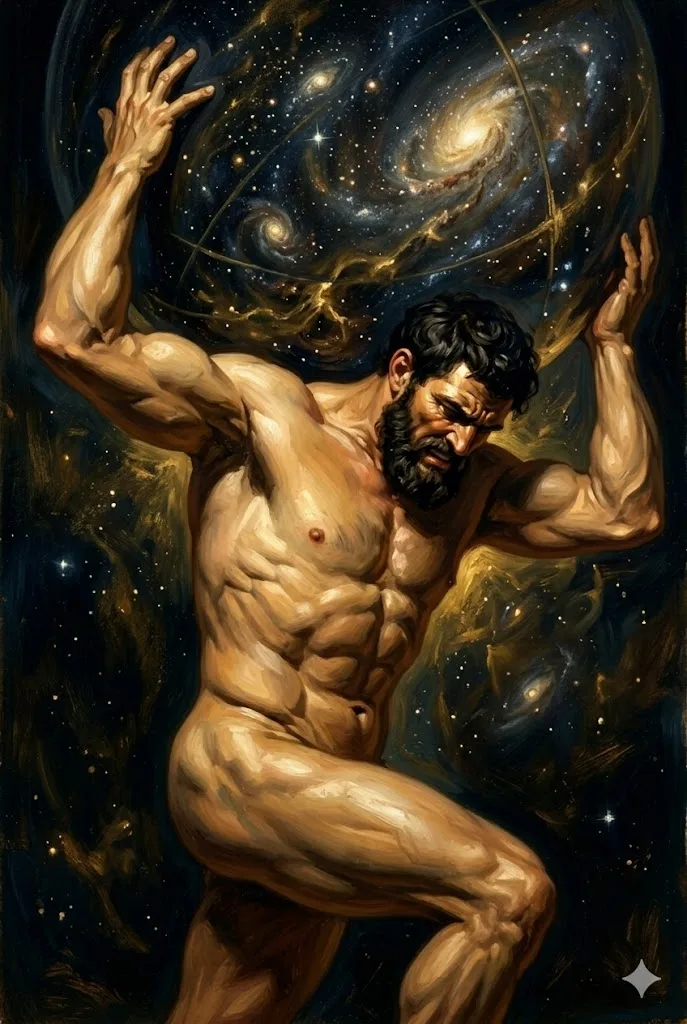
I. Who Was Atlas?
Atlas was a second-generation Titan — son of Iapetus and brother of Prometheus, Epimetheus, and Menoetius. After the Titanomachy, when the Olympian gods defeated the Titans, Zeus singled Atlas out for a special punishment: he was condemned to stand at the western edge of the world (later identified with the Atlas Mountains of North Africa) and hold the celestial spheres upon his shoulders for all eternity. It was Atlas who kept the sky from crashing down upon the earth — a burden no other being, mortal or immortal, could bear.
Despite his punishment, Atlas appeared in several important myths. When Heracles came seeking the Golden Apples of the Hesperides (Atlas's own daughters), he offered to hold the sky temporarily while Atlas fetched the apples. Atlas, delighted to be free of his burden, retrieved the apples but then refused to take the sky back. Heracles outwitted him by asking Atlas to hold the heavens "just for a moment" while he adjusted a pad on his shoulders — then walked away with the apples.
In another tradition, Perseus turned Atlas to stone by showing him the head of Medusa, transforming the Titan into the Atlas Mountains. Atlas was also the father of the Pleiades (the seven sisters who became a star cluster), the Hyades, and the Hesperides (guardians of the golden apples). Our word "atlas" — meaning a book of maps — derives from his name, after a 16th-century collection of maps depicted him holding not the sky but a globe of the earth.
Classical Sources
The mythology of Atlas is preserved in:
- 📜 Hesiod, Theogony (c. 700 BC) — The primary source for Titan mythology, genealogy, and the Titanomachy.
- 📜 Apollodorus, Bibliotheca (c. 1st–2nd century AD) — Comprehensive handbook of Titan genealogies and myths.
- 📜 Aeschylus, Prometheus Bound (c. 5th century BC) — Dramatic portrayal of Titan defiance against Olympian authority.
- 📜 Ovid, Metamorphoses (8 AD) — Roman accounts of Titan mythology and transformations.
Cross-referenced with multiple classical sources for accuracy.
Atlas in the Earliest Poets
The oldest descriptions of Atlas differ in instructive ways. In Hesiod's Theogony, Atlas stands at the limits of the earth, in front of the clear-voiced Hesperides, holding up the wide sky with his head and tireless arms "under strong necessity," a lot assigned him by Zeus. Hesiod does not explain exactly what crime earned it; he simply groups Atlas with his brothers, all of whom pay for some kind of overreach. Homer's Odyssey (book 1) gives a stranger picture: Atlas is "of baneful mind," knows the depths of every sea, and himself keeps the tall pillars that hold earth and sky apart. Homer's Atlas is not crushed under the heavens but acts as the guardian of a cosmic structure.
Aeschylus's Prometheus Bound brings the brothers together: the chained Prometheus grieves for Atlas, who stands in the western regions bearing on his shoulders the pillar of heaven and earth, "a load not easy to hold." The idea that Atlas led the Titans in battle, and was punished more harshly for that reason, is found in later handbooks such as Hyginus rather than in Hesiod.
His mother also varies. Hesiod names the Oceanid Clymene as wife of Iapetus; Apollodorus calls her Asia. The Greeks themselves connected the name Atlas with a root meaning "to endure" or "to bear," which suits the image of the eternal bearer.
The Daughters of Atlas
Atlas fathered several important groups of nymphs, and through them he sits at the root of many famous family trees.
- The Pleiades, born to the Oceanid Pleione: Maia, Electra, Taygete, Alcyone, Celaeno, Sterope and Merope. Maia bore Hermes to Zeus in a cave on Mount Cyllene; Electra bore Dardanus, ancestor of the kings of Troy; Taygete was mother of Lacedaemon, eponym of Sparta. Merope married the mortal Sisyphus, and later writers said she was the faint star of the cluster because she was ashamed of her husband.
- The Hyades, who wept so bitterly for their brother Hyas, killed while hunting, that they became the rain-bringing star cluster in the head of Taurus (see constellation myths).
- Calypso, who in the Odyssey is explicitly "daughter of Atlas" and holds Odysseus on her island for seven years.
- The Hesperides, in some versions. Hesiod actually makes them daughters of Night; their descent from Atlas is a later tradition, encouraged by the fact that their garden lay next to where he stood.
Heracles, Perseus and a Chronological Problem
The trick with the golden apples appears in Apollodorus, who cites the early mythographer Pherecydes: Prometheus, freed by Heracles, advised him not to go for the apples himself but to send Atlas. Other versions have Heracles kill the serpent Ladon and pick the apples personally. One of the finest surviving images of the episode is a metope from the Temple of Zeus at Olympia, carved around 460 BC: Atlas holds out the apples while Heracles strains under the sky, with Athena quietly helping by supporting the load with one hand. The story counted among the twelve labours.
The Perseus episode comes mainly from Ovid's Metamorphoses book 4. Perseus, flying home with Medusa's head, asks Atlas for a night's shelter. Atlas, remembering an oracle of Themis that a son of Zeus would one day rob his tree of its golden fruit, drives him away. Perseus shows him the Gorgon's face, and Atlas grows into a mountain: his beard and hair become forests, his shoulders ridges, his bones rock, and the sky with all its stars comes to rest on him. Ancient readers noticed the problem: Perseus was Heracles' great-grandfather, so if Atlas became a mountain in Perseus's time he could hardly have fetched apples for Heracles later. Mythographers never resolved it; the two stories belong to different traditions.
Later Greek historians rationalised Atlas into a man. Diodorus of Sicily describes him as a king in northwest Africa who was a skilled astronomer and the first to teach people about the sphere of the heavens, which is why he was said to carry the sky.
Atlas in Art and Common Misunderstandings
The most famous statue of Atlas, the Farnese Atlas in the National Archaeological Museum in Naples, is a Roman marble showing the kneeling Titan carrying a celestial globe carved with constellations. That globe is the sky, not the earth. The popular image of Atlas holding up the planet Earth is a modern confusion, encouraged by atlases and corporate logos. When Gerardus Mercator used the name for his collection of maps in 1595, he explained that he was honouring a legendary King Atlas of Mauretania, a learned philosopher-astronomer of the kind Diodorus describes. The Atlantic Ocean, the "sea of Atlas" in Herodotus, and the Atlas Mountains also carry his name.
Ancient sources
- Hesiod, Theogony — Atlas as son of Iapetus and Clymene, standing at the ends of the earth near the Hesperides and holding up the sky by Zeus's decree.
- Homer, Odyssey book 1 — Atlas, father of Calypso, who knows the depths of the sea and keeps the pillars that separate earth and sky.
- Aeschylus, Prometheus Bound — Prometheus laments his brother bearing the pillar of heaven in the west.
- Apollodorus, Library 2.5.11 — the Heracles episode, with Prometheus's advice and Atlas's attempt to keep Heracles under the sky.
- Ovid, Metamorphoses book 4 — Atlas refuses hospitality to Perseus and is turned into a mountain.
- Diodorus of Sicily, Library of History book 3 — a rationalising account of Atlas as an astronomer-king in Africa.
Frequently asked questions
Did Atlas hold up the Earth or the sky?
The sky. Every ancient source describes him supporting the heavens or the pillars between heaven and earth. The globe in later art, as on the Farnese Atlas, represents the celestial sphere.
Why was Atlas punished?
Hesiod only says it was his lot from Zeus. Later writers explain that he fought for the Titans, sometimes as their leader, in the war against the Olympians.
Is Atlas a Titan or a god?
He is a second-generation Titan, son of the Titan Iapetus. He was not worshipped as a major god, though he was honoured as a figure in genealogy and astronomy.
Who are the children of Atlas?
The Pleiades, the Hyades, Hyas, Calypso and, in later tradition, the Hesperides. Through Maia he was grandfather of Hermes, and through Electra an ancestor of the Trojan royal house.
Explore More Mythology
Get weekly deep dives into the gods, heroes, and myths of ancient Greece.