I. The Cause of the War
The Trojan War — the greatest conflict in Greek mythology — was sparked by a golden apple and a beauty contest among goddesses. At the wedding of Peleus and Thetis (parents of Achilles), the goddess of strife Eris threw a golden apple inscribed "To the Fairest" among the guests. Three goddesses claimed it: Hera, Athena, and Aphrodite. Zeus appointed the Trojan prince Paris as judge.
Each goddess offered a bribe: Hera promised power over all Asia, Athena offered wisdom and victory in war, and Aphrodite promised the most beautiful woman in the world — Helen of Sparta, wife of King Menelaus. Paris chose Aphrodite, traveled to Sparta, and spirited Helen away to Troy. Menelaus called upon the oath that all of Helen's former suitors had sworn — to defend the marriage of whoever won her hand — and a thousand ships sailed for Troy.
II. The War
The siege of Troy lasted ten years. The Greek army, led by Agamemnon, included the greatest heroes of the age: Achilles, Odysseus, Ajax, Diomedes, and Patroclus. The Trojans, led by King Priam and his sons Hector and Paris, were aided by allies from across Asia Minor. The gods themselves took sides: Athena, Hera, and Poseidon supported the Greeks; Apollo, Aphrodite, and Ares supported the Trojans.
Homer's Iliad covers only a few weeks in the war's final year, focusing on the wrath of Achilles and the death of Hector. But the wider tradition encompasses countless episodes: the sacrifice of Iphigenia, the duel between Paris and Menelaus, the death of Patroclus, the fall of Ajax, and the intervention of the gods at every turn.
III. The Fall of Troy
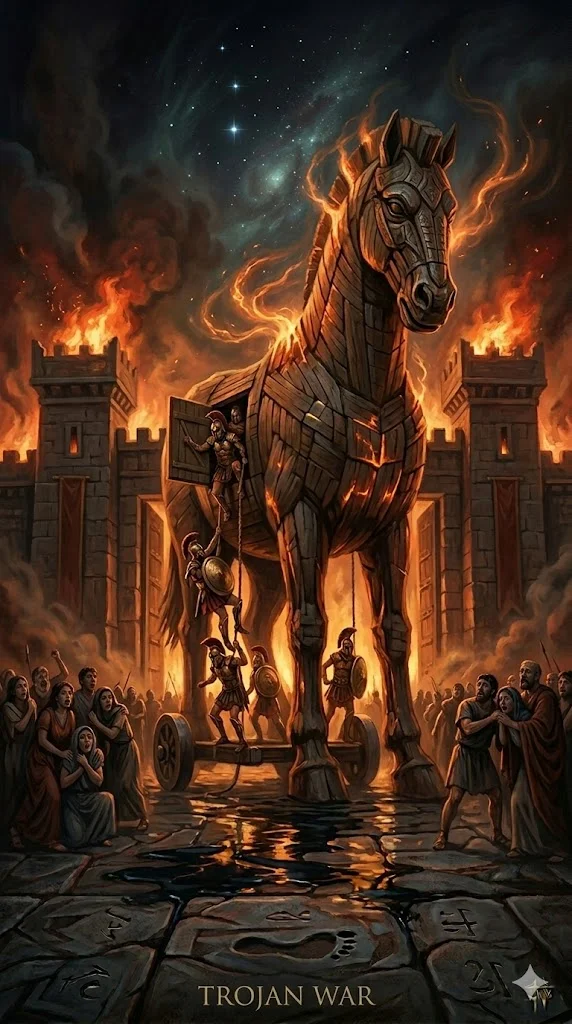
The war ended not through force but through the cunning of Odysseus. He devised the Trojan Horse — an enormous wooden horse in which a select group of Greek warriors hid while the rest of the army pretended to sail away. The Trojans, believing the horse was a sacred offering, dragged it inside their walls. That night, the Greeks emerged, opened the gates for their returning army, and sacked the city. Troy was burned to the ground, its men killed, its women and children enslaved. The aftermath scattered the Greek heroes across the Mediterranean on their journeys home — none more famously than Odysseus, whose ten-year return voyage became the subject of Homer's Odyssey.
Classical Sources
This myth is recorded in multiple ancient sources:
- 📜 Homer, Iliad & Odyssey (c. 750 BC)
- 📜 Hesiod, Theogony & Works and Days (c. 700 BC)
- 📜 Apollodorus, Bibliotheca (c. 1st–2nd century AD)
- 📜 Ovid, Metamorphoses (8 AD)
- 📜 Greek Tragedians — Aeschylus, Sophocles, Euripides (5th century BC)
Cross-referenced with multiple classical sources for accuracy.
The war Homer leaves out: the Epic Cycle
The Iliad and Odyssey were only two parts of a larger body of early epic called the Epic Cycle. The other poems are lost except for fragments, but a later summary attributed to Proclus preserves their plots. The Cypria told the events from the judgement of Paris to the war's ninth year. The Aethiopis picked up where the Iliad ends, the Little Iliad covered the contest for Achilles' armour and the wooden horse, the Iliou Persis (Sack of Ilion) described the night Troy fell, and the Nostoi (Returns) followed the Greek leaders home. Most of the episodes people "know" about the Trojan War come from these poems and from Athenian tragedy, not from Homer.
Before the siege: the false start and the delays
Many Greek leaders were unwilling to go. Odysseus pretended to be mad, yoking an ox and an ass to his plough and sowing salt, until Palamedes put the infant Telemachus in front of the blade and Odysseus swerved. Thetis hid the young Achilles on Skyros, dressed as a girl among the daughters of King Lycomedes. Odysseus exposed him by laying out gifts that included weapons, then sounding a war trumpet. Achilles reached for the spear.
The first expedition never reached Troy at all. In the Cypria the Greeks landed in Mysia by mistake and attacked it, and Achilles wounded its king Telephus. A storm scattered the fleet, and the army only reassembled at Aulis years later. There Artemis held back the winds until Agamemnon sacrificed his daughter Iphigenia. On the voyage the archer Philoctetes was bitten by a snake. His wound smelled so bad that the Greeks left him on Lemnos, a decision they would later have to undo. Protesilaus was the first man to jump ashore at Troy and the first to die, fulfilling a prophecy.
After the Iliad: how Troy actually fell
Hector's funeral ends the Iliad, but the war went on. New allies came to help Troy: the Amazon queen Penthesilea, whom Achilles killed and was said to have mourned, and the Ethiopian king Memnon, son of Eos, whom Achilles also killed. Then Achilles himself was shot by Paris, with Apollo guiding the arrow. The story that he could only be wounded in the heel is post-Homeric. Its fullest early telling is in the Roman poet Statius.
The Greeks then learned through prophecy (mostly from the captured Trojan seer Helenus) that certain conditions had to be met before the city could fall:
- the bow of Heracles had to be brought, so Odysseus and Diomedes (or Neoptolemus, in Sophocles' Philoctetes) went back to Lemnos for Philoctetes, who then shot Paris;
- Achilles' son Neoptolemus had to join the fight;
- the Palladium, an ancient image of Athena that protected the city, had to be stolen from the citadel, a night raid by Odysseus and Diomedes.
In between came the judgement of Achilles' arms. When the armour went to Odysseus and not Ajax, Ajax went mad and killed himself.
Even the wooden horse needed help to work. The Greek Sinon let himself be captured and told the Trojans a false story that the horse was an offering to Athena. The priest Laocoön warned against it (in Virgil he throws a spear into its side), and he and his sons were killed by sea serpents, which the Trojans took as a sign. Cassandra warned them as well, and no one believed her.
The sack and its crimes
The sack of Troy was remembered as a series of atrocities that the gods punished. Neoptolemus killed Priam at the altar of Zeus Herkeios, the god who protected the household. Hector's young son Astyanax was thrown from the walls. Priam's daughter Polyxena was sacrificed at Achilles' tomb. The Locrian Ajax dragged Cassandra from the statue of Athena where she had taken refuge, and the goddess's anger at this was one reason so many Greeks were wrecked or delayed on the way home. Hecuba was given to Odysseus as a slave. Aeneas escaped carrying his father Anchises, the story Virgil developed in the Aeneid.
One ancient line of tradition denied that Helen was ever at Troy. The poet Stesichorus is said to have been blinded for slandering her and to have recovered his sight after writing a "Palinode" (recantation) in which only a phantom went to Troy. Herodotus reports a version told to him by Egyptian priests, in which Helen sat out the war in Egypt and the Trojans could not hand her over because they did not have her. Euripides staged this version in his Helen.
Was the Trojan War real?
The site at Hisarlık in northwest Turkey, excavated by Heinrich Schliemann from 1870 and by later teams, is generally accepted as Troy. Of its many layers, Troy VI and VIIa (roughly the 13th and early 12th centuries BC) are the usual candidates for a Homeric city, and VIIa shows signs of destruction. Hittite texts name a place called Wilusa, widely identified with (W)ilios, and a power called Ahhiyawa that many scholars connect with Homer's Achaeans. None of this proves a ten-year war over a queen. What it suggests is that the legend grew around a real, wealthy city that Bronze Age powers fought over. More on the site is on the Troy page.
Ancient sources
- Homer, Iliad covers some fifty days in the tenth year, from Achilles' quarrel with Agamemnon to Hector's funeral.
- Homer, Odyssey 4, 8 and 11: the wooden horse is told here, by Menelaus, by the bard Demodocus, and by Odysseus to the shade of Achilles. It is not told in the Iliad.
- Proclus' summaries of the Epic Cycle: the plots of the Cypria, Aethiopis, Little Iliad, Iliou Persis and Nostoi.
- Virgil, Aeneid 2: the fullest ancient account of the fall of Troy, with Sinon, Laocoön and Priam's death, told by Aeneas.
- Euripides, Trojan Women and Helen: the fate of the captive Trojan women, and the alternative tradition that Helen was in Egypt.
- Quintus of Smyrna, Posthomerica: a later Greek epic covering everything from Penthesilea to the sack.
Frequently asked questions
Is the Trojan Horse in the Iliad?
No. The Iliad ends before Troy falls. The horse appears in the Odyssey and was told in full in the lost Little Iliad and Iliou Persis. The best-known version is in Virgil's Aeneid Book 2. For the poem's own plot, see the Iliad summary.
How long did the Trojan War last?
In the tradition the siege lasted ten years, with Troy falling in the tenth. Counting the false start in Mysia and the gathering at Aulis, some ancient chronologies put nearly twenty years between Helen's departure and the sack.
Who won the Trojan War?
The Greeks (Achaeans) sacked Troy. But the homecomings were disastrous: Agamemnon was murdered on his return, Odysseus wandered for ten years and many others were shipwrecked. Greek poets often present the victory as nearly as ruinous as defeat.
Who killed Achilles?
Paris, with Apollo's help, shot him with an arrow at the Scaean Gates. Hector foretells this as he dies in Iliad 22.
Explore More Mythology
Get weekly deep dives into the gods, heroes, and myths of ancient Greece.