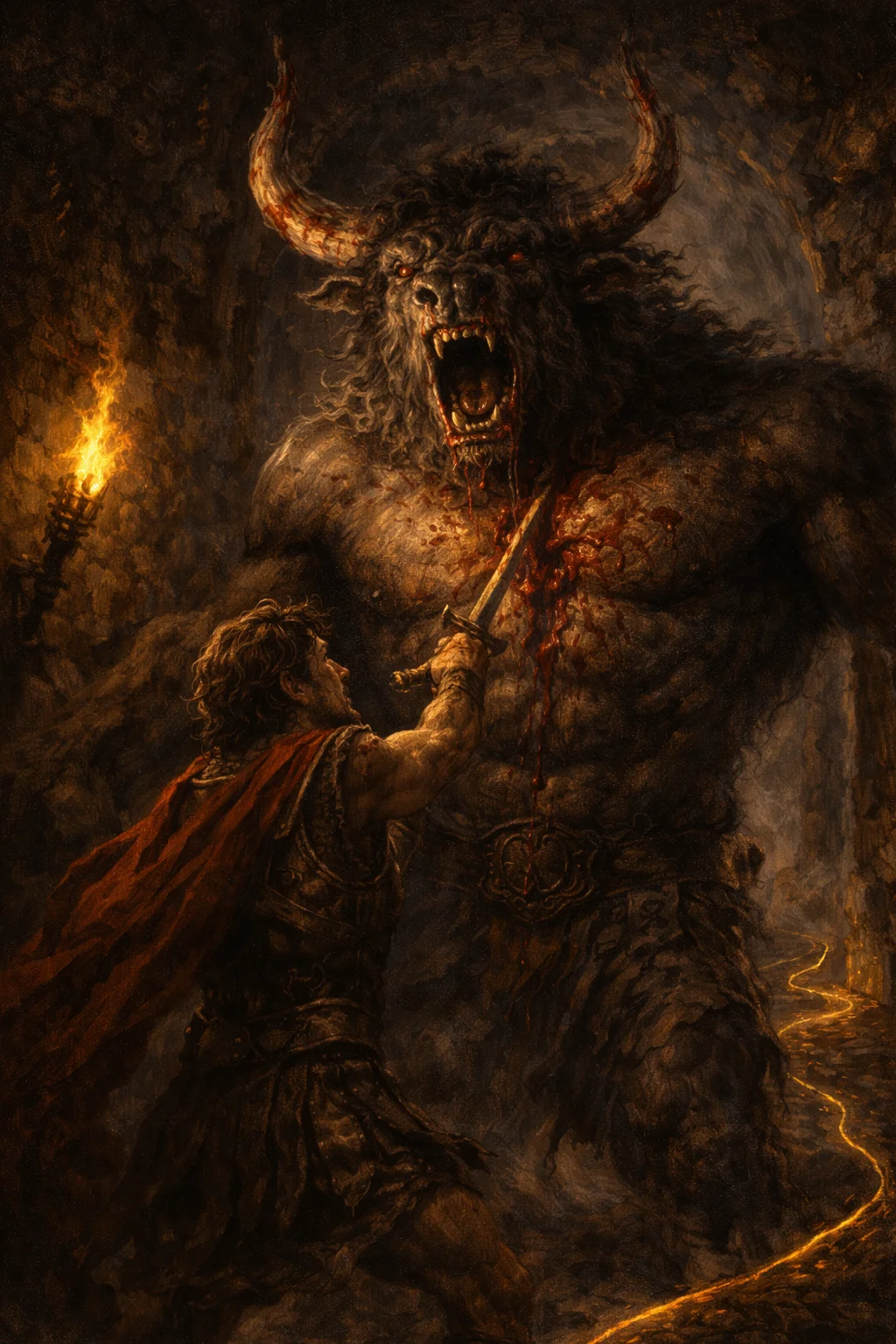
The Tribute
Every nine years, the city of Athens was forced to send seven young men and seven young women to the island of Crete as a blood tribute to King Minos. These fourteen youths were fed to the Minotaur — a monstrous creature with the body of a man and the head of a bull — who was imprisoned in the Labyrinth, an impossibly complex maze beneath the palace of Knossos designed by the master craftsman Daedalus. No one who entered the Labyrinth had ever found their way out.
The tribute had been imposed after Minos's son was killed in Athens, and the Athenians had been unable to resist the military power of the Minoan navy. When the time came for the third tribute, the Athenian prince Theseus — son of King Aegeus (or, in some versions, Poseidon himself) — volunteered to go to Crete as one of the fourteen, vowing to slay the Minotaur and end the slaughter forever.
Ariadne's Thread
Upon arriving in Crete, Theseus caught the eye of Ariadne, the daughter of King Minos. She fell in love with the handsome Athenian prince and could not bear the thought of him dying in the Labyrinth. Secretly, she approached Daedalus and asked how one might survive the maze. The craftsman's answer was elegant in its simplicity: a ball of thread.
Ariadne gave Theseus a sword and a ball of thread, instructing him to tie one end at the entrance and unravel it as he ventured deeper into the Labyrinth. After killing the Minotaur, he could follow the thread back to the entrance. It was a solution so simple that it has become a universal metaphor for finding one's way through any complex problem — 'Ariadne's thread.'
The Kill
Theseus entered the Labyrinth in darkness, feeling his way along cold stone walls, the thread playing out behind him. Deep in the maze, he heard the beast — the heavy breathing, the scrape of hooves on stone. The Minotaur charged from the shadows, half-man and half-bull, bellowing with rage. The battle was savage and close-fought in the narrow corridors, but Theseus was the greatest warrior of his generation. He grappled the monster, wrestled it to the ground, and killed it — with the sword Ariadne had given him, or in some versions with his bare fists.
Escape and Tragedy
Following the thread back to the entrance, Theseus emerged victorious. He freed the other Athenian captives, and together with Ariadne, they fled Crete by ship before Minos could respond. But the journey home was marked by a cruelty that haunts the myth. Theseus abandoned Ariadne on the island of Naxos while she slept — whether by divine command, forgetfulness, or callousness depends on the version.
Then came the final tragedy. Theseus had promised his father Aegeus that if he survived, he would change his ship's sails from black to white as a signal of victory. In the chaos of departure, he forgot. When Aegeus saw the black sails approaching Athens, he believed his son was dead. Consumed by grief, the old king threw himself from the cliffs into the sea — which was named the Aegean Sea in his memory. Theseus returned home a hero and a king, but at a cost that would shadow the rest of his reign.
Classical Sources
This myth is recorded in multiple ancient sources:
- 📜 Homer, Iliad & Odyssey (c. 750 BC)
- 📜 Hesiod, Theogony & Works and Days (c. 700 BC)
- 📜 Apollodorus, Bibliotheca (c. 1st–2nd century AD)
- 📜 Ovid, Metamorphoses (8 AD)
- 📜 Greek Tragedians — Aeschylus, Sophocles, Euripides (5th century BC)
Cross-referenced with multiple classical sources for accuracy.
Explore More
Theseus · Minotaur · Daedalus · Poseidon · Home
Before the Labyrinth: the bull, the queen and Androgeos
The Minotaur came about through a broken promise. Minos prayed to Poseidon for a sign that he should be king of Crete and vowed to sacrifice whatever the god sent. A magnificent bull came up out of the sea. Minos kept it for himself and sacrificed a lesser animal. As punishment, Poseidon made Minos's wife Pasiphaë fall in love with the bull. Daedalus built her a hollow wooden cow so that she could mate with it, and their child was the bull-headed boy whose proper name, according to Apollodorus and Pausanias, was Asterion. Daedalus was then told to build the Labyrinth to hide him.
Accounts of how Minos's son Androgeos died differ. Apollodorus reports that Aegeus sent him to fight the Marathonian bull, which killed him, or that jealous rivals ambushed him after he won at the Panathenaic games. Minos besieged Athens, and the city was struck by plague and famine until an oracle told the Athenians to give Minos whatever he demanded. The sources disagree about how often the tribute was paid. Some say every year, while Plutarch and Diodorus say every nine years.
The voyage to Crete and the ring of Minos
One of the most beautiful versions comes in a poem by Bacchylides from the fifth century BCE. On the voyage, Minos lays hands on one of the Athenian girls, and Theseus challenges him, claiming that he is a son of Poseidon just as Minos is a son of Zeus. Zeus sends lightning to confirm Minos's parentage. Minos then throws a gold ring into the sea and dares Theseus to prove his own by fetching it. Dolphins carry Theseus down to Poseidon's palace, where Amphitrite wraps him in a purple robe and gives him a wreath. He comes back up dry beside the ship, to the young Athenians' joy. A famous red-figure cup by the painter Onesimos, now in the Louvre, shows Theseus under the sea meeting Amphitrite with Athena standing by.
What became of Ariadne
The abandonment on Naxos is only one part of Ariadne's story, and ancient writers ended it in very different ways:
- Homer's version is the darkest. In the Odyssey, Theseus was taking her to Athens, but Artemis killed her on the island of Dia because of something Dionysus told her.
- The best-known version has Dionysus find her asleep on Naxos and marry her. Hesiod already calls her his wife, and her wedding crown was set in the sky as the constellation Corona Borealis.
- Plutarch collected several more. In one, Ariadne hanged herself after being abandoned. In another, the Cypriot version, she died in childbirth on Cyprus and was honoured there in a cult.
The two great Latin treatments of her lament are Catullus's Poem 64, which describes her on the shore watching Theseus's sails disappear, and Ovid's Heroides 10, written as a letter from Ariadne to Theseus.
The rituals Athens remembered it by
The myth was woven into Athenian religion. Plutarch says that on the way home Theseus stopped on Delos and danced with the freed young people a "crane dance" whose winding steps imitated the turns of the Labyrinth. The Athenians said they kept the very ship he sailed in, replacing its timbers one by one, until the time of Demetrius of Phalerum around 300 BCE. That is the origin of the philosophers' puzzle known as the Ship of Theseus. Every year a sacred embassy sailed to Delos to fulfil a vow made to Apollo before the voyage, and no executions were allowed in Athens until the ship came back. Plato's Phaedo explains that this is why Socrates' execution was delayed for about a month. Later rationalisers were less romantic. Plutarch quotes the historian Philochorus, who claimed the Cretans said the Labyrinth was simply a prison and that the "Minotaur" was a cruel general called Taurus whom Theseus beat in games held in Minos's honour.
Ancient sources
- Plutarch, Life of Theseus 15–23: the tribute, rival versions of Ariadne's fate, the crane dance on Delos, Philochorus's "general Taurus", and the preserved ship.
- Bacchylides, Ode 17: Theseus's quarrel with Minos on the voyage and his dive to the palace of Poseidon and Amphitrite.
- Apollodorus, Library 3.1.3–4 and 3.15.7–8; Epitome 1.7–10: Pasiphaë and the bull, the death of Androgeos, the tribute, and Theseus's victory with Ariadne's thread.
- Homer, Odyssey 11.321–325: Ariadne killed by Artemis on Dia because of Dionysus's testimony.
- Catullus, Poem 64: Ariadne's lament on the shore of Naxos and the arrival of Dionysus.
- Plato, Phaedo 58a–c: the annual sacred voyage to Delos commemorating Theseus's return, which delayed Socrates' execution.
Frequently asked questions
What was the Minotaur's real name?
Asterion, or Asterius, which means "starry". It was also the name of an earlier king of Crete who married Europa and raised Minos.
Was the Labyrinth real?
No maze matching the myth has been found. Some scholars connect the word with the labrys, the double axe common in Minoan religious imagery, and suggest the sprawling palace at Knossos inspired the legend. That link is still debated. See Crete for more.
Why did Theseus leave Ariadne on Naxos?
The ancient sources offer different reasons. In some, Dionysus claimed her or appeared in a dream to order Theseus to leave. In others Theseus simply deserted her, or loved another woman. Catullus and Ovid present it as a betrayal.
Who was Theseus's father, Aegeus or Poseidon?
Both, in a sense. Aethra slept with Aegeus and with Poseidon on the same night, so Theseus could claim either. He uses Poseidon's parentage in Bacchylides' poem. More on his life is on the Theseus page.
Books to read next
Links go to Bookshop.org, which supports independent bookstores. We earn a small commission if you buy, at no extra cost to you.