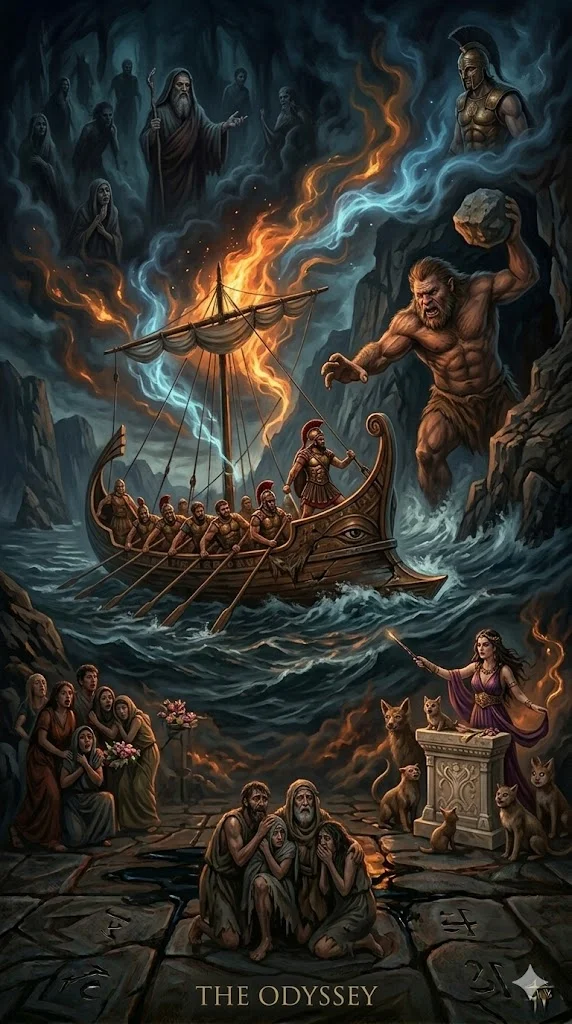
The Greatest Adventure Ever Told
The Odyssey, attributed to the poet Homer, is the story of Odysseus's harrowing ten-year journey home to Ithaca after the fall of Troy. While the Iliad is a tale of war, the Odyssey is a tale of survival, cunning, and the unbreakable human desire to return home. It is perhaps the most influential adventure story ever written — the template for every hero's journey that followed, from Virgil's Aeneid to Star Wars.
After fighting for ten years at Troy, Odysseus — the cleverest of the Greek heroes — set sail with his fleet of twelve ships and his loyal crew. But the gods had other plans. Poseidon, enraged by Odysseus's blinding of his son the Cyclops Polyphemus, cursed the hero to wander the seas for a decade before reaching home. What followed was an odyssey through the most dangerous and wondrous places in the mythological world.
The Cyclops
One of Odysseus's first encounters was with Polyphemus, a one-eyed giant Cyclops and son of Poseidon. Trapped in the monster's cave with his men, Odysseus watched in horror as Polyphemus devoured several of his companions. Using his legendary cunning, Odysseus got the Cyclops drunk on wine, told him his name was 'Nobody,' and then drove a sharpened stake into his single eye while he slept. When Polyphemus screamed for help, his fellow Cyclopes asked who was hurting him — and when he cried 'Nobody!', they went away. Odysseus escaped by clinging to the belly of a ram. But his fatal mistake was shouting his real name as he sailed away, allowing Polyphemus to pray to his father Poseidon for vengeance.
Circe and the Underworld
On the island of Aeaea, Odysseus encountered Circe, a powerful sorceress who turned his men into pigs with her enchanted food. Protected by the herb moly, given to him by Hermes, Odysseus resisted her magic and won her respect. He remained on her island for a year as her lover before Circe directed him to the Underworld to seek guidance from the prophet Tiresias. In the land of the dead, Odysseus spoke with the shades of his mother, Achilles, Agamemnon, and Ajax — learning bitter truths about the cost of war and the fragility of glory.
The Sirens, Scylla, and Charybdis
Odysseus navigated past the Sirens — creatures whose irresistible singing lured sailors to their deaths on the rocks. He ordered his men to plug their ears with wax while he himself was tied to the mast, allowing him to hear the Sirens' song without being destroyed by it. He then faced the impossible choice between Scylla, a six-headed monster who would devour six of his men, and Charybdis, a massive whirlpool that could swallow his entire ship. Choosing the lesser evil, he sailed past Scylla and lost six companions — a devastating but calculated sacrifice.
Return to Ithaca
After twenty years away — ten at war, ten wandering — Odysseus finally returned to Ithaca. But his palace had been overrun by suitors competing for his wife Penelope's hand, assuming Odysseus was dead. Disguised as a beggar by Athena, Odysseus entered his own home unrecognized. Only his ancient dog Argos — who had waited twenty years for his master — recognized him, wagging his tail one last time before dying.
Penelope, who had faithfully resisted the suitors for years, devised a contest: whoever could string Odysseus's great bow and shoot an arrow through twelve axe heads would win her hand. None of the suitors could even bend the bow. Then the disguised beggar stepped forward, strung the bow effortlessly, and shot the arrow true. In the bloodbath that followed, Odysseus and his son Telemachus slaughtered every last suitor, reclaiming his home, his wife, and his kingdom. The greatest journey in literature had reached its end.
Classical Sources
This myth is recorded in multiple ancient sources:
- 📜 Homer, Iliad & Odyssey (c. 750 BC)
- 📜 Hesiod, Theogony & Works and Days (c. 700 BC)
- 📜 Apollodorus, Bibliotheca (c. 1st–2nd century AD)
- 📜 Ovid, Metamorphoses (8 AD)
- 📜 Greek Tragedians — Aeschylus, Sophocles, Euripides (5th century BC)
Cross-referenced with multiple classical sources for accuracy.
Join the Pantheon
Weekly mythology stories & deep dives delivered to your inbox.