The Cleverest King
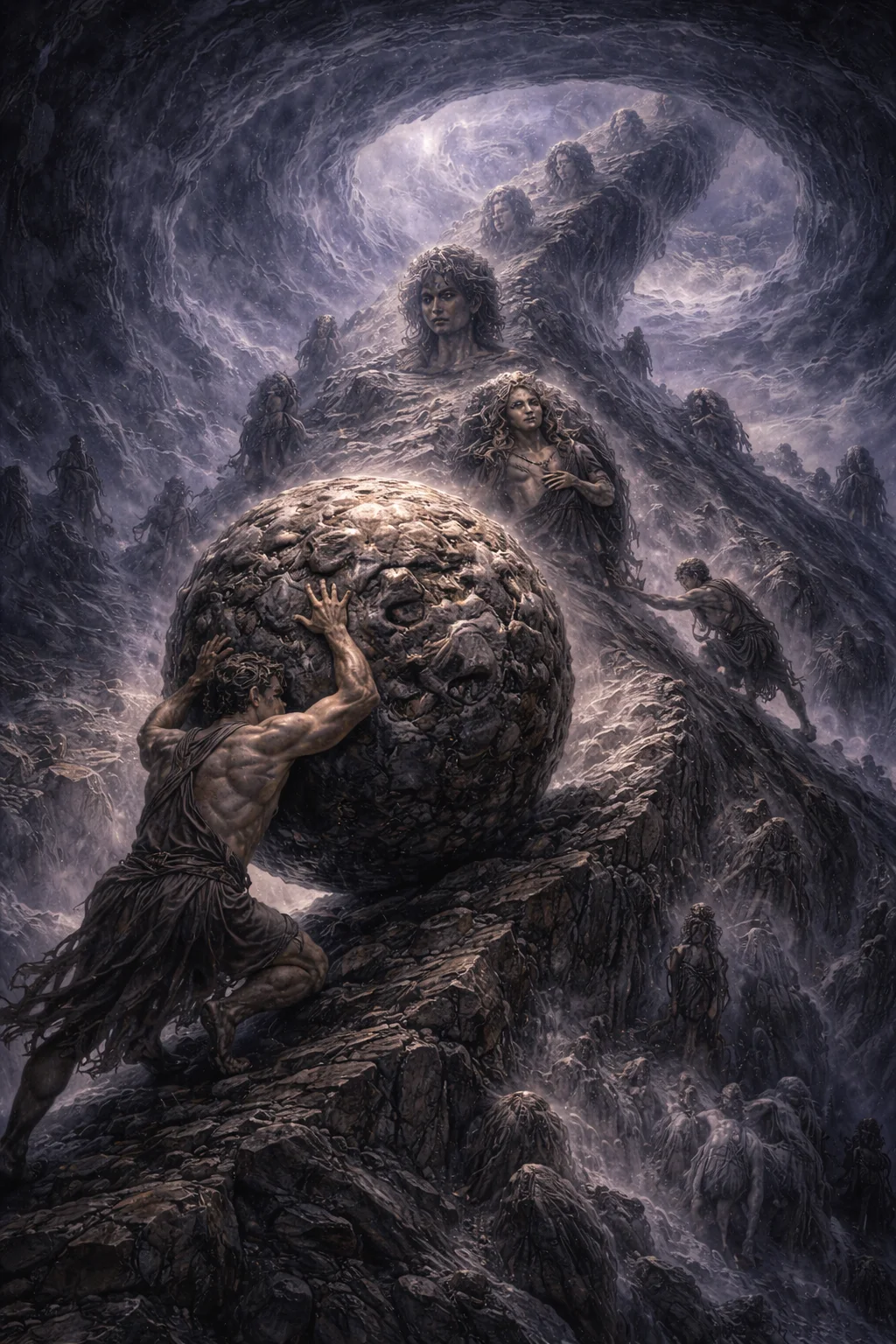
Sisyphus was the founder and king of Corinth and the most cunning mortal who ever lived. His intelligence rivalled that of Odysseus, but where Odysseus used his wits to survive and return home, Sisyphus used his to defy the gods themselves. He cheated death not once but twice, an achievement no other mortal in Greek mythology can claim.
Cheating Death
The first time, when Zeus sent Thanatos (Death) to claim Sisyphus for revealing divine secrets, Sisyphus somehow tricked Thanatos into demonstrating his own chains and then locked Death himself in bonds. While Thanatos was imprisoned, no mortal on earth could die. Warriors fought battles and survived lethal wounds. The old and sick lingered in agony. Ares, furious that his wars produced no casualties, freed Thanatos, and Sisyphus was taken to the Underworld.
But Sisyphus had prepared for this. Before dying, he instructed his wife to throw his body into the public square without proper burial rites. In the Underworld, he complained to Persephone that his wife had disrespected him and begged to be allowed to return briefly to punish her. Persephone agreed. Once back among the living, Sisyphus simply refused to return and lived to old age before the gods finally dragged him back.
The Punishment
Zeus devised a punishment that matched the crime. Sisyphus was condemned to push an enormous boulder up a steep hill in Tartarus. Every time he neared the summit, the boulder would roll back down to the bottom, and he would have to start again. Forever. The punishment was not physical pain but the complete futility of endless, meaningless repetition, a torment perfectly designed for a man whose entire identity was built on his ability to outsmart every obstacle.
Camus and the Absurd
In 1942, the French philosopher Albert Camus published The Myth of Sisyphus, one of the most important philosophical essays of the 20th century. Camus used Sisyphus as a metaphor for the human condition: life is inherently meaningless, yet we must continue living it. His famous conclusion, 'One must imagine Sisyphus happy,' argues that the struggle itself is enough to fill a human heart. By choosing to push the boulder despite knowing it will always roll back, Sisyphus becomes a symbol of defiance against an absurd universe. The ancient Greeks would probably have appreciated the irony that the most punished mortal in their mythology became, 2,400 years later, a hero of existentialist philosophy.
Classical Sources
- 📜 Homer, Iliad & Odyssey (c. 750 BC)
- 📜 Hesiod, Theogony (c. 700 BC)
- 📜 Apollodorus, Bibliotheca (c. 1st-2nd century AD)
- 📜 Ovid, Metamorphoses (8 AD)
Cross-referenced with multiple classical sources for accuracy.
Explore More
Corinth · Zeus · Thanatos · Underworld · Home