The Cleverest King
Sisyphus was the founder and king of Corinth and the most cunning mortal who ever lived. His intelligence rivalled that of Odysseus, but where Odysseus used his wits to survive and return home, Sisyphus used his to defy the gods themselves. He cheated death not once but twice, an achievement no other mortal in Greek mythology can claim.
Cheating Death
The first time, when Zeus sent Thanatos (Death) to claim Sisyphus for revealing divine secrets, Sisyphus somehow tricked Thanatos into demonstrating his own chains and then locked Death himself in bonds. While Thanatos was imprisoned, no mortal on earth could die. Warriors fought battles and survived lethal wounds. The old and sick lingered in agony. Ares, furious that his wars produced no casualties, freed Thanatos, and Sisyphus was taken to the Underworld.
But Sisyphus had prepared for this. Before dying, he instructed his wife to throw his body into the public square without proper burial rites. In the Underworld, he complained to Persephone that his wife had disrespected him and begged to be allowed to return briefly to punish her. Persephone agreed. Once back among the living, Sisyphus simply refused to return and lived to old age before the gods finally dragged him back.
The Punishment
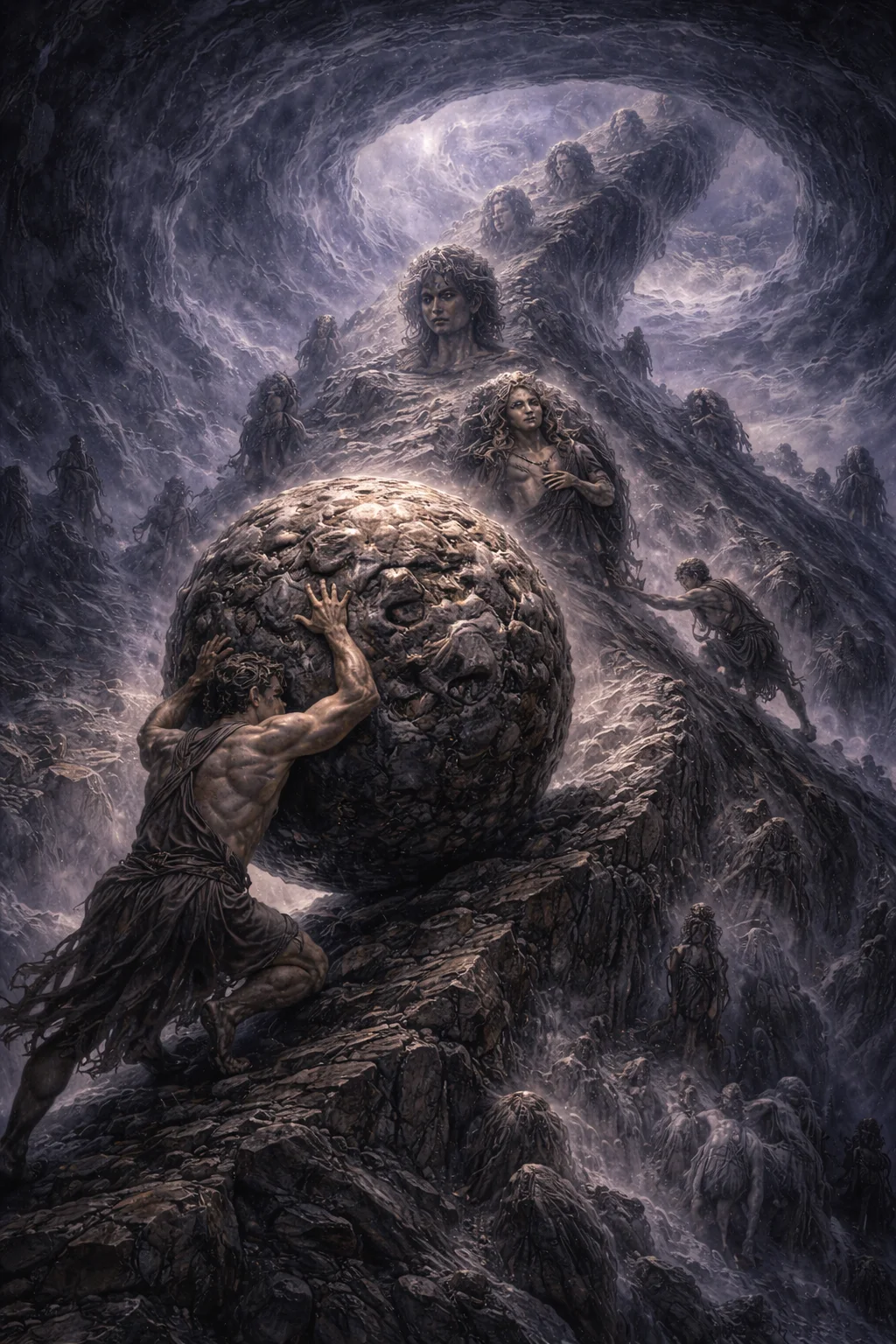
Zeus devised a punishment that matched the crime. Sisyphus was condemned to push an enormous boulder up a steep hill in Tartarus. Every time he neared the summit, the boulder would roll back down to the bottom, and he would have to start again. Forever. The punishment was not physical pain but the complete futility of endless, meaningless repetition, a torment perfectly designed for a man whose entire identity was built on his ability to outsmart every obstacle.
Camus and the Absurd
In 1942, the French philosopher Albert Camus published The Myth of Sisyphus, one of the most important philosophical essays of the 20th century. Camus used Sisyphus as a metaphor for the human condition: life is inherently meaningless, yet we must continue living it. His famous conclusion, 'One must imagine Sisyphus happy,' argues that the struggle itself is enough to fill a human heart. By choosing to push the boulder despite knowing it will always roll back, Sisyphus becomes a symbol of defiance against an absurd universe. The ancient Greeks would probably have appreciated the irony that the most punished mortal in their mythology became, 2,400 years later, a hero of existentialist philosophy.
Classical Sources
- 📜 Homer, Iliad & Odyssey (c. 750 BC)
- 📜 Hesiod, Theogony (c. 700 BC)
- 📜 Apollodorus, Bibliotheca (c. 1st-2nd century AD)
- 📜 Ovid, Metamorphoses (8 AD)
Cross-referenced with multiple classical sources for accuracy.
Explore More
Corinth · Zeus · Thanatos · Underworld · Home
Family and the founding of Corinth
Sisyphus belonged to one of the great heroic families. He was a son of Aeolus, the ancestor of the Aeolian Greeks, and his brothers included Salmoneus, who was struck by Zeus for imitating thunder, Athamas, the father of Phrixus and Helle, and Cretheus, the grandfather of Jason. In the Iliad, Glaucus of Lycia traces his line back to "Sisyphus son of Aeolus, the craftiest of men," who lived in Ephyra, the old name for Corinth. Sisyphus's son Glaucus was the father of Bellerophon, the tamer of Pegasus, so the cleverest man in myth was grandfather to one of its most celebrated monster-slayers.
His wife was Merope, one of the seven Pleiades, the daughters of Atlas. A tradition reported by Ovid in the Fasti and by other writers explains that her star in the cluster shines faintest because she alone married a mortal and hid her face in shame. Corinth honoured Sisyphus as a founder. Pausanias says he established the Isthmian Games in honour of the drowned boy Melicertes, whose body a dolphin had carried to the Isthmus, and that the location of Sisyphus's own grave there was known to only a few Corinthians.
The crimes: why the gods wanted him
Ancient writers give different reasons for his punishment. The best known involves Aegina, daughter of the river-god Asopus, whom Zeus abducted. Sisyphus saw the kidnapping and told her father where she had been taken, in exchange for a spring of fresh water on the dry citadel of Acrocorinth. Pausanias saw that spring, called Peirene, behind the temple of Aphrodite on the summit. Apollodorus says that this betrayal of Zeus's secret is why Sisyphus is rolling a stone in Hades. Other writers accuse him of banditry and of killing travellers, or simply describe him as a man who mocked the gods.
His rivalry with the master thief Autolycus was a favourite story. Autolycus, a son of Hermes, could change the colour and markings of stolen cattle, so Sisyphus, noticing his herds getting smaller, carved letters or marks under the hooves of his animals. When he tracked the prints to Autolycus's land, he proved the theft. One version adds that while he was there, Sisyphus seduced Autolycus's daughter Anticleia shortly before she married Laertes. That made it possible for tragedians to call Odysseus the son of Sisyphus, an insult used against him in Sophocles's Ajax and Philoctetes and in Euripides.
How the death-cheating story developed
Homer gives the boulder but not the trickery. In Odyssey 11, Odysseus sees Sisyphus straining to push a huge stone up a hill with his hands and feet; just as he is about to get it over the top, its weight turns it back, and the "shameless stone" rolls down to the plain. Sweat pours from his limbs and dust rises from his head. Homer says nothing about Tartarus specifically; Sisyphus is among the great sinners whom Odysseus sees in the realm of the dead with Tantalus and Tityos.
The chaining of Thanatos is attributed by ancient commentators on Homer to the early mythographer Pherecydes, and the escape from Hades by persuading Persephone appears as early as the lyric poets Alcaeus and Theognis, both of whom use it to show that even Sisyphus, for all his cleverness, eventually died. Aeschylus wrote a Sisyphus play, now lost, and a striking fragment from another Sisyphus, attributed to either Critias or Euripides, has the character argue that a clever man invented the gods to frighten people into behaving well. Sisyphus became a natural mouthpiece for religious scepticism.
In art and in modern misreadings
Athenian black-figure vases often show Sisyphus bent beneath his rock on a slope, sometimes with Persephone and Hades looking on or with other underworld sinners nearby. The great fifth-century painter Polygnotus painted him in his famous underworld scene at Delphi, which Pausanias describes. Titian's Sisyphus (1548–49), now in the Prado, shows him carrying the boulder on his shoulders as part of a series of the damned painted for Mary of Hungary.
Two common assumptions need correcting. First, the futility is not simply that the task is endless. In Homer the stone always gets near the top, and the cruelty lies in the near-success, which suits a man who always found a way out. Second, Sisyphus was not merely a symbol to the Greeks. He was a real cult figure at Corinth, honoured as a founder and as the originator of the Isthmian Games. More examples of underworld justice are gathered on the punishments page, and his life as a hero is covered on the Sisyphus hero page.
Ancient sources
- Homer, Odyssey 11.593–600 — Odysseus sees Sisyphus pushing the boulder uphill, only for it to roll back as it nears the top.
- Homer, Iliad 6.152–155 — Sisyphus son of Aeolus, "craftiest of men", ruling at Ephyra as grandfather of Bellerophon.
- Theognis 702–712 — Sisyphus's return from Hades after persuading Persephone with clever words.
- Apollodorus, Library 1.9.3 and 3.12.6 — the sons of Aeolus, and Sisyphus's punishment for revealing Aegina's abduction to Asopus.
- Pausanias, Description of Greece 2.1.3, 2.2.2 and 2.5.1 — the Isthmian Games founded for Melicertes, the secret grave of Sisyphus and the spring on Acrocorinth given by Asopus.
- Sophocles, Philoctetes — Odysseus called a son of Sisyphus, the slur based on the Anticleia story.
Frequently asked questions
Why was Sisyphus punished?
Sources differ. The most common reason is that he revealed to the river-god Asopus that Zeus had carried off his daughter Aegina. Others stress his deception of death and of Persephone, or general violence against travellers.
Where is Sisyphus punished?
Homer places him in the realm of the dead without naming Tartarus. Later writers and modern retellings usually put him in Tartarus, the deepest region of the underworld reserved for those who offended the gods.
Was Sisyphus the father of Odysseus?
Not in Homer, where Odysseus is the son of Laertes. The idea that Sisyphus seduced Anticleia comes from later tradition and is used by tragedians as an insult to Odysseus's honesty.
What does "Sisyphean" mean?
It describes a task that is endless and futile, from the image of the boulder that always rolls back before the summit.
Books to read next
Links go to Bookshop.org, which supports independent bookstores. We earn a small commission if you buy, at no extra cost to you.