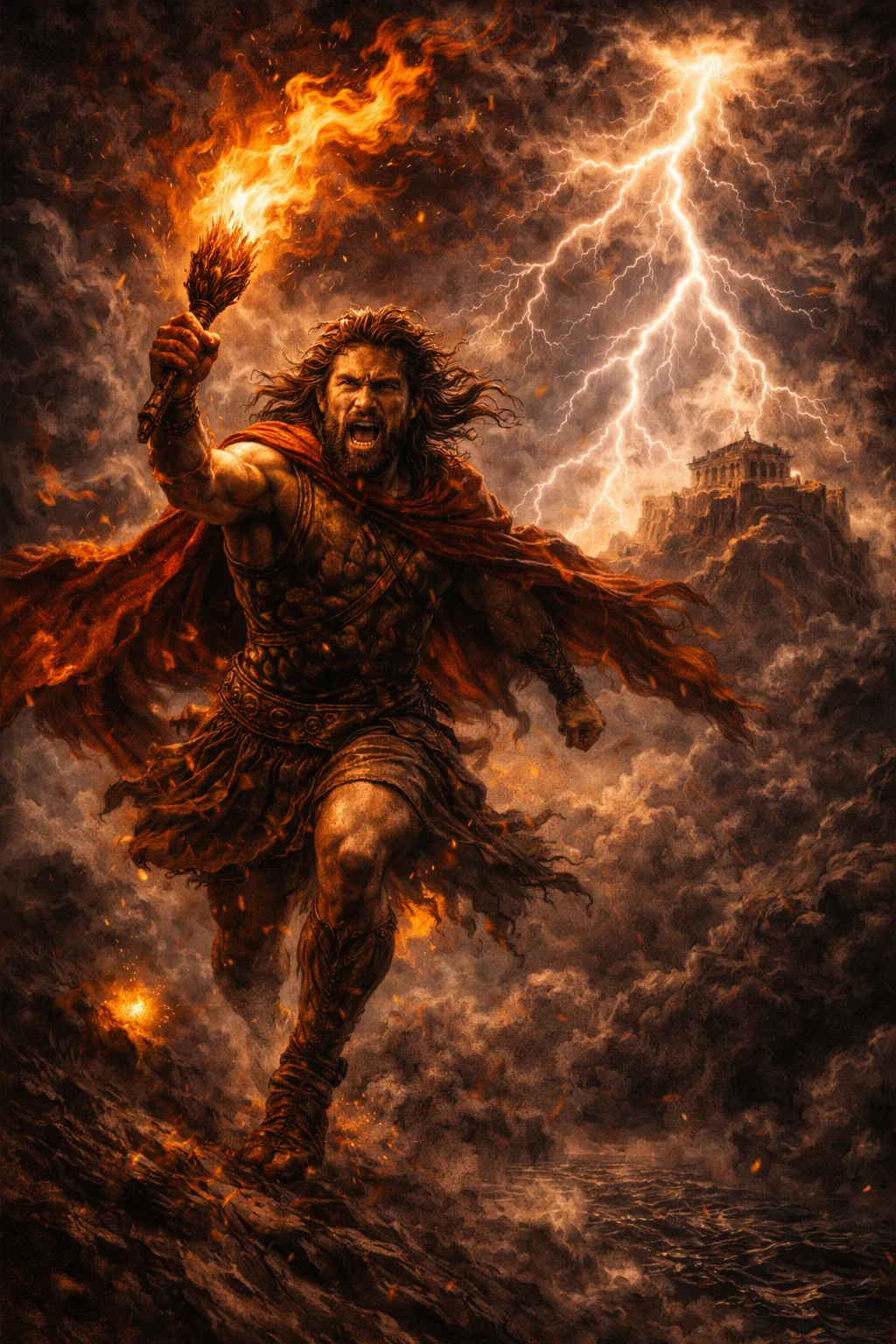
The Great Theft
Of all the myths in the Greek tradition, none has resonated more deeply across the centuries than the story of Prometheus, the Titan who stole fire from the gods and gave it to humanity. This single act of rebellion — born from compassion for mortals and defiance of divine authority — transformed the human condition forever and earned Prometheus an eternity of unimaginable suffering. It is a story about knowledge, power, sacrifice, and the terrible price of progress.
Before Prometheus's intervention, mortals lived in darkness and ignorance, barely distinguishable from animals. They ate raw food, cowered in caves, and had no art, no craft, and no technology. They were playthings of the gods — creatures made from clay who existed at the whim of higher powers. Prometheus, whose name means 'Forethought,' saw their misery and resolved to change their fate.
Why Prometheus Acted
Prometheus had a special bond with humanity. In some traditions, he was their creator — the Titan who shaped the first humans from clay and water, modelling them in the image of the gods. Whether or not he made them, Prometheus loved mortals in a way that no other god did. He saw their potential — their capacity for thought, creativity, and wonder — and believed they deserved more than the wretched existence the Olympians had allotted them.
Zeus, however, had little affection for mortals. After a dispute with Prometheus over sacrificial offerings — in which the crafty Titan tricked Zeus into choosing the worst portion of a sacrificed ox — Zeus punished humanity by withholding fire. Without fire, humans could not cook, forge metal, see in the darkness, or warm themselves against the cold. Zeus intended to keep mortals weak and dependent.
The Theft
Defying the king of the gods, Prometheus ascended to Mount Olympus — or, in some versions, to the forge of Hephaestus, or to the chariot of Helios the Sun — and stole a spark of divine fire. He concealed the ember inside a hollow fennel stalk and carried it down to earth, where he presented it to humanity. In an instant, the world changed. Mortals could now cook their food, light their homes, smelt metals, fire pottery, and begin the long march toward civilization.
Fire was more than a practical tool — it was a symbol of divine knowledge and creative power. With fire came technology, art, medicine, mathematics, navigation, and ultimately philosophy. Prometheus had not merely given humanity warmth; he had given them the spark of civilization itself.
Zeus's Punishment
Zeus was furious. He devised two punishments — one for Prometheus and one for the mortals who had received his gift. For humanity, Zeus ordered Hephaestus to create Pandora, the first woman, who was given a jar (often mistranslated as a 'box') containing all the evils and sorrows of the world. When Pandora opened the jar, disease, suffering, old age, and death escaped into the world — the price humanity would pay for the fire Prometheus had stolen on their behalf.
For Prometheus himself, the punishment was far more personal and brutal. Zeus had the Titan chained to a rock in the Caucasus Mountains, where each day a great eagle descended and devoured his liver. Each night, because Prometheus was immortal, his liver regenerated — only to be torn out again the following day. This cycle of agony was intended to continue for all eternity. Yet Prometheus endured, unbroken and unrepentant, knowing that his suffering had purchased humanity's freedom.
Liberation
Prometheus's torment eventually ended when the hero Heracles, during his famous labours, came upon the bound Titan and shot the eagle with his bow. With Zeus's reluctant permission — for Prometheus possessed knowledge of a prophecy that Zeus needed — Heracles broke the chains and freed the Titan. In exchange, Prometheus revealed the secret: that if Zeus married the sea nymph Thetis, her son would be greater than his father and could overthrow him. Zeus avoided the marriage, and the prophecy was ultimately fulfilled through Thetis's mortal husband Peleus, whose son Achilles became the greatest warrior of the Trojan War.
Why This Myth Matters
The myth of Prometheus has been retold, reinterpreted, and reimagined more than perhaps any other Greek myth. It speaks to the fundamental human experience of striving for knowledge at great cost. Mary Shelley subtitled her novel Frankenstein 'The Modern Prometheus,' drawing a direct line between the ancient Titan's creation of humanity and Dr. Frankenstein's creation of life. The myth raises questions that remain urgently relevant: What is the cost of progress? Should knowledge be withheld to prevent suffering? Is defiance of authority justified when it serves the greater good?
Classical Sources
This myth is recorded in multiple ancient sources:
- 📜 Homer, Iliad & Odyssey (c. 750 BC)
- 📜 Hesiod, Theogony & Works and Days (c. 700 BC)
- 📜 Apollodorus, Bibliotheca (c. 1st–2nd century AD)
- 📜 Ovid, Metamorphoses (8 AD)
- 📜 Greek Tragedians — Aeschylus, Sophocles, Euripides (5th century BC)
Cross-referenced with multiple classical sources for accuracy.
Explore More
Prometheus · Zeus · Heracles · Pandora · Home
The trick at Mecone: where the quarrel really began
Hesiod is the earliest author to tell the story in full, and in his Theogony the theft of fire is the second round of a contest, not the first. At Mecone (often identified with Sicyon), gods and mortals met to settle how sacrifice would be divided. Prometheus butchered an ox and made two portions: the meat and rich innards wrapped in the ox's unappetising stomach, and the bare bones wrapped in glistening fat. Zeus chose the fat-covered bones. Hesiod adds a pointed detail that later retellings drop: Zeus saw through the deception and chose the bones anyway, already planning evil for mortals. The myth explained a real ritual puzzle, why Greeks burned thigh-bones and fat for the gods on the altar while the worshippers ate the meat.
Zeus's response was to "hide" fire. Prometheus stole it back in a hollow stalk of giant fennel (narthex), a plant whose dry pith smoulders slowly and could carry an ember. In Works and Days Hesiod pairs this with the creation of Pandora, built by Hephaestus and dressed by Athena, whose jar released sorrows while Elpis (Hope, or Expectation) stayed inside. Hesiod's Prometheus is clever but ultimately the loser: the poem's moral is that no one outwits Zeus.
Aeschylus and Plato: two very different Prometheuses
The defiant, almost saintly Titan of modern imagination owes most to Prometheus Bound, the tragedy transmitted under Aeschylus's name (its authorship is debated by scholars). It opens with Kratos and Bia (Power and Force) dragging Prometheus to a remote crag in Scythia while a reluctant Hephaestus pins him there. Prometheus claims far more than fire: he says he gave humans numbers, writing, the yoking of animals, ships, medicine, divination and mining, and that he stopped mortals foreseeing their deaths by planting "blind hopes" in them. Visitors include Oceanus, the chorus of Oceanids and the wandering Io, to whom Prometheus foretells that a descendant of hers, Heracles, will free him. The play ends with Hermes threatening, and Zeus delivering, a thunderbolt that hurls the Titan into the abyss. It belonged to a connected group of plays; a Prometheus Unbound survives only in fragments, and in it the liver-eating eagle and the release by Heracles appear.
Plato offers a third version in the Protagoras. There the Titan's brother Epimetheus ("Afterthought") hands out fur, claws, speed and wings to the animals and has nothing left for humans. Prometheus, to make up the shortfall, steals fire together with technical skill from the workshop shared by Hephaestus and Athena. Even so, humans cannot live together in cities until Zeus sends Hermes with aidos (shame, respect) and dike (justice). Plato's point is that craft alone does not make a civilisation.
Release, the ring and the cost to Chiron
Hesiod already says Heracles killed the eagle, and that Zeus allowed it so his son's glory would grow. Later mythographers add terms. Apollodorus says that an immortal had to give up immortality in Prometheus's place, and that Chiron, suffering from an incurable wound from one of Heracles's poisoned arrows, agreed to die. Some Roman writers (Hyginus among them) say Prometheus then wore a ring made from his iron fetters set with a piece of the rock, so that in a sense he remained bound, and they offer this as the origin of wearing rings. The prophecy he traded concerned Thetis. In Pindar's eighth Isthmian Ode it is Themis who reveals the danger; the attribution to Prometheus is the version of the Aeschylean plays.
Cult, art and common mistakes
Prometheus had a real cult in Athens. Pausanias describes his altar in the Academy, the starting point of a torch race in which runners tried to reach the city with the flame still alight. The Prometheia festival included such a race, and craftsmen, especially potters in the Kerameikos, honoured him alongside Hephaestus and Athena. In art, a well-known Laconian cup of the mid-sixth century BC (now in the Vatican Museums) shows the eagle at Prometheus's body beside his brother Atlas holding up the sky. Rubens's Prometheus Bound (Philadelphia Museum of Art), with the eagle painted by Frans Snyders, is the most famous later image.
Several details often presented as fixed are not. The Caucasus is not in Hesiod, who names no place, and the Aeschylean play sets the punishment in Scythia. Prometheus as the maker of humans out of clay is a later tradition (it appears in Apollodorus and Pausanias, who saw clay-coloured stones at Panopeus said to be left over); Hesiod never says it. And the eagle eats the liver, not the heart. The liver was a seat of the passions and the organ diviners read, which may be why it was chosen.
Ancient sources
- Hesiod, Theogony 507–616 — the sons of Iapetus, the trick at Mecone, the fennel-stalk theft, the eagle, Heracles's rescue and the first woman.
- Hesiod, Works and Days 42–105 — fire hidden and stolen, Pandora's creation by the gods, and the jar with Hope left inside.
- Aeschylus (attributed), Prometheus Bound — the binding by Kratos, Bia and Hephaestus, Prometheus's list of gifts to humanity, Io's visit and the prophecy hanging over Zeus.
- Plato, Protagoras 320c–322d — Epimetheus's misallocation of abilities, the theft of fire and craft from Hephaestus and Athena, and Zeus's gift of shame and justice.
- Apollodorus, Library 1.7.1, 2.5.4 and 2.5.11 — Prometheus shaping humans from water and earth, the eagle, and Chiron's surrender of immortality.
- Pausanias, Description of Greece 1.30.2 and 10.4.4 — the altar and torch race in the Academy at Athens, and the clay stones at Panopeus linked to the making of humans.
Frequently asked questions
Why did Zeus punish Prometheus by eating his liver?
No ancient author explains the choice of organ, but the liver regenerates, which suits endless punishment, and Greeks regarded it as a seat of strong emotion and used animal livers for divination. In Hesiod the bird simply eats the immortal liver, which grows back each night as much as it lost by day.
How long was Prometheus chained?
Sources disagree. Hesiod gives no number. The Aeschylean tradition, as reported by later writers such as Hyginus, spoke of thirty thousand years, while the usual mythographic chronology has Heracles free him a generation or so before the Trojan War.
Did Prometheus create humans?
Only in later sources. Hesiod and the Aeschylean play make him humanity's benefactor, not its maker. The clay-modelling story appears in writers of the Hellenistic and Roman periods, including Apollodorus and Ovid's hint that the son of Iapetus mixed earth with water.
Who were Prometheus's family?
He was a son of the Titan Iapetus and the Oceanid Clymene in Hesiod (Aeschylus makes his mother Themis). His brothers were Atlas, Menoetius and Epimetheus, and his son Deucalion survived the great flood with Pyrrha, daughter of Epimetheus and Pandora. More on the Titan himself is on the Prometheus page.