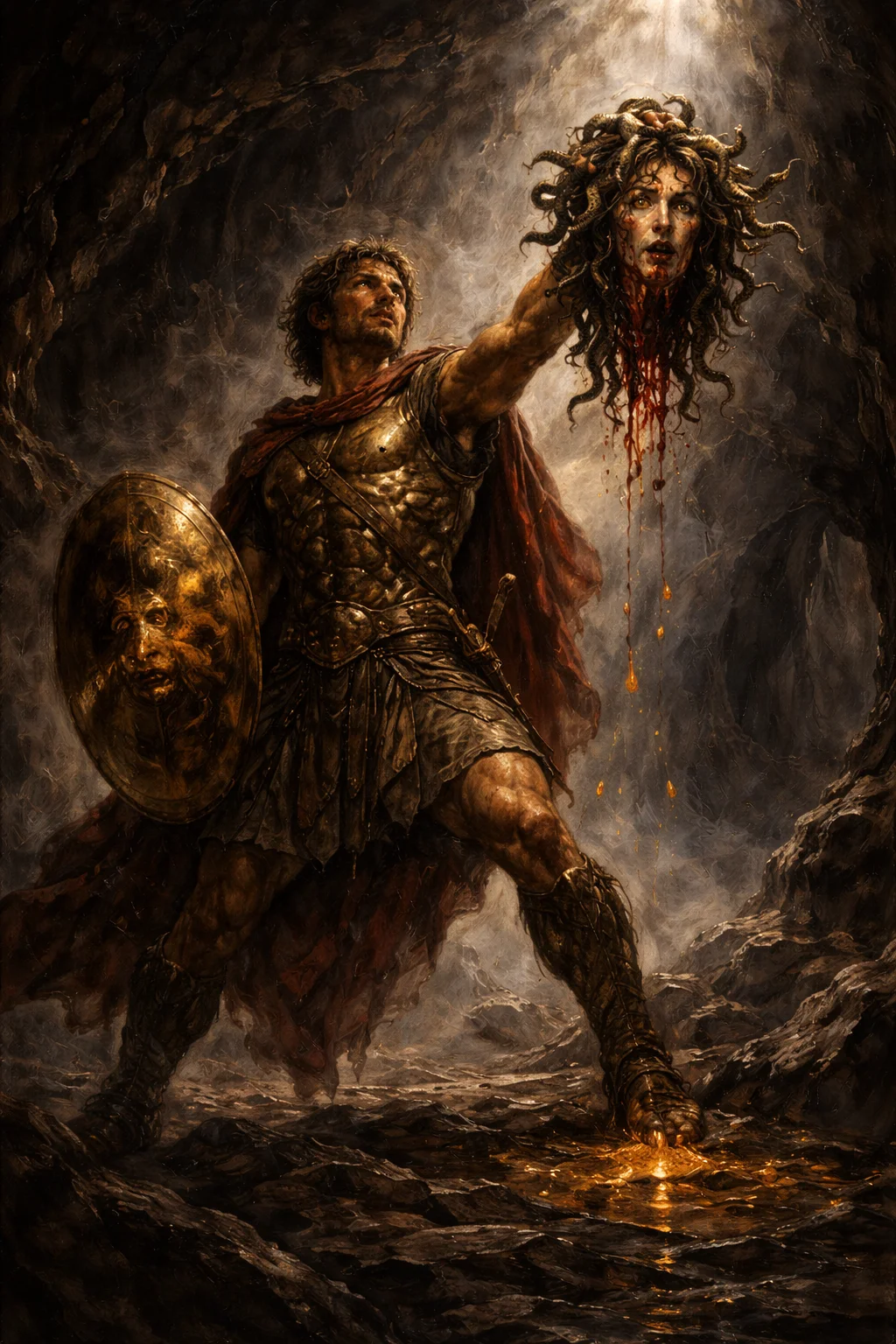
The Impossible Task
Perseus was the son of Zeus and the mortal princess Danaë. His grandfather, King Acrisius of Argos, had been told by an oracle that his grandson would one day kill him, so he set Danaë and the infant Perseus adrift at sea in a wooden chest. They washed ashore on the island of Seriphos, where they were taken in by a fisherman. Perseus grew into a brave and noble young man.
The king of Seriphos, Polydectes, desired Danaë and wanted Perseus out of the way. He tricked the young hero into promising to bring him the head of Medusa — one of the three Gorgon sisters. Medusa was a monster so horrifying that anyone who looked directly at her face was instantly turned to stone. Her hair was a writhing mass of living snakes, and her eyes burned with a petrifying gaze. No warrior had ever faced her and survived.
Divine Aid
The gods themselves intervened to help Perseus. Athena, who despised Medusa, gave him a polished bronze shield as bright as a mirror. Hermes gave him a pair of winged sandals for flight, the cap of Hades that granted invisibility, and a special pouch called a kibisis that could safely contain Medusa's severed head without the bearer being petrified. Armed with these divine gifts and a sickle of adamantine, Perseus set out on his quest.
The Beheading
Perseus flew to the edge of the world where the Gorgons dwelled. He found Medusa sleeping among her two immortal sisters. Using the mirrored surface of Athena's shield to watch Medusa's reflection — never looking at her directly — Perseus descended silently from above. With a single stroke of the adamantine sickle, he severed Medusa's head. From her neck sprang two beings: Pegasus, the winged horse, and Chrysaor, a giant wielding a golden sword — children conceived through Poseidon's earlier union with Medusa.
Perseus stuffed the still-living head into the kibisis and fled on his winged sandals as the two immortal Gorgons awoke and pursued him. Protected by the cap of invisibility, he escaped their fury and soared across the sky toward home.
The Return
On his journey home, Perseus used Medusa's head as a weapon of devastating power. When the Titan Atlas refused him hospitality, Perseus revealed the head and transformed the giant into the Atlas Mountains. When he found the princess Andromeda chained to a rock as a sacrifice to a sea monster, he slew the beast and claimed her as his bride. And when he finally returned to Seriphos, he found Polydectes threatening his mother. Perseus walked into the king's hall, drew out the Gorgon's head, and turned Polydectes and his court to stone.
The prophecy about his grandfather came true as well — at a discus-throwing contest years later, Perseus's throw was caught by a gust of wind and struck Acrisius, killing him. Thus the cycle of fate that began with an oracle's warning ended exactly as foretold, proving once again that in Greek mythology, no mortal — however heroic — can escape destiny.
Classical Sources
This myth is recorded in multiple ancient sources:
- 📜 Homer, Iliad & Odyssey (c. 750 BC)
- 📜 Hesiod, Theogony & Works and Days (c. 700 BC)
- 📜 Apollodorus, Bibliotheca (c. 1st–2nd century AD)
- 📜 Ovid, Metamorphoses (8 AD)
- 📜 Greek Tragedians — Aeschylus, Sophocles, Euripides (5th century BC)
Cross-referenced with multiple classical sources for accuracy.
Explore More
Perseus · Medusa · Pegasus · Athena · Home
Parts of the story that usually get left out
The early chapters are stranger than the summary suggests. Acrisius did not merely fear a grandson; he shut his daughter Danaë in an underground bronze chamber so that she would never bear one, and Zeus reached her as a shower of gold through the roof. When the chest with mother and child came ashore on Seriphos, it was caught in the net of Dictys, the fisherman who took them in, and he was the brother of King Polydectes. That relationship matters at the end, when Perseus makes Dictys king.
The quest itself began with a social trap. According to Apollodorus, Polydectes held a feast at which each guest was to bring a gift, supposedly to help him court Hippodamia. He asked for horses; Perseus, who had none, rashly said he would bring the Gorgon's head. Polydectes demanded the horses from everyone else but held Perseus to his boast.
Perseus could not simply fly to the Gorgons, because he did not know where they lived. First he went to the Graeae, the grey-haired sisters of the Gorgons who shared a single eye and a single tooth. Hesiod names two, Pemphredo and Enyo; later writers add Deino. Perseus snatched the eye as they passed it between them and refused to return it until they showed him the way. In Apollodorus they lead him to certain nymphs, and it is these nymphs, not Hermes, who give him the winged sandals, the kibisis and the cap of Hades. Hermes supplies the adamantine sickle (harpe), and Athena guides his hand as he strikes. Different authors assign the gifts differently, and the version where Hermes provides everything is a later simplification.
After the beheading
Ovid is the main source for the journey home, and he adds several "origin" stories. As Perseus flew over Libya, drops of blood fell from the head and became the venomous snakes of the desert. When he set the head down on a bed of seaweed after rescuing Andromeda, the plants hardened, and that, Ovid says, is how coral was born. His petrification of Atlas, who refused him hospitality because of a prophecy that a son of Zeus would steal his golden apples, creates a famous chronological problem: in the Heracles myths, which are set a few generations later, Atlas is still alive and holding up the sky.
Andromeda was the daughter of King Cepheus and Queen Cassiopeia of Ethiopia. Cassiopeia had boasted that she was more beautiful than the Nereids, and Poseidon sent a flood and a sea monster (ketos) until the princess was offered to it. Perseus killed the monster, but her uncle Phineus, to whom she had been promised, burst into the wedding feast with an armed band. Ovid describes a long, bloody battle that ends when Perseus raises the head and turns some two hundred of them to stone. All the main characters were later placed among the stars as the constellations Perseus, Andromeda, Cepheus, Cassiopeia and Cetus (see constellation myths).
Perseus then gave the head to Athena, who set it on her aegis, and returned the sandals, bag and cap through Hermes to the nymphs. The death of Acrisius happened at funeral games in Larissa in Thessaly, where his grandfather had fled to avoid him. Ashamed to inherit Argos from the man he had killed, Perseus exchanged kingdoms with his cousin Megapenthes and took Tiryns. Pausanias reports the tradition that he founded Mycenae, naming it either after the cap (mykes) of his scabbard that fell there or after a mushroom (also mykes) from which he drank water. Through his son Electryon, Perseus was the great-grandfather of Heracles. His full biography is at Perseus.
Medusa and the Gorgons in art
Hesiod makes the Gorgons daughters of the sea deities Phorcys and Ceto, and Medusa the only mortal one. Archaic artists often showed her not as a beautiful woman but as a grinning, tusked, tongue-lolling face, the gorgoneion, painted on shields, temple roofs and drinking cups to ward off evil. The early sixth-century pediment of the Temple of Artemis on Corfu shows a huge running Gorgon flanked by Pegasus and Chrysaor, and a metope from Temple C at Selinus in Sicily shows Perseus beheading her while Athena stands by. The idea of a beautiful, tragic Medusa becomes common only in the classical period and later; see Medusa, the Gorgons and Medusa: victim or villain?
In the Renaissance, Benvenuto Cellini's bronze Perseus with the Head of Medusa, completed in 1554, became a political emblem of the Medici in Florence's Loggia dei Lanzi. Edward Burne-Jones painted a whole Perseus cycle in the 1870s and 1880s. Pindar adds a musical footnote: Athena invented the art of playing the aulos to imitate the shrill lament of the surviving Gorgons for their sister. And Pegasus, born from Medusa's neck, would later carry Bellerophon against the Chimera.
Ancient sources
- Hesiod, Theogony 270–286 — the Graeae and Gorgons as children of Phorcys and Ceto, Medusa's mortality, and the birth of Pegasus and Chrysaor when Perseus beheads her.
- Apollodorus, Library 2.4.1–5 — the most complete summary: Danaë, Polydectes' feast, the Graeae, the nymphs' gifts, Andromeda, and Acrisius' death at Larissa.
- Ovid, Metamorphoses 4.604–5.249 — Atlas, the Libyan snakes, coral, Andromeda and the battle with Phineus, with Medusa's backstory told at the wedding feast.
- Pindar, Pythian Ode 12 — Perseus' revenge on Polydectes and Athena's invention of the aulos from the Gorgons' wailing.
- Simonides, fragment on Danaë — a famous lyric of Danaë lulling the infant Perseus to sleep in the drifting chest.
- Pausanias, Description of Greece 2.16.3 — Perseus as founder of Mycenae and the explanations of its name.
Frequently asked questions
How did Perseus find Medusa?
He forced the Graeae, the Gorgons' sisters, to tell him the way by stealing the single eye they shared. In Apollodorus they direct him to nymphs who supply his equipment, and he then flies to the Gorgons' home by the stream of Oceanus at the edge of the world.
Who gave Perseus his weapons?
It depends on the author. Commonly Hermes gives the sickle and Athena the guidance (later, the polished shield), while nymphs supply the winged sandals, the cap of invisibility and the bag. Some later versions credit Hermes with the sandals.
What did Perseus do with Medusa's head?
He used it against Atlas, Phineus and Polydectes, then gave it to Athena, who set it on her aegis or shield.
Did Perseus kill his grandfather on purpose?
No. He threw a discus at funeral games in Larissa and it struck Acrisius by accident, fulfilling the oracle that Acrisius had tried so hard to avoid.
Books to read next
- Natalie Haynes, Stone Blind
- Stephen Fry, Heroes
- Natalie Haynes, Pandora's Jar: Women in the Greek Myths
Links go to Bookshop.org, which supports independent bookstores. We earn a small commission if you buy, at no extra cost to you.