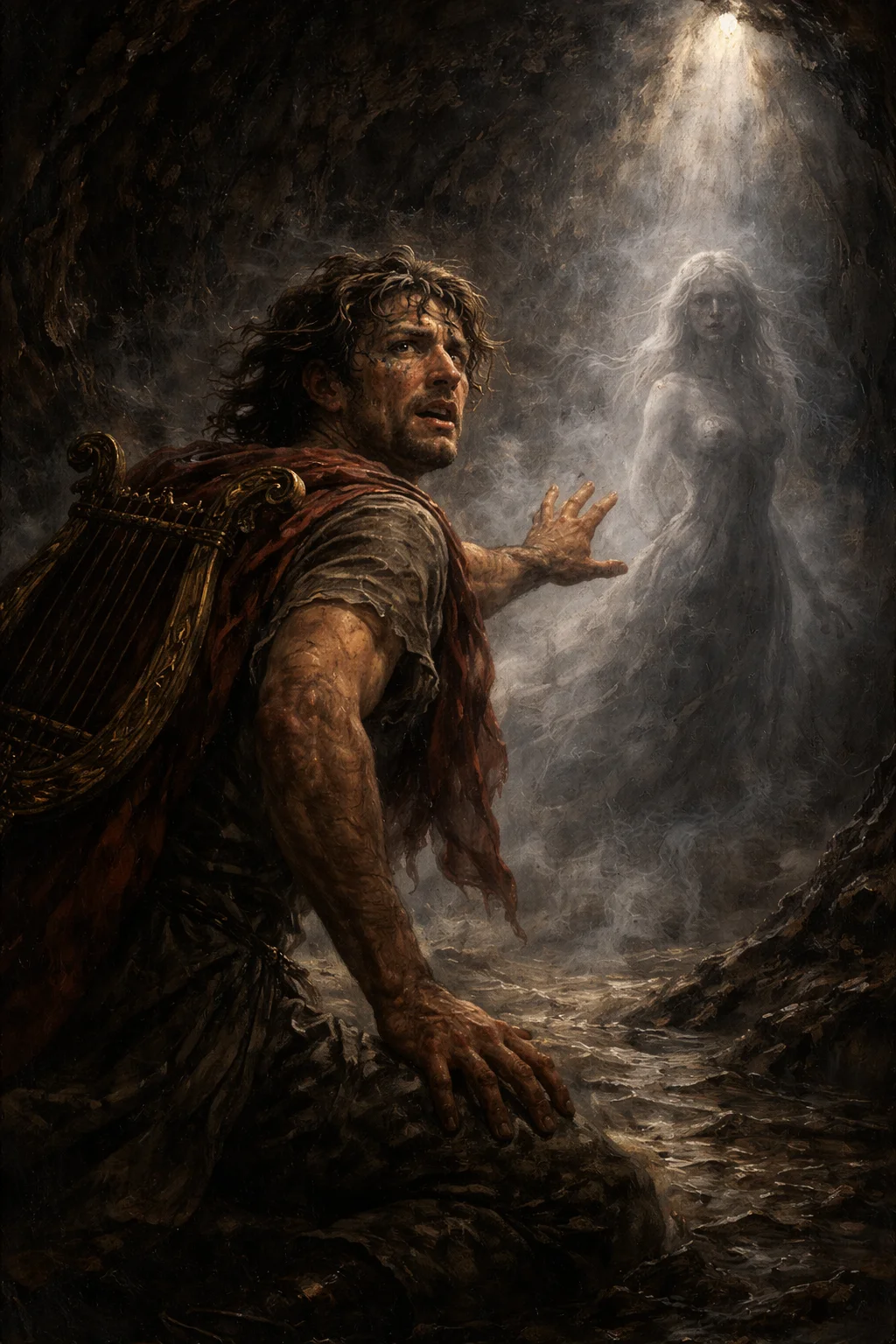
The Greatest Musician
Orpheus was the son of Apollo and the Muse Calliope, and he possessed a gift that no mortal or immortal could match: his music could charm all living things. When he played his lyre and sang, wild beasts lay docile at his feet, rivers paused in their courses, trees uprooted themselves to draw closer, and even the stones wept. He was, by every account, the greatest musician who ever lived.
When Orpheus married the beautiful nymph Eurydice, it seemed that the universe itself blessed their union. But their happiness was cruelly brief. Shortly after their wedding, Eurydice was bitten by a venomous snake while walking through a meadow and died. Orpheus was consumed by a grief so overwhelming that his songs of mourning made the gods themselves weep.
The Descent
Driven by love beyond reason, Orpheus resolved to do what no living mortal had ever attempted — descend to the Underworld and bring Eurydice back from the dead. Carrying only his lyre, he found the entrance to Hades's realm and began his journey into darkness. His music charmed Charon into ferrying him across the Styx without payment. Cerberus, the three-headed guardian, lay down whimpering at the beauty of his playing. Even the tormented souls of Tartarus found momentary relief from their eternal punishments as his melodies echoed through the caverns.
Before Hades and Persephone
Orpheus stood before the thrones of Hades and Persephone and played. He sang of his love for Eurydice, of the cruelty of a death that came too soon, and of the universal power of love that bound all beings — mortal and immortal alike. For the first and only time in all of mythology, the lord of the dead was moved to tears. Persephone, who understood separation and loss better than any other goddess, wept openly.
Hades agreed to release Eurydice on one condition: Orpheus must walk ahead of her out of the Underworld, and he must not look back until they had both reached the surface. If he turned to look at her before they emerged into sunlight, she would be lost forever.
The Backward Glance
Orpheus began the long ascent, hearing Eurydice's footsteps behind him. Through the dark tunnels and caverns he climbed, resisting the desperate urge to turn and confirm she was truly there. But as he neared the exit and saw daylight breaking through, doubt overwhelmed him. Was she really behind him? Had Hades deceived him? In a moment of agonizing weakness, just steps from freedom, Orpheus turned.
He saw Eurydice — pale, ghostly, but beautiful — reaching toward him. Their eyes met for one heartbreaking instant. Then she was pulled backward into the darkness, her final word a whispered 'farewell' that faded into silence. Orpheus lunged after her but found only empty air. He had lost her twice, and this time there would be no second chance. The gates of the Underworld sealed shut, and no amount of music could open them again.
Legacy
The myth of Orpheus and Eurydice is the ancient world's definitive love story — a tale about the power and limits of devotion, and the devastating consequences of doubt. It has inspired over a thousand operas, paintings, poems, films, and songs, from Monteverdi's L'Orfeo (1607) to the Broadway musical Hadestown. The story asks a question with no comfortable answer: is it possible to love someone so much that you would defy death itself — and still fail?
Classical Sources
This myth is recorded in multiple ancient sources:
- 📜 Homer, Iliad & Odyssey (c. 750 BC)
- 📜 Hesiod, Theogony & Works and Days (c. 700 BC)
- 📜 Apollodorus, Bibliotheca (c. 1st–2nd century AD)
- 📜 Ovid, Metamorphoses (8 AD)
- 📜 Greek Tragedians — Aeschylus, Sophocles, Euripides (5th century BC)
Cross-referenced with multiple classical sources for accuracy.
Explore More
Orpheus · Hades · Persephone · The Underworld · Home
How the story changed between authors
The version most people know, with the snake, the plea before the throne and the fatal backward look, is essentially the Roman one, fixed by Virgil and Ovid. Earlier Greek writers tell it differently, and some of them may not have known a failed rescue at all. Euripides' Alcestis has Admetus wish he had the tongue and song of Orpheus so he could charm Persephone and her husband and bring his wife back, which reads most naturally if Orpheus was remembered as having succeeded. The orator Isocrates likewise says Orpheus led the dead up out of Hades. The tragic ending, if it existed this early, was not yet the only version.
Plato offers a harsher account. In the Symposium, Phaedrus says the gods showed Orpheus only a phantom of his wife and gave him nothing real, because he was a soft-hearted lyre player who schemed to enter Hades alive instead of daring to die for love as Alcestis did. His violent death at the hands of women is presented as his punishment. Even the wife's name is not fixed: the Hellenistic poet Hermesianax calls her Agriope, and "Eurydice" becomes standard only later.
Virgil's Georgics adds the detail that explains the snakebite. Eurydice was fleeing the beekeeper Aristaeus, who was pursuing her along a riverbank, and never saw the serpent in the grass. The death of Aristaeus' bees is the nymphs' revenge, which is why the whole Orpheus episode sits inside a poem about farming. In Virgil, Eurydice herself speaks the final lament as she is pulled back. In Ovid's quieter retelling she makes no complaint, because, as he puts it, what could she complain of except that she had been loved?
Orpheus before and after Eurydice
The descent was not his only famous episode. Orpheus sailed with Jason on the Argo, and in Apollonius of Rhodes he keeps time for the rowers, calms quarrels among the crew, and drowns out the Sirens with his own song so the heroes row past safely (only Butes leaps overboard). See the quest for the Golden Fleece for the wider voyage. His parentage also varies: his mother is usually the Muse Calliope (see the Muses), but his father is often the Thracian king or river-god Oeagrus rather than Apollo.
His death is told in several incompatible ways. In Ovid, after losing Eurydice a second time, Orpheus grieves for seven days on the bank of the Styx, refuses the love of women for three years, and is eventually torn apart by the frenzied Ciconian women, followers of Dionysus, whose stones at first fall harmlessly, charmed by his music, until their shrieking drowns it out. His head and lyre float down the river Hebrus, still singing, and wash up on Lesbos, the island later famous for lyric poetry. In Aeschylus' lost play Bassarids, known from a later summary, Orpheus offended Dionysus by honouring the sun as the greatest god, climbing Mount Pangaion each dawn to greet it, and Dionysus sent his Bassarids to dismember him. Ovid at least allows a gentle ending: the shade of Orpheus finds Eurydice in the Underworld and the two walk together, where he may now look back at her as much as he likes.
Orphism, art and the afterlife of the myth
Because Orpheus had gone down to the dead and returned, the Greeks credited him with secret knowledge of the afterlife. A body of poems and rites called "Orphic" circulated under his name from at least the sixth century BC, teaching purification and a better fate for initiates. The gold leaves found in graves in southern Italy, Thessaly and Crete, instructing the dead soul which spring to drink from in the Underworld, belong to this broad tradition. His lyre was said to have been placed in the sky as the constellation Lyra (see constellation myths).
In ancient art the most celebrated image is a classical relief, known through Roman marble copies (the best-known is in Naples), showing Orpheus, Eurydice and Hermes as guide of souls at the moment of parting. Athenian vase painters preferred other scenes: Orpheus playing to rapt Thracian men, and Thracian women attacking him with spits, axes and rocks. Later centuries returned to the descent again and again, from Monteverdi and Gluck's Orfeo ed Euridice (1762) to Offenbach's parody Orpheus in the Underworld, Rilke's Sonnets to Orpheus, Jean Cocteau's film Orphée (1950) and Marcel Camus' Black Orpheus (1959), set during the Rio carnival.
Common misreadings
The prohibition on looking back is not a random test. It echoes a widespread ritual rule that those who make offerings to underworld powers must not turn round, as when Odysseus is told to avert his face while sacrificing to the dead. Nor is it clear in the sources that Orpheus simply doubted. Virgil calls it a "sudden madness" of love; Ovid says he looked because he was afraid she was failing and longed to see her. Finally, Eurydice is often called a nymph, but the earliest sources say almost nothing about her; much of her character was supplied by Roman and modern writers.
Ancient sources
- Virgil, Georgics 4.453–527 — the fullest early account of the failed rescue, with Aristaeus causing Eurydice's flight, the backward look, and Orpheus' death and singing head.
- Ovid, Metamorphoses 10.1–85 and 11.1–66 — the wedding and snakebite, Orpheus' speech before Hades and Persephone, the loss, and his death at the hands of the Ciconian women, ending with the couple reunited among the dead.
- Plato, Symposium 179d — claims the gods gave Orpheus only a phantom because he would not die for love.
- Euripides, Alcestis — Admetus' wish for Orpheus' power over the rulers of the dead, possible evidence for a successful rescue tradition.
- Apollonius of Rhodes, Argonautica — Orpheus' role on the Argo, including outsinging the Sirens in Book 4.
- Apollodorus, Library 1.3.2 — brief summary: Orpheus' parentage, his descent to recover Eurydice, the condition, and his death by the Maenads.
Frequently asked questions
Why did Orpheus look back at Eurydice?
The ancient poets give emotional rather than logical reasons. Virgil calls it a sudden madness that seized the lover when they were almost in the light; Ovid says he feared she was weakening and wanted to see her. Plato's cynical version suggests he never had the real Eurydice at all.
Did Orpheus ever see Eurydice again?
In Ovid, yes. After Orpheus is killed, his shade goes down to the Underworld, finds Eurydice in the fields of the blessed and walks beside her, sometimes ahead and sometimes behind, free to look back without fear.
Who killed Orpheus?
Thracian women devoted to Dionysus, called Ciconian women by Ovid and Bassarids in Aeschylus' lost play. Reasons vary: anger at his rejection of women after Eurydice's death, or Dionysus' resentment at his devotion to the sun.
Is Hadestown based on the original myth?
It follows the core story (descent, bargain, backward look) but adds a modern economic setting and frames Hades and Persephone's marriage as a parallel plot. The narrator figure of Hermes reflects his ancient role as guide of souls.
Books to read next
- Stephen Fry, Heroes
- Apollodorus, The Library of Greek Mythology (Oxford World's Classics)
- Edith Hamilton, Mythology
Links go to Bookshop.org, which supports independent bookstores. We earn a small commission if you buy, at no extra cost to you.