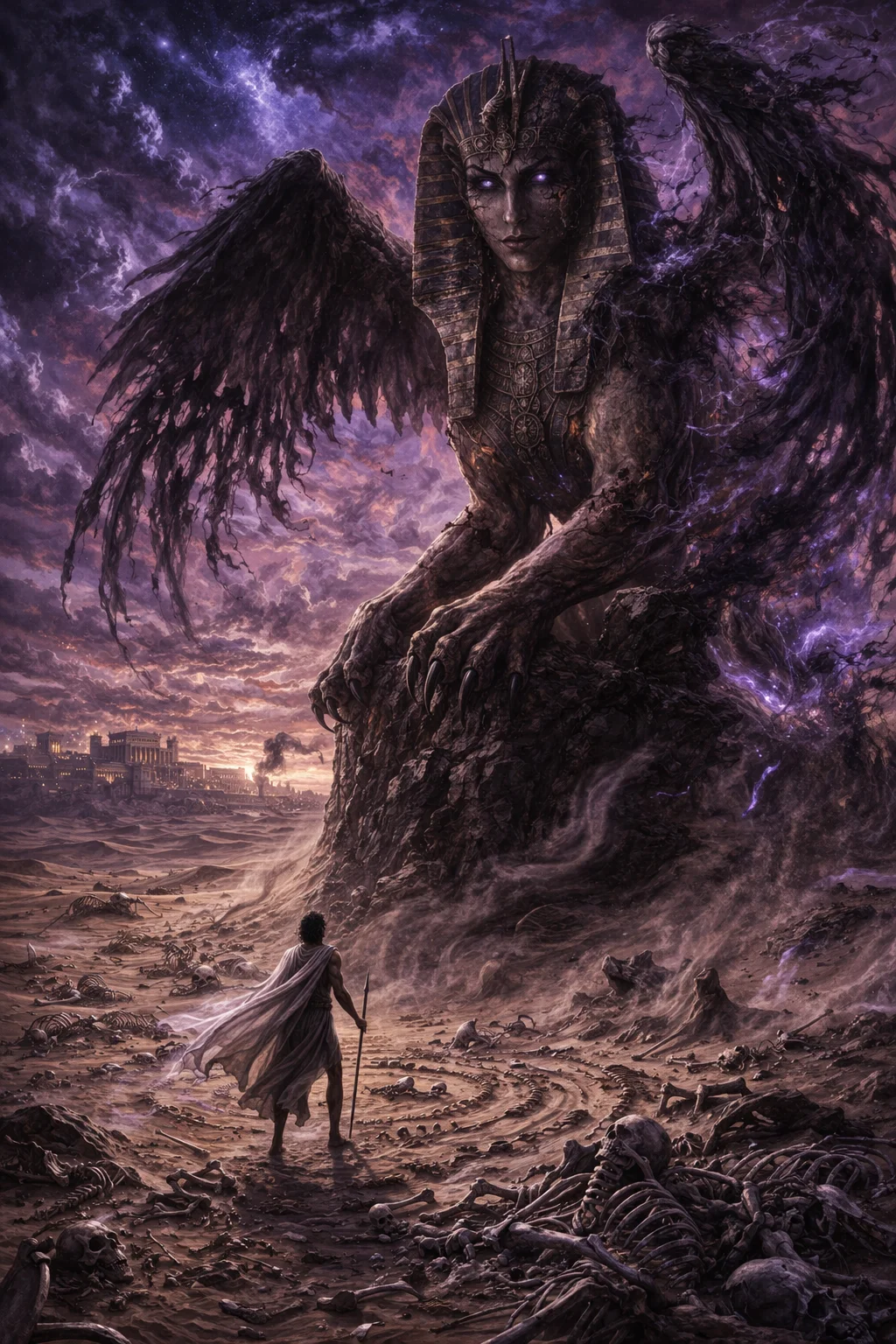
The Prophecy
Before Oedipus was even born, an oracle at Delphi delivered a horrifying prophecy to his parents, King Laius and Queen Jocasta of Thebes: their son would grow up to kill his father and marry his mother. Desperate to avoid this fate, Laius ordered a servant to take the newborn infant to the mountains and leave him to die, his ankles pierced and bound with a pin.
But the servant, unable to kill the child, gave the baby to a shepherd, who carried him to Corinth. There, King Polybus and Queen Merope adopted the boy as their own, raising him as a prince. They named him Oedipus — 'Swollen Foot' — for the wounds on his ankles. Oedipus grew up believing Polybus and Merope were his true parents, never suspecting the terrible destiny that awaited him.
The Road to Thebes
As a young man, Oedipus heard a rumour that he was not truly the son of Polybus. Troubled, he journeyed to the Oracle at Delphi to learn the truth. The Oracle, instead of answering his question, delivered the same devastating prophecy: he would kill his father and marry his mother. Horrified, and believing that Polybus and Merope were his real parents, Oedipus resolved never to return to Corinth. He set out in the opposite direction — toward Thebes.
At a narrow crossroads, Oedipus encountered a chariot carrying an older man and his attendants. A dispute over right of way escalated into violence, and Oedipus, in a burst of rage, killed the older man and all but one of his servants. He did not know that the man he had just murdered was King Laius — his biological father. The first half of the prophecy was fulfilled.
The Sphinx
Arriving at Thebes, Oedipus found the city terrorized by the Sphinx — a monstrous creature with the head of a woman, the body of a lion, and the wings of an eagle. The Sphinx posed a riddle to every traveller, devouring those who answered incorrectly. The riddle: 'What walks on four legs in the morning, two legs at noon, and three legs in the evening?' Oedipus answered correctly: 'Man — who crawls as an infant, walks upright in his prime, and uses a cane in old age.' The Sphinx, defeated, hurled herself from the cliff and perished.
King of Thebes
Thebes hailed Oedipus as a hero and liberator. With Laius dead and no heir apparent, the people offered Oedipus the throne — and, with it, the hand of the widowed queen Jocasta. Oedipus married his own mother and became king, fathering four children with her: Antigone, Ismene, Eteocles, and Polynices. For many years, he ruled wisely and was beloved by his people. He had no idea that the prosperity he enjoyed was built on the foundation of the very crimes he had fled Corinth to avoid.
The Truth Revealed
Years later, a terrible plague struck Thebes. The Oracle declared that the city was polluted by the presence of Laius's unpunished killer. Oedipus, the brilliant solver of riddles, launched an investigation — not realizing he was hunting himself. Through a chain of testimony from the blind prophet Tiresias, a messenger from Corinth, and the surviving servant from the crossroads, the truth emerged with devastating clarity: Oedipus was the son of Laius and Jocasta. He had killed his father at the crossroads and married his mother in Thebes.
Jocasta, unable to bear the revelation, hanged herself. Oedipus, finding her body, tore the golden brooches from her robe and drove them into his own eyes, blinding himself. He could not bear to look upon the children he had fathered with his mother, or the city he had ruled under false pretenses. He was cast out of Thebes and spent the remainder of his life as a blind wanderer, guided by his faithful daughter Antigone.
Classical Sources
This myth is recorded in multiple ancient sources:
- 📜 Homer, Iliad & Odyssey (c. 750 BC)
- 📜 Hesiod, Theogony & Works and Days (c. 700 BC)
- 📜 Apollodorus, Bibliotheca (c. 1st–2nd century AD)
- 📜 Ovid, Metamorphoses (8 AD)
- 📜 Greek Tragedians — Aeschylus, Sophocles, Euripides (5th century BC)
Cross-referenced with multiple classical sources for accuracy.
Explore More
Sphinx · Delphi · Apollo · Home
Before Sophocles: Homer and the Lost Epics
The story above follows Sophocles' Oedipus the King, but it is not the oldest version, and the earlier ones differ in important ways. In Odyssey Book 11, Odysseus sees in the underworld the mother of Oedipus, whom Homer calls Epicaste, not Jocasta. She married her son unknowingly, and "the gods soon made it known." She hanged herself, but Oedipus went on ruling the Cadmeans in Thebes, suffering, pursued by the Furies his mother called down on him. Homer says nothing about self-blinding or exile. In the Iliad, the hero Mecisteus is said to have competed in Thebes at the funeral games "of fallen Oedipus." That suggests a version in which he died as king and received a hero's funeral.
The lost epic Oedipodeia apparently changed the family too. Pausanias, citing it, says Oedipus' four children were born not to his mother but to a second wife, Euryganeia. That spares the children the stain of incest. Another lost epic, the Thebaid, told how Oedipus cursed his sons Eteocles and Polynices, in one fragment because they served him a cut of meat he considered an insult.
The Family Curse and the Tragedians' Versions
Several sources trace the disaster back to Laius. As a young exile at the court of Pelops, Laius abducted Pelops' son Chrysippus. Euripides dramatised this in a lost play, and Apollodorus treats it as the reason for the curse. Aeschylus produced a Theban trilogy in 467 BC: Laius, Oedipus and the surviving Seven Against Thebes. In it Apollo warned Laius three times that he could save the city only by dying childless. Here the oracle is a warning Laius ignores, not an unconditional prophecy.
Euripides went his own way. In Phoenician Women, Jocasta does not hang herself after the revelation. She lives on, tries to make peace between her warring sons, and kills herself with a sword over their bodies. The blind Oedipus has been shut away inside the palace and only goes into exile at the end. A fragment of Euripides' lost Oedipus indicates that in that play Laius' servants blinded him, which removes the self-punishment that is so central for Sophocles.
Sophocles came back to the story near the end of his life in Oedipus at Colonus, produced after his death in 401 BC. The old, blind Oedipus arrives with Antigone at Colonus, Sophocles' own home district outside Athens, and is taken in by Theseus. He insists he is innocent in intent, since he acted without knowing. He curses Polynices, and then, summoned by thunder and a divine voice, he disappears from the earth at a place only Theseus is allowed to know. His secret grave is to protect Athens against future invasion from Thebes.
The Sphinx, the Riddle and Common Mistakes
Apollodorus says Hera sent the Sphinx, though other writers name different gods, and that she had learned the riddle from the Muses. The famous "morning, noon and evening" form of the riddle is a later, simplified retelling. The oldest surviving text, quoted by Athenaeus from the mythographer Asclepiades, asks about a creature on earth that is "two-footed and four-footed and three-footed," with one voice, and that moves most slowly when it has the most feet. Some ancient writers even made the Sphinx a bandit or a riddling daughter of Laius instead of a monster.
Other common mistakes:
- The plague that opens Sophocles' play is not found in earlier versions. Many scholars suspect it reflects the plague that struck Athens from 430 BC, though the date of the play is uncertain.
- The name "Swollen-foot" (oidein, to swell) is the traditional explanation. Sophocles also plays on oida, "I know." Oedipus is the man who knows the answer to the riddle and does not know himself.
- Freud's "Oedipus complex" draws on Sophocles' play, discussed in The Interpretation of Dreams (1899). Sophocles' Oedipus, though, had no desire for the woman he knew as his mother. He fled Corinth precisely to avoid the prophecy.
In art, the best-known ancient image is an Attic red-figure cup in the Vatican, by the painter named after it (the Oedipus Painter, c. 470 BC), showing Oedipus calmly facing the Sphinx perched on a column. Ingres' Oedipus and the Sphinx (1808, Louvre) and Gustave Moreau's version (1864, Metropolitan Museum) are the most famous modern treatments.
Ancient sources
- Homer, Odyssey 11.271–280 — Epicaste hangs herself after the gods reveal the marriage, while Oedipus goes on ruling Thebes in torment.
- Sophocles, Oedipus the King and Oedipus at Colonus — the self-investigation, the blinding and exile, and the mysterious death at Colonus under Theseus' protection.
- Aeschylus, Seven Against Thebes — the surviving play of the 467 BC trilogy: Apollo's warning to Laius and Oedipus' curse fulfilled in the brothers' mutual killing.
- Euripides, Phoenician Women — Jocasta survives the revelation and dies over her sons' bodies, and Oedipus is sent into exile at the end.
- Apollodorus, Library 3.5.7–9 — a mythographer's summary including Chrysippus, the Sphinx sent by Hera and the riddle learned from the Muses.
- Pausanias, Description of Greece 9.5.10–11 — cites the Oedipodeia for Euryganeia as the mother of Oedipus' children.
Frequently asked questions
Did Oedipus know Jocasta was his mother?
No. In every version he married her without knowing. In Sophocles he had fled Corinth to avoid harming the people he believed were his parents, Polybus and Merope.
How did Oedipus die?
It depends on the source. Homer implies he died as king in Thebes and received funeral games. Sophocles has him vanish mysteriously at Colonus near Athens, where his hidden grave protects the city.
What was the riddle of the Sphinx?
The oldest recorded form asks what creature is two-footed, four-footed and three-footed with a single voice, and slowest when it has the most feet. The answer is man: crawling as a baby, walking upright as an adult and using a stick in old age.
Why was Oedipus' family cursed?
Several sources blame his father Laius, who abducted Chrysippus, son of Pelops. Aeschylus stresses that Laius defied Apollo's warning not to have children.
Books to read next
- Sophocles, The Three Theban Plays (trans. Robert Fagles)
- Stephen Fry, Heroes
- Edith Hamilton, Mythology
Links go to Bookshop.org, which supports independent bookstores. We earn a small commission if you buy, at no extra cost to you.