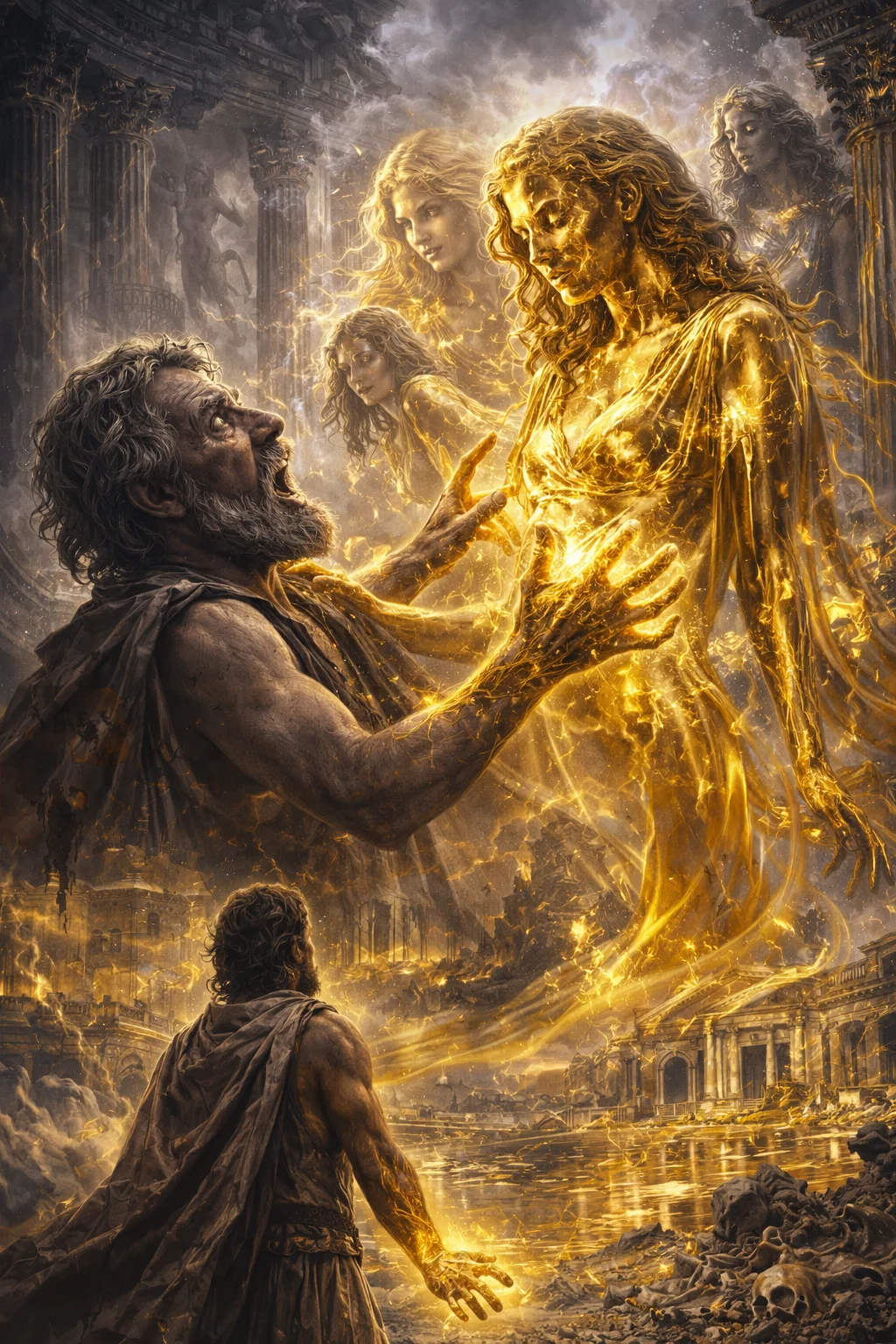
The Wish
King Midas of Phrygia was already one of the wealthiest rulers in the ancient world, but his appetite for gold was insatiable. When the drunken satyr Silenus — companion and tutor of Dionysus — wandered into Midas's famous rose garden, the king treated him with lavish hospitality for ten days. Grateful for the kindness shown to his beloved companion, Dionysus offered Midas any wish his heart desired.
Without hesitation, Midas wished that everything he touched would turn to gold. Dionysus granted the wish, though the god warned him he had not chosen wisely. Midas dismissed the warning and rushed to test his new power. He touched an oak branch — gold. A stone — gold. An apple — solid gold. He ran through his palace transforming everything in sight, laughing with delight as his wealth multiplied beyond imagination.
The Horror
The ecstasy faded when Midas sat down to eat. The bread he raised to his lips hardened into a golden lump. The wine pouring into his mouth became liquid gold that burned his throat. Every morsel of food, every drop of water transformed at his touch into beautiful, inedible, lethal metal. The most powerful gift in the world was starving him to death.
Then came the moment of true horror. Midas's beloved daughter ran to embrace her father. The instant his hands touched her, she froze — her warm flesh hardening into a cold, gleaming golden statue. Her eyes, her smile, her outstretched arms — all solid gold. Midas fell to his knees before the lifeless figure of his child and understood at last the full measure of his folly. He had destroyed the one thing he loved more than gold itself.
Redemption
Broken and desperate, Midas begged Dionysus to take back the gift. The god, taking pity on the repentant king, instructed him to wash himself in the River Pactolus at its source on Mount Tmolus. Midas plunged into the river, and the golden curse flowed from his body into the water. According to legend, this is why the sands of the Pactolus contained gold dust for centuries afterward — the remnant of Midas's curse, forever washing downstream.
The Deeper Meaning
The story of King Midas is the ancient world's most powerful warning against greed — a parable so effective that 'the Midas touch' has become a universal expression. But the myth is about more than wealth. It explores the catastrophic consequences of getting exactly what you want, and the terrible realization that the things we pursue most obsessively are often the things that destroy what we truly value. Midas had to lose everything to understand that the real gold in his life had never been metal.
Classical Sources
This myth is recorded in multiple ancient sources:
- 📜 Homer, Iliad & Odyssey (c. 750 BC)
- 📜 Hesiod, Theogony & Works and Days (c. 700 BC)
- 📜 Apollodorus, Bibliotheca (c. 1st–2nd century AD)
- 📜 Ovid, Metamorphoses (8 AD)
- 📜 Greek Tragedians — Aeschylus, Sophocles, Euripides (5th century BC)
Cross-referenced with multiple classical sources for accuracy.
Explore More
Dionysus · Apollo · Pan · Home
The Golden Daughter Is Not Ancient
The part of the story that most people remember, Midas turning his daughter into a statue, does not appear in any Greek or Roman source. It comes from Nathaniel Hawthorne's "The Golden Touch" in A Wonder-Book for Girls and Boys (1852), where the child is named Marygold. Hawthorne wanted a moral that children would feel, and the image has been so successful that it is now usually retold as if it were classical.
In Ovid's Metamorphoses (11.85–145), the main ancient telling, the punishment is hunger and thirst alone. Bread hardens in Midas's teeth and wine flows down his throat as molten gold. Horrified, he prays to Dionysus (Bacchus) for release. Ovid also explains why Midas was kind to Silenus in the first place: he had been initiated into the god's rites by Orpheus and Eumolpus, so he recognised the old satyr when Phrygian countrymen dragged him in, drunk and garlanded. Midas feasted him for ten days and nights and then returned him to Dionysus in Lydia. The god was grateful and granted the wish.
The Ass's Ears
Ovid follows the golden touch with a second episode, one that shows Midas learned less than the moral tradition suggests. Now hating wealth, he took to the countryside and became a follower of Pan. When Pan boasted that his reed pipes were better than Apollo's lyre, the mountain god Tmolus judged the contest and gave it to Apollo. Everyone agreed except Midas. Apollo decided such dull ears did not deserve human shape and gave him the long, grey, twitching ears of an ass.
Midas hid them under a purple turban, but his barber saw them. Unable to keep the secret and afraid to tell it, the barber dug a hole, whispered into it that the king had ass's ears, and filled it in. Reeds grew on the spot, and when the wind moved them they murmured the secret to the world. In some later versions, the musical contest involves the satyr Marsyas instead of Pan, mixing Midas into another of Apollo's punishments.
Other Ancient Traditions About Midas
The Greeks told several Midas stories beyond Ovid's two:
- Catching Silenus. Herodotus (8.138) places the "gardens of Midas," where roses with sixty petals grew wild, in Macedonia below Mount Bermion, and says Silenus was caught there. Xenophon (Anabasis 1.2.13) describes a spring in Phrygia called the Spring of Midas, where the king trapped the satyr by mixing wine into the water.
- The wisdom of Silenus. In a story from a lost dialogue of Aristotle, quoted by Plutarch, the captured Silenus is forced to share his wisdom. He says that the best thing for a human is never to have been born, and the second best is to die as soon as possible. This is a darker lesson than greed.
- The Gordian connection. Midas was said to be the son of Gordias, the farmer who became king of Phrygia when he arrived in an ox-cart as an oracle had foretold. The cart was dedicated with its famously intricate knot, which Alexander the Great later cut or untied at Gordion (Arrian, Anabasis 2.3).
- Founding Ancyra. Pausanias (1.4.5) credits Midas with founding Ancyra, modern Ankara, and says an anchor he found there was still shown in a temple of Zeus.
The Real King Midas
Midas is unusual among mythical kings in that he almost certainly existed. Assyrian records of Sargon II, in the late eighth century BC, name a ruler called Mita of Mushki, who is generally identified with the Phrygian Midas. Herodotus (1.14) says Midas dedicated his royal throne at Delphi, the first foreign king to send an offering there. At Gordion, the Phrygian capital in central Anatolia, a huge burial mound known as the Midas Mound (Tumulus MM) was excavated in 1957. Its timber chamber held a royal burial with bronze vessels and remains of a funeral feast. Dendrochronology now dates the tomb to around 740 BC, so many archaeologists think it belonged to Midas's father rather than to Midas himself. Later Greek tradition said Midas died by drinking bull's blood when the Cimmerians overran Phrygia.
The famous wealth may reflect the real riches of Anatolia. The Pactolus did carry gold-bearing sands, which made neighbouring Lydia and its capital Sardis rich. Lydia is also credited with some of the earliest coins. A myth explaining that gold as Midas's washed-off curse is just the kind of local origin story the Greeks liked to tell.
Ancient sources
- Ovid, Metamorphoses 11.85–193 — the fullest account: Silenus, the golden touch, washing in the Pactolus, the contest of Pan and Apollo, the ass's ears and the whispering reeds.
- Herodotus, Histories 1.14 and 8.138 — Midas's throne dedicated at Delphi, and the rose gardens of Midas in Macedonia where Silenus was caught.
- Xenophon, Anabasis 1.2.13 — the Spring of Midas in Phrygia, where the king caught the satyr by mixing wine into it.
- Aristotle, Politics 1257b — cites Midas, who starved because everything set before him became gold, as proof that money is not the same as real wealth.
- Hyginus, Fabulae 191 — a brief Latin version of the golden touch and the ass's ears.
- Pausanias, Description of Greece 1.4.5 — Midas as founder of Ancyra.
Frequently asked questions
Was King Midas a real person?
Very likely. A king named Mita appears in Assyrian records of the late eighth century BC, and Phrygian Gordion has royal tombs from that time. The golden touch, of course, is myth.
Did Midas really turn his daughter to gold?
Not in ancient sources. The daughter comes from Nathaniel Hawthorne's 1852 retelling. Ovid's Midas suffers only because he cannot eat or drink.
Why did Midas get donkey ears?
Because he disputed Tmolus' verdict in the music contest between Pan and Apollo. Apollo punished his poor judgement with the ears of an ass, the stock image of a stupid animal.
Where is the River Pactolus?
In western Turkey. It flows from Mount Tmolus (Boz Dağ) past ancient Sardis and was famous in antiquity for its gold-bearing sands. For other myths of changed bodies and objects, see transformation myths.
Books to read next
Links go to Bookshop.org, which supports independent bookstores. We earn a small commission if you buy, at no extra cost to you.