The Labyrinth
The story begins with Daedalus, the greatest inventor and craftsman in the ancient world. He had designed the Labyrinth of Crete — an impossibly complex maze built to imprison the Minotaur — for King Minos. But when Daedalus helped Theseus escape the Labyrinth after slaying the beast, Minos was furious. He imprisoned Daedalus and his young son Icarus in a high tower on the island, ensuring that no ship would carry them to freedom.
Daedalus, ever resourceful, devised an escape route that Minos could not control: the sky. He collected feathers shed by the birds that roosted on the tower's ledges — seagulls, eagles, and doves — and arranged them from smallest to largest, binding the smaller ones with thread and the larger ones with beeswax. Over weeks of painstaking work, he crafted two pairs of magnificent wings: one for himself and one for Icarus.
The Warning
Before they took flight, Daedalus gave his son careful instructions. 'Follow my path,' he said. 'Do not fly too low, or the sea spray will dampen your feathers and drag you down. And do not fly too high, or the heat of the sun will melt the wax that holds your wings together. Stay the middle course.' Icarus nodded, but his eyes were already fixed on the open sky, blazing with the anticipation of flight.
The Flight
Father and son launched themselves from the tower and soared over the sea. Below them, fishermen and shepherds looked up in astonishment, believing they were witnessing gods in flight. For the first time in human experience, mortals were airborne — riding the wind like birds, free from the earth and all its prisons.
Icarus was intoxicated by the sensation. The rush of wind, the dizzying height, the godlike perspective of the world below — it was more thrilling than anything he had ever imagined. He began to climb higher, ignoring his father's warnings. Higher and higher he rose, drunk on freedom, spiraling toward the burning sun like a moth drawn to a flame.
The Fall
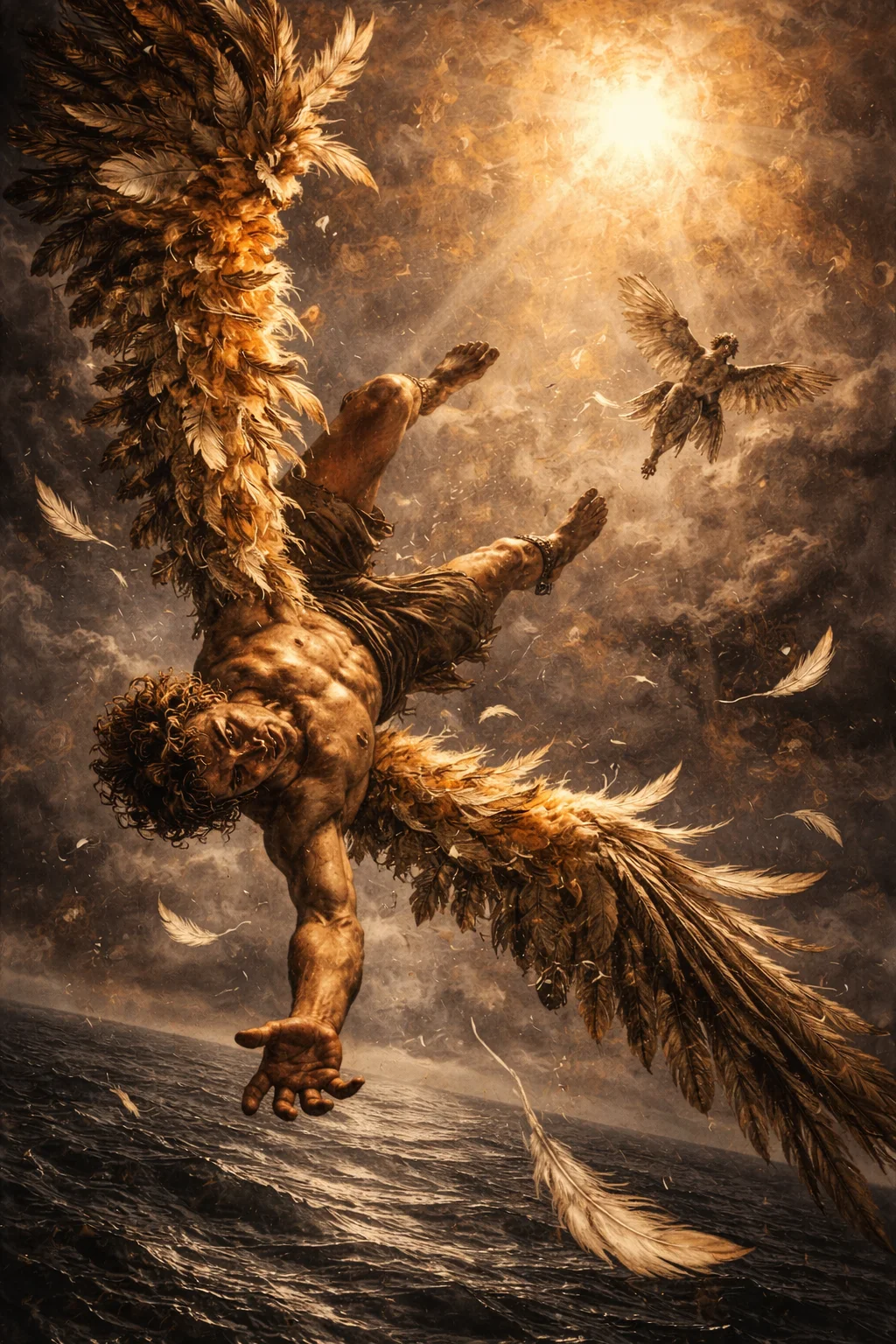
As Icarus soared ever higher, the blazing heat of the sun softened the beeswax holding his wings together. One by one, feathers began to loosen and peel away, drifting down like snow. By the time Icarus realized what was happening, it was too late. His wings disintegrated, and he plunged screaming from the sky, tumbling through the empty air until he struck the sea far below. The waters closed over him, and he was gone.
Daedalus circled back, calling his son's name. He saw nothing but scattered feathers floating on the waves. He searched until he found the boy's body, and carried it to a nearby island, where he buried his son with trembling hands. The sea where Icarus fell was named the Icarian Sea in his memory, and the island where he was buried became Icaria — names that persist on maps to this day.
The Eternal Warning
The fall of Icarus is perhaps the most famous cautionary tale in Western civilization — a myth about the lethal danger of ambition unchecked by wisdom. It warns against hubris, against ignoring the counsel of experience, and against the seductive belief that we are invincible. Yet there is also something heroic in Icarus's story: he chose the sky over safety, he reached for the sun, and for one glorious moment, he flew. The myth endures because it speaks to both the danger and the beauty of human aspiration — the eternal tension between caution and daring that defines the human spirit.
Classical Sources
This myth is recorded in multiple ancient sources:
- 📜 Homer, Iliad & Odyssey (c. 750 BC)
- 📜 Hesiod, Theogony & Works and Days (c. 700 BC)
- 📜 Apollodorus, Bibliotheca (c. 1st–2nd century AD)
- 📜 Ovid, Metamorphoses (8 AD)
- 📜 Greek Tragedians — Aeschylus, Sophocles, Euripides (5th century BC)
Cross-referenced with multiple classical sources for accuracy.
Explore More
Daedalus · Theseus · Minotaur · Home
How Different Authors Tell the Story
Neither Homer nor Hesiod mentions Icarus. The flight is essentially a Roman-era favourite, and the version most people know comes from Ovid. He tells it twice: once in Metamorphoses 8.183–235, and at greater length in the Ars Amatoria 2.21–96, where Daedalus's warning speech is fuller. Ovid gives Daedalus no specific crime. The craftsman is simply homesick, and Minos refuses to let him leave Crete, so he declares, "He may block land and sea, but the sky is surely open."
Apollodorus (Epitome 1.12–13) gives a different cause. Minos shut Daedalus and Icarus inside the Labyrinth itself, not a tower, because Daedalus had given Ariadne the thread that let Theseus find his way out. In this version Icarus's body washes up on the island later called Icaria, and it is Heracles, passing by, who recognises and buries it.
Some Greek writers found the flight too fantastic and explained it away. Diodorus (4.77) says Pasiphaë helped the pair escape by ship, and that Icarus drowned after jumping too eagerly from the boat as it landed. Pausanias (9.11.4–5) says Daedalus escaped in a boat and invented sails, while Icarus, steering clumsily, capsized his own boat. On these readings the "wings" were sails. Heracles again buries the body.
Daedalus After the Fall
Ovid adds a dark detail: as Daedalus buries his son, a partridge watches from a ditch and claps its wings. It is Perdix, Daedalus's nephew and apprentice, whom Daedalus had once thrown from the Acropolis out of envy at his talent. Athena turned him into a bird (Metamorphoses 8.236–259). Ovid presents Icarus's death as payment for that earlier killing, a detail almost always left out of modern retellings.
Virgil gives the most moving aftermath. In Aeneid 6.14–33, Daedalus lands at Cumae in Italy, dedicates his wings to Apollo and carves the story of Crete on the temple doors. He tries twice to carve Icarus's fall, and twice his hands fail him. Afterwards he fled to Sicily, to King Cocalus. Minos tracked him down with a puzzle: he challenged everyone to pass a thread through a spiral seashell, knowing only Daedalus could solve it. Daedalus did, by tying the thread to an ant. When Minos demanded he be handed over, Cocalus's daughters killed Minos in his bath (Apollodorus, Epitome 1.14–15). See Daedalus and King Minos.
Icarus in Art and Poetry
Roman wall paintings from Pompeii show the fall, often with Daedalus hovering above and Icarus's body on the shore. The most famous painting is Landscape with the Fall of Icarus in Brussels, long attributed to Pieter Bruegel the Elder, though many scholars now think it is an early copy of a lost original. Icarus is just a pair of legs splashing into the sea, while a ploughman and a shepherd carry on with their work. That indifference inspired W. H. Auden's poem "Musée des Beaux Arts" (1938) and William Carlos Williams's "Landscape with the Fall of Icarus" (1962). Later treatments include Herbert Draper's The Lament for Icarus (1898, Tate) and Henri Matisse's cut-out Icarus in his book Jazz (1947).
What People Get Wrong
- "Don't fly too close to the sun" is only half the warning. In Ovid, Daedalus warns equally against flying too low, where sea spray would weigh down the feathers. The lesson is to keep to the middle course, not simply to avoid ambition.
- Icarus was not an inventor. The wings were his father's work. Icarus is the son, not the "Greek who invented flight".
- Not every version uses wax. Rationalising writers such as Pausanias and Diodorus describe sails and boats, not wings.
For other mythic falls and punishments, see Greek mythology punishments and Crete.
Ancient sources
- Ovid, Metamorphoses 8.183–259 — the classic account of the wings, the warning, the fall, and the partridge Perdix.
- Ovid, Ars Amatoria 2.21–96 — a longer retelling with Daedalus's full instructions to his son.
- Apollodorus, Epitome 1.12–15 — imprisonment in the Labyrinth, Heracles burying Icarus, and Minos's death in Sicily.
- Diodorus Siculus, Library of History 4.77 — a rationalised escape by ship with Pasiphaë's help.
- Pausanias, Description of Greece 9.11.4–5 — Daedalus invents sails, and Icarus capsizes.
- Virgil, Aeneid 6.14–33 — Daedalus at Cumae, unable to carve his son's fall.
Frequently asked questions
Who buried Icarus?
The sources differ. Ovid says Daedalus buried him. Apollodorus and Pausanias say Heracles found the body on Icaria and buried it.
Why were Daedalus and Icarus imprisoned?
In Apollodorus, Minos punished Daedalus for giving Ariadne the thread that helped Theseus escape the Labyrinth. In Ovid, Minos simply refused to let the craftsman leave Crete.
What is the moral of Icarus?
Traditionally, moderation: follow the middle path between extremes. Modern readers often also see it as a story about youthful daring and a father's grief.
Books to read next
Links go to Bookshop.org, which supports independent bookstores. We earn a small commission if you buy, at no extra cost to you.