The Quest
Jason was the rightful heir to the throne of Iolcus in Thessaly, but his uncle Pelias had seized power by force, killing Jason's father and claiming the kingdom. When Jason came of age and confronted Pelias, the cunning usurper agreed to surrender the throne — but only if Jason could retrieve the legendary Golden Fleece from the distant land of Colchis on the far shore of the Black Sea. Pelias believed the mission was suicide. No Greek had ever sailed so far east and returned alive.
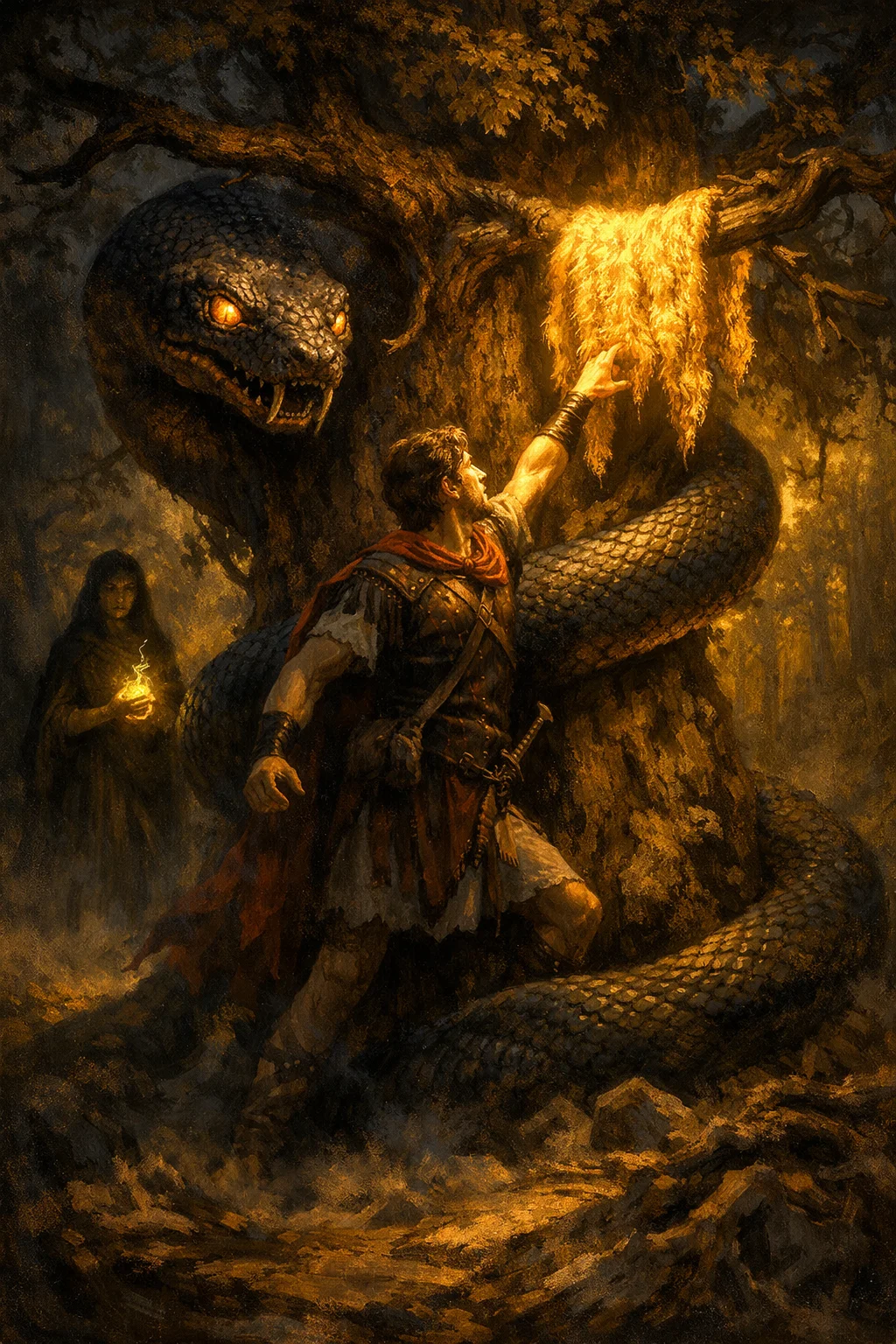
The Golden Fleece came from a magical flying ram sent by the gods to rescue two children, Phrixus and Helle, from a wicked stepmother. Phrixus sacrificed the ram upon arriving in Colchis and hung its golden fleece on an oak tree in a sacred grove, where it was guarded by a dragon that never slept. The Fleece became a symbol of kingship, authority, and divine favour — and recovering it became Jason's impossible test.
The Argonauts
Jason commissioned the master shipwright Argus to build the Argo — the finest ship ever constructed, incorporating a beam of sacred oak from Dodona that could speak prophecy. He then assembled the greatest crew of heroes the Greek world had ever seen: Heracles, the strongest man alive; Orpheus, whose music could calm any storm; Castor and Pollux, the divine twins; Atalanta, the huntress; and dozens more. Together, they were called the Argonauts — the sailors of the Argo — and their voyage became one of the most celebrated adventures in mythology.
The Trials at Colchis
After a voyage filled with dangers — the Clashing Rocks, the Harpies, the isle of the Amazons — Jason arrived at Colchis and presented himself before King Aeëtes. The king, unwilling to surrender the Fleece, set Jason three seemingly impossible tasks: yoke a pair of fire-breathing bronze bulls and plow a field with them; sow the field with dragon teeth that would sprout into armed warriors; and then defeat the warriors. Any one of these challenges should have killed him.
But Aphrodite, supporting Jason's quest, caused Aeëtes's daughter Medea — a powerful sorceress and priestess of Hecate — to fall desperately in love with Jason. Medea gave Jason a magical ointment that made him invulnerable to fire for one day, allowing him to yoke the bulls. She told him to throw a stone among the warriors when they sprouted, causing them to fight and destroy each other. And when Aeëtes still refused to honour his word, Medea drugged the sleepless dragon and helped Jason steal the Fleece by night.
Triumph and Tragedy
Jason and the Argonauts fled Colchis with the Golden Fleece and Medea, pursued by her father's fleet. They eventually returned to Greece in triumph, and Jason reclaimed his throne. But the story does not end happily. Jason later abandoned Medea for a younger princess, and the scorned sorceress took terrible revenge — killing Jason's new bride, the bride's father, and finally her own children by Jason, before escaping in a chariot drawn by dragons. Jason died alone and forgotten, crushed by a falling timber from the rotting Argo. The hero who achieved the impossible quest was destroyed by his own faithlessness.
Classical Sources
This myth is recorded in multiple ancient sources:
- 📜 Homer, Iliad & Odyssey (c. 750 BC)
- 📜 Hesiod, Theogony & Works and Days (c. 700 BC)
- 📜 Apollodorus, Bibliotheca (c. 1st–2nd century AD)
- 📜 Ovid, Metamorphoses (8 AD)
- 📜 Greek Tragedians — Aeschylus, Sophocles, Euripides (5th century BC)
Cross-referenced with multiple classical sources for accuracy.
Explore More
Jason · Heracles · Orpheus · Hecate · Home
How the Ram Reached Colchis
The fleece's backstory is a Boeotian family drama. King Athamas of Orchomenus had two children, Phrixus and Helle, with the cloud-goddess Nephele, then married Ino, daughter of Cadmus. Jealous of her stepchildren, Ino persuaded the women of the land to roast the seed-corn so that nothing grew. She then bribed the messengers sent to Delphi to report that the famine would end only if Phrixus were sacrificed. As the boy stood at the altar, Nephele sent a golden-fleeced ram, a gift from Hermes, which carried both children away through the air. Helle slipped off and drowned in the strait that was named after her, the Hellespont ("sea of Helle"). Phrixus reached Colchis, where King Aeëtes, son of Helios, welcomed him and gave him his daughter Chalciope in marriage. Phrixus sacrificed the ram to Zeus Phyxios ("Zeus of Escape") and gave the fleece to Aeëtes. Later writers add that the ram itself was a son of Poseidon, and that its golden image was placed in the sky as the constellation Aries.
Episodes on the Outward Voyage
Apollonius of Rhodes's Argonautica, the only complete ancient epic of the quest, gives the voyage a sequence of distinct episodes:
- Lemnos: the island's women had killed their husbands. Queen Hypsipyle welcomes the crew, and the Argonauts stay long enough to father a new generation.
- Cyzicus: after leaving the friendly Doliones, the Argo is blown back at night. Neither side recognises the other, and Jason unknowingly kills their young king Cyzicus.
- Mysia: Heracles' companion Hylas is pulled into a spring by a water-nymph. Heracles searches for him and the ship sails on without him. In Apollonius he never reaches Colchis, despite modern retellings.
- The Bebryces: King Amycus challenges every stranger to a boxing match and is beaten by Polydeuces.
- Phineus: the blind prophet is tormented by Harpies who snatch and foul his food. The winged sons of Boreas, Zetes and Calais, chase them away, and in return Phineus tells the crew how to pass the Clashing Rocks: release a dove first, and row hard if it gets through.
The Long Way Home and the Murder of Apsyrtus
The sources disagree sharply about the return. In Pindar's Fourth Pythian, the Argonauts reach the outer Ocean, sail to Libya and carry the Argo overland for twelve days. Apollonius sends them up the Danube (Ister) into the Adriatic, through the legendary rivers Eridanus and Rhodanus, past the island of Circe, Medea's aunt, who purifies them of bloodshed, and on to the Phaeacians and the Libyan desert. As the Argo approaches Crete, Medea brings down the bronze giant Talos with the evil eye, and he bleeds to death from the single vein in his ankle.
The bloodshed Circe has to purify is the killing of Medea's brother Apsyrtus, and here too the versions differ. In Apollonius he is a grown man leading the Colchian pursuit, lured to a meeting by Medea and ambushed by Jason. In the account Apollodorus preserves, he is a small child whom Medea takes with her, then kills and cuts apart, scattering the pieces in the sea so that Aeëtes has to stop and gather them.
Back in Iolcus, Medea persuades the daughters of Pelias that she can make their father young again. She shows them an old ram cut up and boiled, which comes out of the cauldron as a lamb. They do the same to Pelias, and he does not come back. Ovid adds that she first restored Jason's old father Aeson in the same way, for real.
The Fleece in Art, History and the Sky
One of the strangest images of the myth is on a red-figure cup by the painter Douris, now in the Vatican Museums. It shows Jason, limp, being disgorged from the dragon's mouth while Athena watches and the fleece hangs on a tree behind. No surviving text tells of the dragon swallowing Jason, which suggests a lost version of the story. Ancient writers also proposed rational explanations: Strabo reports that peoples of the Caucasus collected gold from mountain streams using fleeces, which may have inspired the legend. Afterwards the Argo was said to have been dedicated to Poseidon at the Isthmus of Corinth. In the sky it became Argo Navis, a single vast constellation until the eighteenth century, when astronomers split it into Carina, Puppis and Vela. For the hero's whole life, see Jason and Medea. For the destination, see Colchis.
Ancient sources
- Apollonius of Rhodes, Argonautica: the four-book Hellenistic epic of the whole voyage, from the gathering of the crew to the return past Crete. It is the source for Lemnos, Cyzicus, Hylas, Phineus and Talos.
- Pindar, Pythian 4: the earliest substantial account. Jason confronts Pelias, Aphrodite gives him the iynx love-charm to win Medea, and the crew carries the Argo across Libya.
- Apollodorus, Library 1.9: a prose summary of Phrixus and Helle, the voyage, the dismemberment of the child Apsyrtus and the death of Pelias.
- Euripides, Medea: Jason's betrayal in Corinth and Medea's revenge. At the end of the play she foretells that Jason will die struck by a piece of the Argo.
- Ovid, Metamorphoses 7: Medea's inner conflict over helping Jason, the rejuvenation of Aeson, and the trick played on Pelias's daughters.
- Strabo, Geography, Book 11: describes Colchis and the practice of catching gold dust from rivers with fleeces.
Frequently asked questions
What did the Golden Fleece actually do?
No ancient source gives it a clear magical power. It mattered as a royal treasure and a sign of divine favour. Pelias demanded it partly so that the ghost of Phrixus could be brought home and put to rest.
Did Heracles sail all the way to Colchis?
In Apollonius, no. He is left behind in Mysia while searching for Hylas. Some other ancient writers kept him aboard, and films such as Jason and the Argonauts (1963) changed the story further.
Where was Colchis?
Colchis lay at the eastern end of the Black Sea, in what is now western Georgia, around the Rioni River, which the Greeks called the Phasis.
Who were the Argonauts?
Lists vary, but Apollonius includes Heracles, Orpheus, Castor and Polydeuces, Peleus, Telamon, Zetes and Calais, the seer Mopsus and the helmsman Tiphys. Atalanta is included by Apollodorus but deliberately left out by Apollonius.
Books to read next
- Stephen Fry, Heroes
- Apollodorus, The Library of Greek Mythology (Oxford World's Classics)
- Edith Hamilton, Mythology
Links go to Bookshop.org, which supports independent bookstores. We earn a small commission if you buy, at no extra cost to you.