The Most Beautiful Mortal
Psyche was a mortal princess so extraordinarily beautiful that people began worshipping her instead of Aphrodite. Temples to the goddess of love stood empty as crowds gathered to admire the mortal girl. Aphrodite, furious at being upstaged by a human, sent her son Eros (Cupid) to make Psyche fall in love with the ugliest creature on earth. But when Eros saw Psyche, he accidentally pricked himself with his own arrow and fell desperately in love with her.
The Invisible Husband
Eros arranged for Psyche to be carried by the wind to a magnificent palace where she would be his bride. But there was one condition: she must never see his face or know his identity. Each night Eros came to her in complete darkness, and their relationship was tender and passionate. Each morning he vanished before dawn. Psyche was happy but troubled by the mystery. Her jealous sisters, visiting the palace, convinced her that her invisible husband must be a monster who would eventually devour her.
The Betrayal
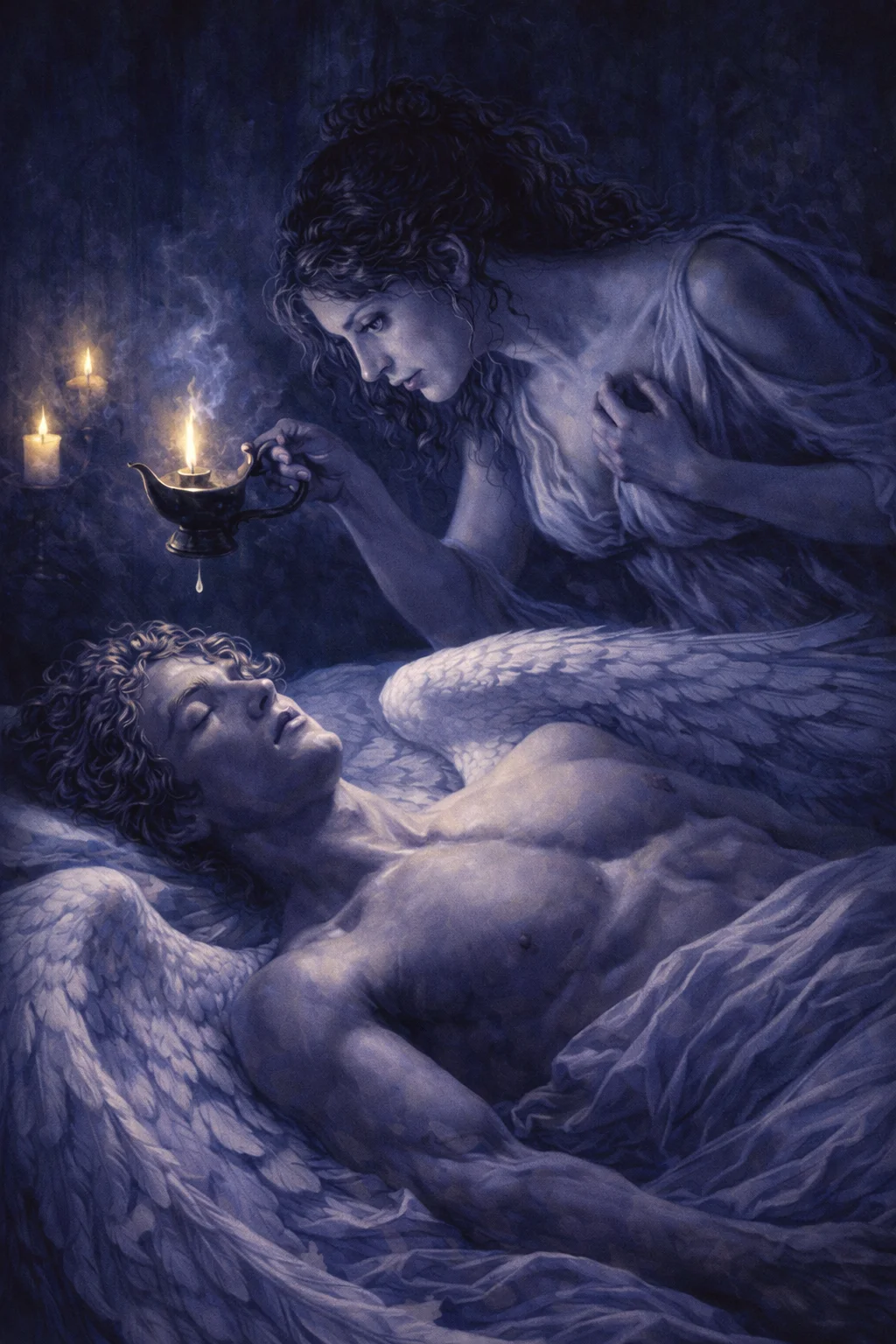
One night, overcome by doubt, Psyche lit an oil lamp and held it over her sleeping husband. She saw not a monster but the most beautiful god in existence, with golden wings folded against his back. Overcome with awe, her hand trembled. A drop of hot oil fell on his shoulder. Eros woke, saw the lamp, and flew away in pain and betrayal. 'Love cannot exist where there is no trust,' he told her. Psyche was cast out of the palace and left alone in the world.
The Impossible Tasks
Desperate to win Eros back, Psyche went to Aphrodite and begged for help. The goddess, still furious, set her four seemingly impossible tasks. First, she had to sort an enormous mixed pile of seeds (wheat, barley, millet, poppy, lentils) into separate heaps by morning. Ants, taking pity on her, did the work. Second, she had to gather golden wool from a flock of violent, sun-maddened sheep. A river reed whispered advice: wait until evening when the sheep calm down, then collect the wool caught on the thorns. Third, she had to fill a crystal flask with water from the River Styx at its most inaccessible point. An eagle of Zeus carried the flask and filled it for her.
The final task was the most dangerous: descend to the Underworld and ask Persephone for a box containing a portion of her divine beauty. Psyche succeeded, but on the way back, curiosity overcame her again. She opened the box, and instead of beauty, a deathlike sleep poured over her. She collapsed on the road, seemingly dead.
Immortality
Eros, who had been recovering from his burn wound, could no longer bear to be apart from Psyche. He flew to her, wiped the sleep from her eyes, and carried her to Olympus. Zeus, moved by their love story, granted Psyche immortality. She drank ambrosia and was transformed into a goddess. She and Eros were married on Olympus in a celebration attended by all the gods, and even Aphrodite danced at the wedding. They had a daughter named Hedone (Pleasure).
The Allegory
The story of Cupid and Psyche is one of the most explicitly allegorical myths in Greek tradition. Psyche means 'Soul' in Greek, and the story can be read as the journey of the human soul: born in beauty, tested by doubt and suffering, descending into death, and ultimately achieving immortality through love. The tale was preserved by the Roman writer Apuleius in his novel The Golden Ass (2nd century AD) and has influenced countless works of art and literature, from Renaissance paintings to the fairy tale of Beauty and the Beast.
Classical Sources
- 📜 Homer, Iliad & Odyssey (c. 750 BC)
- 📜 Hesiod, Theogony (c. 700 BC)
- 📜 Apollodorus, Bibliotheca (c. 1st-2nd century AD)
- 📜 Ovid, Metamorphoses (8 AD)
Cross-referenced with multiple classical sources for accuracy.
Explore More
Eros · Aphrodite · Persephone · Underworld · Home
A Roman novel, not a Greek epic
Almost everything we know of this story comes from one ancient source: the Metamorphoses of Apuleius, the Latin novel usually called The Golden Ass, written in the 2nd century AD by a North African author. The characters there are Venus, Cupid, Jupiter and Proserpina, and the Greek names (Aphrodite, Eros, Zeus, Persephone) are the usual modern way of rendering them. No Greek author before Apuleius tells the tale. Psyche does appear in earlier Hellenistic and Roman art, though: a girl with butterfly wings, often embracing or being tormented by Eros. The Greek word psyche means both "soul" and "butterfly".
The setting matters too. The story is told by a drunken old woman in a robbers' cave, to comfort a kidnapped bride named Charite. Apuleius calls it an old wives' tale (anilis fabula). It sits inside a comic and sometimes bawdy novel, and that playful frame shapes its tone, which is witty, sharp and only sometimes solemn.
Episodes that most retellings skip
The oracle and the "monster". Psyche's parents consult Apollo's oracle at Miletus, which orders them to dress her for a funeral-wedding and leave her on a mountain crag. Her husband, it says, will be a cruel winged evil feared even by Jupiter. That is Cupid, described the way his victims experience him. Zephyrus, the West Wind, carries her gently down into a valley with a palace served by bodiless voices.
The pregnancy and the razor. Cupid warns Psyche that she is pregnant. If she keeps his secret the child will be divine, and if she betrays it the child will be mortal. Her sisters persuade her that her husband is a huge serpent who will eat her once the pregnancy is far along. So she goes to the bed with a razor as well as the lamp, meaning to kill him. On seeing him she drops the blade, pricks her finger on one of his arrows and falls in love with Love himself.
Pan at the river. After Cupid flies off, Psyche throws herself into a river, which gently puts her back on the bank. Pan, sitting nearby with the mountain nymph Echo, kindly tells her to stop trying to die and to win the god back with prayers.
The sisters' end. Psyche takes revenge. She tells each sister in turn that Cupid now wants to marry her instead. Each one hurries to the crag, calls on Zephyrus to carry her down, jumps, and is dashed on the rocks.
Venus's household. Ceres and Juno both turn Psyche away to avoid offending Venus. Mercury puts out a reward for her capture. When she finally gives herself up, Venus hands her over to two servants named Anxiety and Sadness to be beaten before the tasks begin.
The rules of the underworld. For the last task, a speaking tower tells Psyche exactly what to do. Carry two barley cakes soaked in honeyed wine for Cerberus, one for each direction, and two coins in her mouth for Charon. Refuse to help a lame donkey driver, a dead man in the river reaching for the boat, and some old women weaving, because these are traps. In Proserpina's hall, sit on the ground and eat only coarse bread. Psyche follows every instruction until the very last test, which is curiosity about the box. See Cerberus and the Underworld.
The wedding. Cupid wipes the sleep off Psyche and puts it back in the box. Jupiter agrees to make the marriage lawful, with a joking condition: Cupid must find him a beautiful girl in return. At the feast Vulcan cooks, the Hours scatter roses, the Graces sprinkle balsam, Apollo sings to the lyre and Venus dances. Their daughter is called Voluptas in Latin, Hedone in Greek.
Afterlife in art and literature
Late antique and medieval readers treated the story as an allegory. Fulgentius (around the 5th–6th century) read Psyche's sisters as the flesh and free will, and Boccaccio's Genealogy of the Pagan Gods made it an allegory of the soul's union with God. In the Renaissance, Raphael and his workshop painted the Loggia of Psyche at the Villa Farnesina in Rome. Antonio Canova's marble Psyche Revived by Cupid's Kiss in the Louvre is probably the best-known image of the myth. In literature there is Keats's "Ode to Psyche" (1819) and C. S. Lewis's novel Till We Have Faces (1956), which retells the story through the eyes of an elder sister. Folklorists classify it with tales of the "search for the lost husband", such as "East of the Sun and West of the Moon", and its link to "Beauty and the Beast" is one of family resemblance, not direct descent.
One small correction. The line often quoted as Cupid's farewell, "Love cannot dwell with suspicion", comes from Thomas Bulfinch's 19th-century retelling, not from Apuleius. In the Latin, Cupid tells Psyche that his flight alone will be her punishment.
Ancient sources
- Apuleius, Metamorphoses (The Golden Ass) 4.28–6.24: the complete tale, from Psyche's dangerous beauty to the wedding feast on Olympus and the birth of Voluptas.
- Fulgentius, Mythologies, book 3: the earliest surviving allegorical reading, interpreting the characters as parts of the soul.
- Martianus Capella, The Marriage of Philology and Mercury, book 1: a late antique allegory in which Mercury considers Psyche as a bride but finds Cupid has already carried her off, showing how widely Apuleius' character was known.
- Boccaccio, Genealogy of the Pagan Gods: a medieval retelling and allegorisation that passed the story on to Renaissance artists.
Frequently asked questions
Is Cupid and Psyche a Greek or Roman myth?
The only full ancient version is Roman, in Latin prose, by Apuleius. Psyche as a winged soul-figure paired with Eros does appear in earlier Greek art, so the story may draw on older Greek ideas, but no Greek text of it survives.
What does Psyche's name mean?
"Soul" or "breath of life" in Greek. The same word also means "butterfly", which is why Psyche is often shown with butterfly wings.
Did Cupid and Psyche have a child?
Yes. A daughter called Voluptas in Apuleius' Latin (Hedone in Greek), meaning Pleasure or Delight.
Why couldn't Psyche look at Cupid?
Cupid was hiding the marriage from his mother, Venus, who had ordered him to punish Psyche. Seeing him would reveal his identity. He also warned that breaking the rule would make their unborn child mortal.
Books to read next
Links go to Bookshop.org, which supports independent bookstores. We earn a small commission if you buy, at no extra cost to you.