The Most Dramatic Birth in Mythology
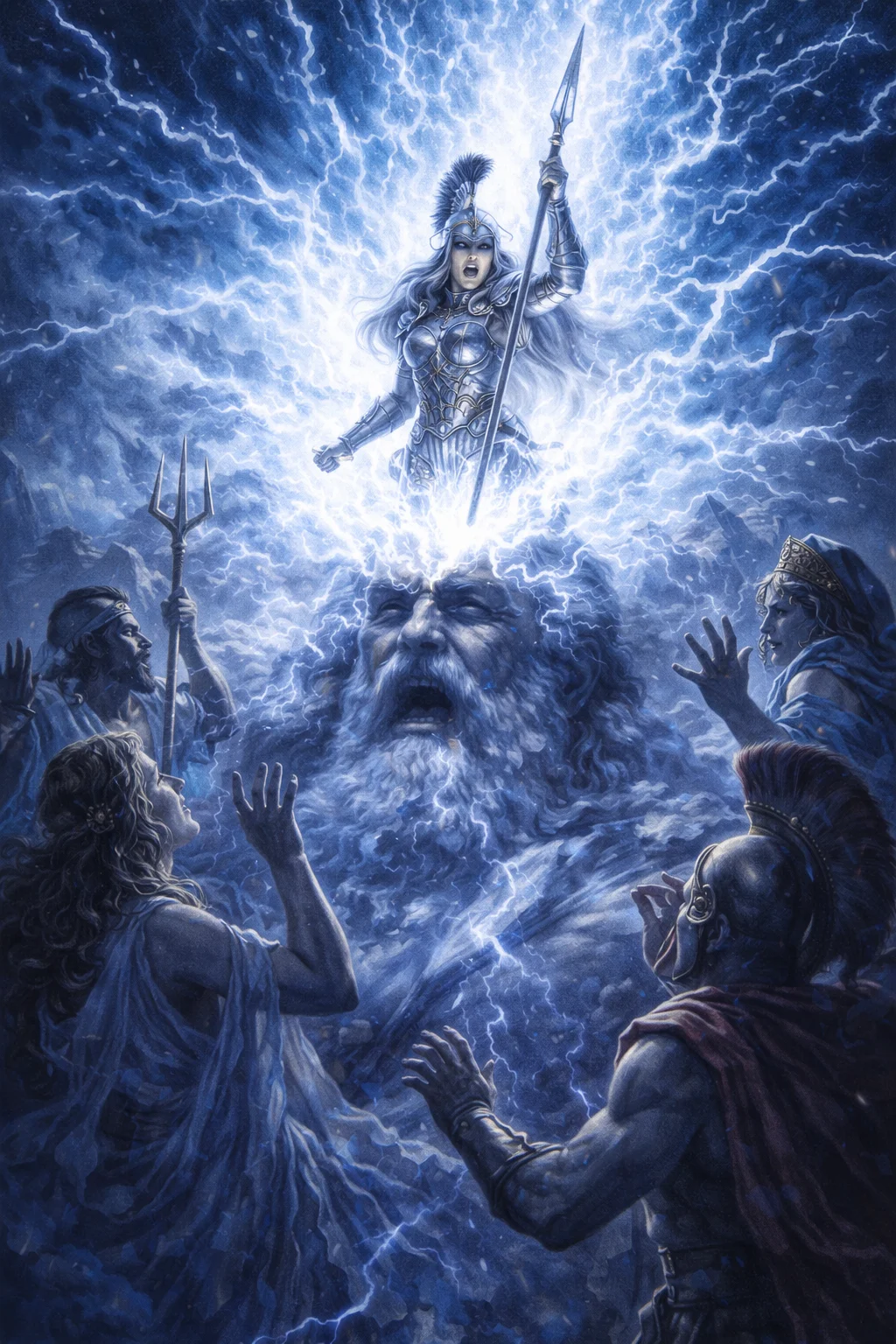
The birth of Athena is one of the most extraordinary events in all of Greek mythology — a story so dramatic and strange that it captured the imagination of artists, poets, and philosophers for thousands of years. Unlike every other god, Athena was not born in the conventional sense. She erupted from the skull of her father Zeus, fully grown and clad in gleaming golden armour, with a war cry that shook the heavens and made the earth tremble beneath her feet.
The Prophecy of Metis
The story begins with Zeus and the Titaness Metis — whose name means 'Wisdom' or 'Cunning Counsel.' Metis was Zeus's first wife and his most brilliant advisor. She had helped him devise the potion that forced his father Cronus to regurgitate Zeus's swallowed siblings, enabling the Olympians' rise to power. But Zeus received a prophecy that proved fatal to their union: Metis would bear two children. The first would be a daughter equal to Zeus in wisdom. The second would be a son destined to overthrow his father — just as Zeus had overthrown Cronus, and Cronus had overthrown Ouranos before him.
Terrified of repeating the cycle of divine succession, Zeus acted with the same ruthless pragmatism his father and grandfather had shown. When Metis became pregnant with their first child, Zeus tricked her into transforming into a small form — a fly or a drop of water, depending on the version — and swallowed her whole. By consuming Metis, Zeus absorbed her wisdom into himself and prevented the birth of the prophesied son.
The Splitting of Zeus's Head
But the daughter was already growing inside him. As the unborn Athena developed within Zeus's body, she migrated to his head, where she continued to grow. Zeus began to suffer agonizing headaches — blinding, crushing pain that no remedy could ease. The king of the gods, who could hurl thunderbolts and shake the earth, was brought to his knees by the pressure building inside his own skull.
Unable to bear the pain any longer, Zeus called upon Hephaestus — or, in some versions, Prometheus or Hermes — to split open his head with an axe. The blow was struck, and from the wound sprang Athena: a fully formed adult goddess wearing a crested helmet and carrying a spear and the fearsome aegis, a magical shield or breastplate. She gave a tremendous shout — a war cry that echoed across the cosmos — and the earth and sky shook at her arrival.
Significance
Athena's birth from Zeus's head — rather than from a mother's body — carried profound symbolic meaning for the ancient Greeks. It established Athena as purely her father's daughter, a goddess of the mind and intellect rather than of physical generation. She was born from thought itself, which connected her permanently to wisdom, strategy, and rational order. This origin also explained why Athena, alone among the major goddesses, remained a perpetual virgin — she was born outside the cycle of sexual reproduction and existed beyond its domain.
The myth also served a political function: it legitimised patriarchal authority by suggesting that a father alone could produce offspring, and that the mother's contribution was secondary. This argument appears explicitly in Aeschylus's Oresteia, where Apollo cites Athena's birth as proof that the father is the true parent. Athena herself, presiding over the trial, casts the deciding vote in favour of this view. Modern readers may find this deeply problematic, but it reveals how myths were used to justify and naturalise social structures in the ancient world.
Athena's Nature
Having been born in full armour, Athena was a warrior from her first breath — but a warrior of a particular kind. She represented disciplined, strategic warfare as opposed to the mindless violence of Ares. She was the goddess of the well-planned campaign, the fortified city, the defensive shield. Her birth in armour symbolised readiness and preparedness, while her emergence from Zeus's head connected her forever to wisdom, skill, and the life of the mind. She would become the patron of Athens, the goddess of crafts and weaving, and one of the most beloved and widely worshipped deities in the Greek world.
Classical Sources
This myth is recorded in multiple ancient sources:
- 📜 Homer, Iliad & Odyssey (c. 750 BC)
- 📜 Hesiod, Theogony & Works and Days (c. 700 BC)
- 📜 Apollodorus, Bibliotheca (c. 1st–2nd century AD)
- 📜 Ovid, Metamorphoses (8 AD)
- 📜 Greek Tragedians — Aeschylus, Sophocles, Euripides (5th century BC)
Cross-referenced with multiple classical sources for accuracy.
Explore More
Athena · Zeus · Hephaestus · Prometheus · Home
How the Ancient Poets Told It
The oldest full account is in Hesiod's Theogony. There Metis is the first of Zeus's wives, and Zeus swallows her on the advice of Gaia and Ouranos, who warn him that after a grey-eyed daughter Metis would bear a son to be king of gods and men. Hesiod says only that Athena was born from Zeus's head; he does not name anyone who swung an axe. He adds a pointed sequel: Hera, furious that Zeus had produced a child on his own, bore Hephaestus without any father. The Homeric Hymn to Apollo tells a darker version of Hera's response, in which her answer to Athena's birth is the monster Typhon.
The Homeric Hymn to Athena (Hymn 28) gives the most cosmic picture. When the goddess leapt from the immortal head brandishing a spear, great Olympus reeled, the earth cried out, the sea heaved with dark waves, and Helios halted his horses until Athena took the armour from her shoulders. Pindar's seventh Olympian ode supplies the axe: Hephaestus struck with a bronze-bladed axe, Athena sprang out with a shout, and Ouranos and Mother Earth shuddered. Pindar ties the birth to Rhodes, where Zeus rained gold on the island and the Rhodians, rushing to be first to honour her, forgot to bring fire, which explained why their sacrifices to Athena on the acropolis of Lindos were made without flame.
The axe-wielder varies. Since Hesiod makes Hephaestus Hera's response to Athena's birth, he could hardly have been the one to deliver her, and later writers sometimes gave the role to Prometheus instead. Euripides' Ion credits the Titan Prometheus, and Apollodorus records both names without choosing. Apollodorus also adds that Metis changed into many shapes to escape Zeus's embraces before he caught her, and that Athena was born beside the river Triton.
Other Fathers, Other Births
The head-birth was the Panhellenic version, but it was not the only one. Herodotus reports that the Libyans living around Lake Tritonis said Athena was the daughter of Poseidon and the lake, and that after a quarrel with her father she gave herself to Zeus, who made her his own daughter. Cicero's On the Nature of the Gods lists several Athenas, including one fathered by a Pallas whom she killed for trying to violate her. These variants are tied to the puzzling epithet Tritogeneia, which ancient writers explained in competing ways: born by the river or lake Triton (placed in Libya, Boeotia or Arcadia), or, by a strained etymology, "born from the head."
Homer knows the idea that Zeus bore Athena himself without telling the story. In Iliad 5, the wounded Ares complains to Zeus that he favours this destructive daughter because "you yourself begot her." Homer never mentions Metis.
The Birth in Art and Festival
The scene was a favourite of Athenian black-figure painters in the sixth century BC. The usual composition shows Zeus enthroned with a miniature, fully armed Athena springing from the crown of his head, birth-goddesses (Eileithyiai) flanking him as if attending a normal delivery, and Hephaestus hurrying away with his axe. The most famous version was the east pediment of the Parthenon, carved in the 430s BC, which faced worshippers as they approached the temple's entrance. Its centre was lost long ago, when the building was converted into a church, and scholars reconstruct it from surviving corner figures and later echoes such as a Roman marble well-head in Madrid.
Athens celebrated the goddess's birthday at the Panathenaia, held in the month Hekatombaion. The festival's centrepiece was a procession bringing a newly woven robe (peplos) to the ancient olive-wood statue of Athena Polias, and every fourth year the Great Panathenaia added athletic and musical contests, with prize amphorae of olive oil for the winners.
Common Misunderstandings
Athena is often said to have no mother, but the story only works because she has one: she is Metis's child, gestated inside Zeus after he swallowed her. The point of the myth is that Zeus absorbs both the mother's wisdom and the threat of her future son, ending the cycle of succession seen in the Titanomachy. Nor is the head-birth unique to Athena in Zeus's career: he also carried Dionysus in his thigh after Semele's death, though that was a rescue rather than a solo conception.
Ancient sources
- Hesiod, Theogony 886–900, 924–929 — Zeus swallows Metis to prevent the prophesied son; Athena born from his head; Hera bears Hephaestus alone in anger.
- Homeric Hymn to Athena (Hymn 28) — the armed birth that shakes Olympus, earth and sea and stops Helios in his course.
- Pindar, Olympian 7 — Hephaestus's bronze axe, the golden rain on Rhodes and the fireless sacrifices at Lindos.
- Herodotus, Histories 4.180 — the Libyan tradition that Athena was daughter of Poseidon and Lake Tritonis.
- Apollodorus, Library 1.3.6 — Metis's shape-changing, Prometheus or Hephaestus as the one who strikes, birth by the river Triton.
- Aeschylus, Eumenides — Apollo cites Athena, born without a mother's womb, as proof that the father is the true parent.
Frequently asked questions
Who split open Zeus's head?
Most often Hephaestus, as in Pindar and in Athenian vase-painting. Euripides and some later sources name Prometheus, and Apollodorus gives both options. Hesiod names no one.
Who was Athena's mother?
Metis, the Oceanid goddess of cunning intelligence, whom Zeus swallowed while she was pregnant. Local traditions recorded by Herodotus and Cicero gave her other parents, but Metis is the standard answer.
Why was Athena born in armour?
The poems do not explain it, but the image marks her as a war goddess from the first moment. The Hymn's detail that the cosmos only settled when she removed her armour suggests that her power was felt as a threat even by the gods.
Where was Athena's birth depicted?
Most famously on the east pediment of the Parthenon, and on many Athenian black-figure vases of the sixth century BC.