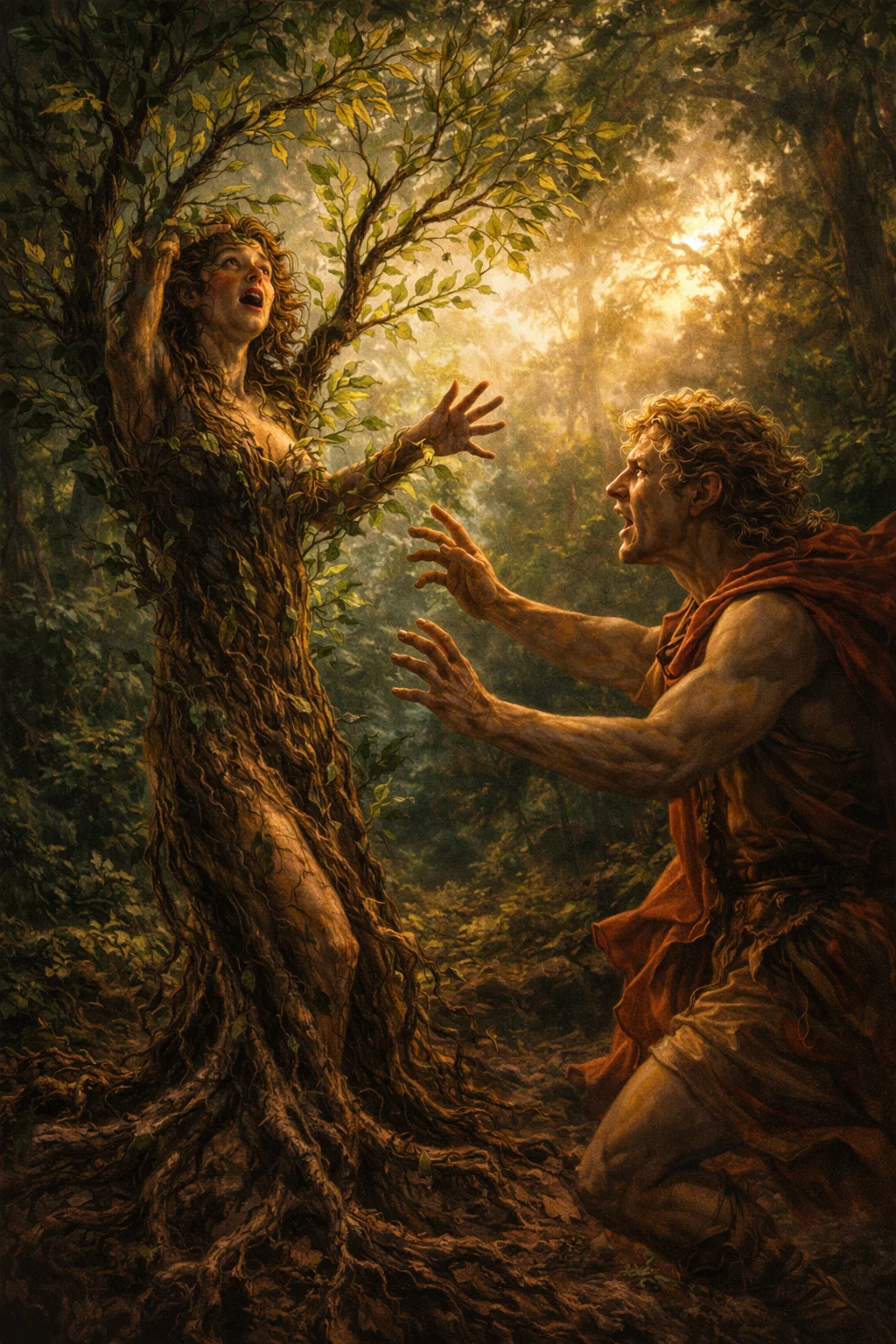
Eros's Revenge
The myth begins with Apollo mocking Eros. Fresh from slaying the great serpent Python, Apollo was boasting about his prowess with the bow when he saw the young love god and laughed at him. What could a child with a toy bow know about real archery? Eros, insulted, decided to teach Apollo a lesson about the power of love. He fired two arrows: one gold-tipped, which caused irresistible desire, and one lead-tipped, which caused utter repulsion. The gold arrow struck Apollo. The lead arrow struck the nymph Daphne.
The Chase
Apollo was instantly consumed with desire for Daphne. Daphne was instantly consumed with revulsion for Apollo. He pursued her through forests and meadows, calling out promises of love, listing his accomplishments, telling her he was the god of prophecy, medicine, and music. Daphne ran. She did not care that he was a god. She did not care about his temples or his powers. She wanted nothing to do with him or any man. She was a devotee of Artemis who had sworn to remain a virgin, and Apollo's pursuit was a violation of everything she valued.
The Transformation
As Apollo gained on her, Daphne cried out to her father, the river god Peneus, begging him to destroy her beauty or transform her so that Apollo could not have her. The moment Apollo's fingers touched her skin, bark began to cover her body. Her feet became roots sinking into the earth. Her arms became branches reaching toward the sky. Her hair became leaves. In seconds, the running girl was gone. In her place stood a laurel tree.
Apollo, reaching the tree, pressed his hand against the bark and felt her heart still beating inside the trunk. He wept. He declared that since he could not have Daphne as his lover, the laurel would be his sacred tree forever. He would wear a crown of laurel leaves, and laurel wreaths would be awarded to victors in athletic games, poets, and military commanders. To this day, the laurel wreath remains a symbol of achievement, and the word 'laureate' (as in Nobel Laureate or Poet Laureate) derives directly from this myth.
What the Myth Really Says
Modern readers often note the disturbing dynamics of this story. A woman says no, a powerful male refuses to accept it, and the only escape available to her is to stop being human entirely. Daphne would literally rather become a tree than be with Apollo. And even after her transformation, Apollo claims ownership of the laurel, turning her rejection into his symbol. The myth can be read as a story about the impossibility of escape from power, or as a critique of male entitlement that the ancient authors embedded in a seemingly romantic narrative. The laurel wreath on every graduate's cap carries this uncomfortable history within it.
Classical Sources
- 📜 Homer, Iliad & Odyssey (c. 750 BC)
- 📜 Hesiod, Theogony (c. 700 BC)
- 📜 Apollodorus, Bibliotheca (c. 1st-2nd century AD)
- 📜 Ovid, Metamorphoses (8 AD)
Cross-referenced with multiple classical sources for accuracy.