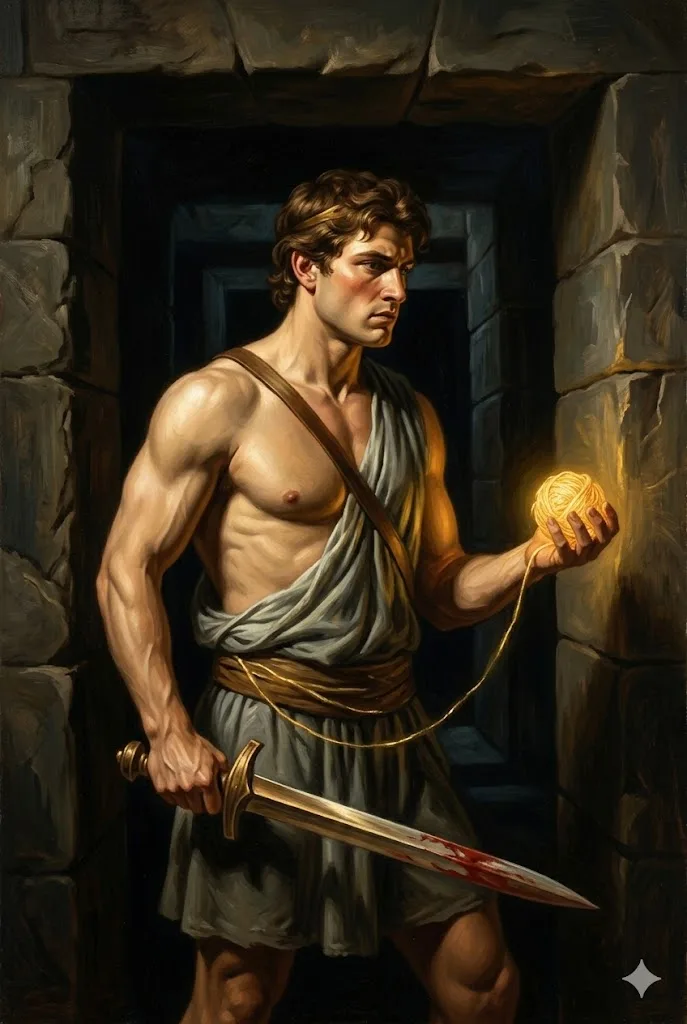
I. Who Was Theseus?
Theseus was the great hero-king of Athens — the city's mythological founder and the mortal who freed Athens from its terrible tribute to King Minos of Crete. While Heracles was the hero of all Greece and Achilles the hero of the Trojan War, Theseus belonged specifically to Athens. The Athenians revered him as the man who unified the scattered settlements of Attica into a single city-state and laid the foundations for what would become the world's first democracy.
His parentage was dual: his mother Aethra lay with both the mortal King Aegeus of Athens and the god Poseidon on the same night, giving Theseus both a royal and a divine claim to power. He grew up in Troezen, unaware of his true father's identity, until he was old enough to lift a heavy rock under which Aegeus had hidden a sword and a pair of sandals — the tokens by which Theseus would prove his heritage.
II. The Journey to Athens
Rather than sail safely to Athens by sea, the young Theseus chose the dangerous overland route, deliberately seeking out and defeating a series of bandits and monsters along the way — much as Heracles had done with his Labours. He killed Periphetes the club-wielder, Sinis the pine-bender, the Crommyonian Sow, Sciron who kicked travelers off a cliff, Cercyon the wrestler, and Procrustes who stretched or amputated travelers to fit his iron bed. By the time he reached Athens, he was already famous.
III. The Minotaur
Athens owed a terrible debt to Crete: every nine years, fourteen young Athenians (seven men and seven women) were sent as tribute to be devoured by the Minotaur in the Labyrinth. Theseus volunteered to be one of the fourteen, vowing to end the tribute forever. On Crete, King Minos's daughter Ariadne fell in love with him and gave him a ball of thread to unwind as he entered the maze so he could find his way back out.
Theseus ventured into the dark heart of the Labyrinth, found the Minotaur, and slew it — either with his fists, a club, or a hidden sword. Following Ariadne's thread, he led the other Athenians safely out. He sailed home with Ariadne (whom he later abandoned on the island of Naxos, where Dionysus found and married her), but forgot his father's instruction to change his ship's black sails to white. Seeing the black sails, Aegeus believed his son was dead and threw himself into the sea — thereafter called the Aegean.
IV. King of Athens
As king, Theseus was credited with the synoikismos — the unification of the independent villages of Attica into a single political entity centered on Athens. He was said to have established democratic institutions, willingly surrendering much of his royal authority to the people. Later adventures included his expedition with Heracles against the Amazons (capturing their queen Hippolyta, who became his wife) and his ill-fated descent into the underworld with his friend Pirithous to abduct Persephone — where they were trapped by Hades until Heracles eventually freed Theseus.
Medea, the Marathonian Bull and the Pallantids
Theseus's arrival in Athens did not go smoothly. Aegeus had by then married Medea, who had fled Corinth after murdering her children. She recognised the young stranger before Aegeus did and saw a threat to her own son, Medus. In the version Apollodorus gives (Epitome 1), she first persuaded Aegeus to send the newcomer against the Marathonian bull, the same Cretan bull Heracles had brought to the mainland. Theseus captured it and sacrificed it. Medea then handed him a cup of poison at a banquet. Ovid (Metamorphoses 7) says it was aconite. Just in time Aegeus recognised the sword at the young man's belt and knocked the cup away, and Medea fled the city.
His claim was challenged next by his cousins, the fifty sons of Pallas, Aegeus's brother. They had expected to inherit Athens and took up arms against him. Plutarch tells how a herald named Leos betrayed their ambush, and Theseus wiped them out. Some writers said he went into a year's exile at Troezen to purify himself of kin-killing, and Euripides makes this the background of his Hippolytus.
Ariadne, Phaedra and Hippolytus: The Variant Versions
Ancient authors could not agree on what happened to Ariadne. In the Odyssey (11.321–325) she is killed by Artemis on the island of Dia "on the testimony of Dionysus", which suggests she was already promised to the god. Other writers say Dionysus took her from Theseus by force, or that Theseus left her of his own accord. Plutarch quotes a verse attributed to Hesiod that blames his love for Aigle, daughter of Panopeus. Bacchylides' Ode 17 tells a separate episode from the voyage to Crete. Minos mocked Theseus's claim to be Poseidon's son and threw a gold ring into the sea. Theseus dived after it and was welcomed beneath the waves by Amphitrite, who gave him a purple robe and a wreath. He came back up dry, which proved his descent.
His later marriage turned out worse. He married Phaedra, Ariadne's sister. She fell in love with Hippolytus, Theseus's son by the Amazon queen (called Hippolyta or Antiope, depending on the author). When Hippolytus rejected her, she accused him of rape and hanged herself. Theseus cursed his son with one of three wishes Poseidon had granted him. A bull rose from the sea, Hippolytus's horses bolted, and he was dragged to his death. In Euripides' surviving play Artemis reveals the truth only after the curse can no longer be stopped.
Pirithous, Helen and an Ignoble Death
Theseus's friendship with the Lapith king Pirithous began with a stand-off over stolen cattle. It ended with the two of them making reckless vows. At Pirithous's wedding Theseus fought the drunken centaurs, a scene the Greeks carved on the west pediment of the temple of Zeus at Olympia. The two friends then swore to marry daughters of Zeus. Theseus kidnapped the young Helen from Sparta and left her with his mother Aethra at Aphidna. While he was in the underworld, Helen's brothers Castor and Polydeuces invaded Attica, freed Helen and took Aethra away as a slave. Aethra later turns up at Troy as Helen's servant.
When Theseus came back, the Athenians had turned against him. A rival named Menestheus held power, and Menestheus is the man who leads the Athenians in the Iliad's Catalogue of Ships. Theseus went to the island of Skyros, where King Lycomedes pushed him off a cliff. Centuries later, in about 476/5 BC, the Athenian general Cimon conquered Skyros. He claimed to have found a huge skeleton there with a bronze spear and sword, and brought the bones home to be buried in a new sanctuary, the Theseion.
Cult, Festivals and Art
Athenians honoured Theseus at the Theseia, held on the eighth of the month Pyanepsion. Plutarch links the Oschophoria and the Pyanepsia festivals to his return from Crete. Plutarch also preserves two well-known traditions. On Delos, Theseus and the rescued youths were said to have performed the geranos ("crane dance"), whose winding steps imitated the Labyrinth. The Athenians also kept his ship until the time of Demetrius of Phalerum and replaced its rotten planks one by one, which gave philosophers the "Ship of Theseus" puzzle about identity.
In art, Theseus became a deliberate Athenian rival to Heracles in the late sixth century BC. Painters began showing his roadside labours in sequence on "cycle cups". The Athenian Treasury at Delphi (c. 500–490 BC) set his deeds on its metopes next to those of Heracles. One common mistake concerns the well-preserved Doric temple overlooking the Athenian Agora. It is usually called the "Theseion", but it was actually the temple of Hephaestus. The name comes from its sculptures of Theseus's deeds. Cimon's real shrine for the hero's bones, which the painter Micon decorated, has never been securely located.
Ancient sources
- Plutarch, Life of Theseus: the fullest ancient biography. It weighs rival versions and records the Ship of Theseus, the crane dance and Cimon's recovery of the bones.
- Bacchylides, Odes 17 and 18: Ode 17 tells the dive for Minos's ring. Ode 18 is a dialogue announcing the young Theseus's roadside victories as he approaches Athens.
- Euripides, Hippolytus (428 BC): the tragedy of Phaedra's false accusation and Theseus's curse. His Suppliants presents him as the ideal democratic king.
- Apollodorus, Library 3.15–16 and Epitome 1: a compact narrative from his birth to his death on Skyros.
- Homer, Odyssey 11.321–325: the earliest mention of Ariadne's death on Dia.
- Pausanias, Description of Greece, Book 1: describes the Athenian sanctuary of Theseus and its paintings of the Amazons, the centaurs and the dive to the sea.
Frequently asked questions
How did Theseus die?
Theseus had lost power in Athens to Menestheus, so he went to the island of Skyros. Its king Lycomedes feared him and pushed him off a cliff. The Athenians later brought back bones they believed were his.
Who was Theseus's wife?
He had several wives. Ancient sources name the Amazon queen Antiope or Hippolyta, the mother of Hippolytus, and later Phaedra, the daughter of Minos. Some versions also give Ariadne as his bride, at least for a while.
What is the Ship of Theseus paradox?
Plutarch says the Athenians preserved Theseus's ship by replacing each decayed timber. Philosophers then asked whether a ship whose parts have all been replaced is still the same ship.
Was Theseus a real person?
There is no evidence that he was a historical king. To the Athenians he was a founding figure, and they reshaped his legend over time to suit their politics, especially in the sixth and fifth centuries BC.
Explore More Mythology
Get weekly deep dives into the gods, heroes, and myths of ancient Greece.