The Craftiest Mortal
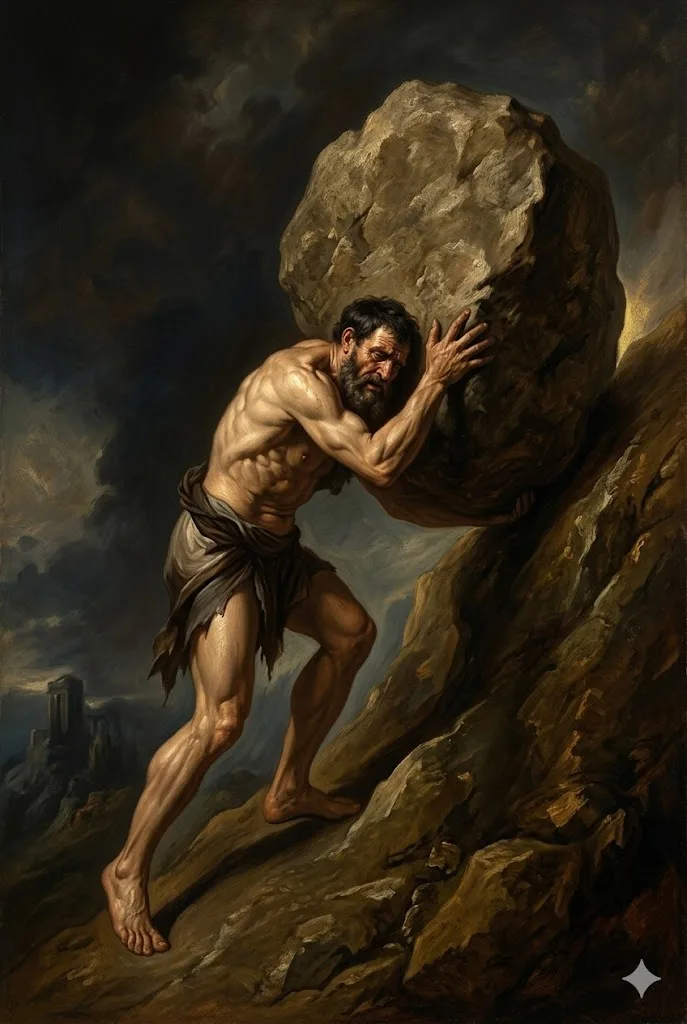
Sisyphus was the legendary founder and first king of Corinth (originally called Ephyra), and the craftiest mortal who ever lived. He was so clever that he cheated Death not once but twice — a feat unmatched in Greek mythology. His eventual punishment became the most famous image of futility in Western culture: condemned for eternity to push a massive boulder up a hill, only for it to roll back down each time he neared the summit. But Sisyphus was more than his punishment. He was a trickster, a deceiver of gods, and a man who refused to accept the limits that separated mortals from immortals.
Cheating Death — Twice
The first time Death came for Sisyphus, the king somehow managed to bind Thanatos (Death) himself in chains. With Death imprisoned, no one on earth could die. Warriors fell in battle and got back up. The sick lingered endlessly. Ares, god of war, was particularly annoyed — what was the point of warfare if no one died? The gods eventually freed Thanatos and ordered him to take Sisyphus to the underworld. But Sisyphus had prepared a second trick. He instructed his wife Merope not to perform any funeral rites for him. Once in the underworld, he complained to Persephone that his wife had dishonored him by leaving his body unburied. Sympathetic, Persephone allowed him to return to the living to reprimand his wife. Once back in the sunlight, Sisyphus simply refused to return. He lived for many more years before the gods finally dragged him back.
The Eternal Punishment
The gods assigned Sisyphus his famous punishment: to push an immense boulder up a steep hill for eternity. Each time he neared the summit, the boulder would roll back to the bottom, and he would have to begin again. The most common ancient reason given for it was a betrayal of Zeus: Sisyphus had told the river god Asopus that Zeus had carried off his daughter Aegina. Many retellings also tie the punishment to his escapes from Death. He had tried to make himself immortal through cleverness, so the gods gave him immortality — but as an endless, meaningless task. The boulder represented the futility of trying to overcome the fundamental conditions of human existence. No matter how clever you are, the rock always rolls back down.
The Myth of Sisyphus
In 1942, the French philosopher Albert Camus published The Myth of Sisyphus, transforming the ancient punishment into the central metaphor of existentialist philosophy. Camus argued that Sisyphus's situation — endlessly performing a meaningless task — was the perfect image of human life. We all push our boulders uphill, knowing they will roll back down. But Camus concluded with a radical inversion: 'One must imagine Sisyphus happy.' The act of pushing, of refusing to give up, of choosing to continue despite the absurdity — that was where meaning was created. Sisyphus became a hero not despite his punishment but because of how he endured it.
Classical Sources
- 📜 Homer, Iliad & Odyssey (c. 750 BC)
- 📜 Apollodorus, Bibliotheca
- 📜 Ovid, Metamorphoses (8 AD)
- 📜 Pausanias, Description of Greece
Cross-referenced with multiple classical sources for accuracy.
Explore More
Thanatos · Corinth · Hades · Persephone · Home
Family and kingdom
Sisyphus was a son of Aeolus, the ancestor of the Aeolian Greeks (not the keeper of the winds), and Enarete. His brothers included Salmoneus, who imitated Zeus' thunder, and Athamas. He hated Salmoneus enough that, according to Hyginus, he asked Apollo how he could kill him and was told to father children on his brother's daughter Tyro. Tyro discovered the prophecy and killed the children. His wife Merope was one of the Pleiades. Ovid says that of the seven stars she shines most faintly, ashamed that she alone married a mortal. Their son Glaucus was the father of Bellerophon, so Sisyphus is the great hero's grandfather. Homer names him in the Iliad when Glaucus of Lycia recites his family tree: "Sisyphus, who was craftiest of men, son of Aeolus", living in Ephyra "in a corner of horse-pasturing Argos". As founder of Corinth he was also credited with setting up the Isthmian Games in honour of the drowned boy Melicertes, whose body washed ashore there.
Why the gods punished him: the sources disagree
The page's story of cheating Death is only one explanation. Several others were told. The most common, in Apollodorus and Pausanias, is that Sisyphus told the river-god Asopus who had carried off his daughter Aegina: it was Zeus. In return Asopus gave him a spring on the Acrocorinth, which Pausanias identifies with the spring behind the temple of Aphrodite there. Zeus' anger at the informer explains why Thanatos was sent in the first place. Other traditions make him a robber who killed travellers, or a man who revealed the gods' secrets to mortals in general.
The trick of escaping the underworld is old. The 6th-century poet Theognis says Sisyphus came back up from Hades by persuading Persephone with his clever words. A fragment of Alcaeus mentions him crossing the Acheron twice. The version in which he chains Death himself goes back to the early mythographer Pherecydes, and in that account it is Ares who frees Thanatos, annoyed that no one on the battlefield could die. Aeschylus wrote at least one satyr play about him. The titles Sisyphus the Runaway and Sisyphus the Stone-Roller survive, though whether they were one play or two is unclear.
Thief, seducer, and possible father of Odysseus
Sisyphus also features in a well-known contest of thieves with Autolycus, the son of Hermes, who could change the appearance of anything he stole. When Sisyphus' cattle kept disappearing while Autolycus' herd kept growing, Sisyphus marked the underside of his animals' hooves so their tracks spelled out his name or "stolen by Autolycus". That is how he caught the thief. Later sources add that he then seduced Autolycus' daughter Anticleia, just before her marriage to Laertes. That makes Odysseus Sisyphus' son. Attic tragedy liked this hostile genealogy: in Sophocles' Ajax and Philoctetes, and in Euripides' Cyclops, enemies of Odysseus call him "son of Sisyphus" as an insult to his trickery.
The boulder in literature and art
The punishment first appears in Odyssey Book 11, where Odysseus sees Sisyphus heaving a huge stone with hands and feet. Just as he is about to push it over the top, its weight turns it back, the "shameless stone" rolls down to the plain, and he strains again with sweat streaming from his limbs and dust rising from his head. Homer never says what his crime was. The Roman poet Lucretius reads the myth as an allegory of the politician who keeps running for office and keeps being defeated. Pausanias describes Polygnotus' great painting of the underworld at Delphi, in which Sisyphus appears pushing his rock. Titian painted him with the boulder on his shoulders (1548–49, now in the Prado). A speech from a lost drama titled Sisyphus, attributed to Critias or Euripides, has the character argue that a clever man invented the gods to keep people from secret crimes. It is one of the earliest atheist arguments in Greek. For his place among the damned, see Greek mythology punishments.
Ancient sources
- Homer, Iliad 6.152–155: Sisyphus son of Aeolus, "craftiest of men", ruler of Ephyra and grandfather of Bellerophon.
- Homer, Odyssey 11.593–600: the earliest description of the boulder punishment.
- Theognis, Elegies 702–712: Sisyphus returning from Hades by persuading Persephone.
- Apollodorus, Bibliotheca 1.9.3 and 3.12.6: his parentage, the betrayal of Zeus' abduction of Aegina to Asopus, and the stone punishment.
- Pausanias, Description of Greece 2.1.3, 2.5.1 and 10.31.10: the Isthmian Games, the spring on Acrocorinth, and Polygnotus' painting at Delphi.
- Lucretius, De Rerum Natura 3.995–1002: the allegory of the ambitious politician.
Frequently asked questions
What did Sisyphus do to deserve his punishment?
Ancient answers vary. He revealed Zeus' abduction of Aegina to her father, he chained or tricked Death, and he escaped Hades by deceiving Persephone. Most versions combine betraying the gods' secrets with refusing to stay dead.
Was Sisyphus the father of Odysseus?
In the Odyssey, Laertes is the father. A hostile later tradition, used often by the tragedians, said Sisyphus seduced Anticleia before her marriage, making Odysseus his son.
Where is Sisyphus punished?
Homer places him in Hades among the great sinners alongside Tantalus and Tityus. Later writers locate the punishment in Tartarus.
What does "Sisyphean" mean?
A Sisyphean task is endless and futile, one that must be done again and again without ever being finished. For the myth in brief, see the myth of Sisyphus.