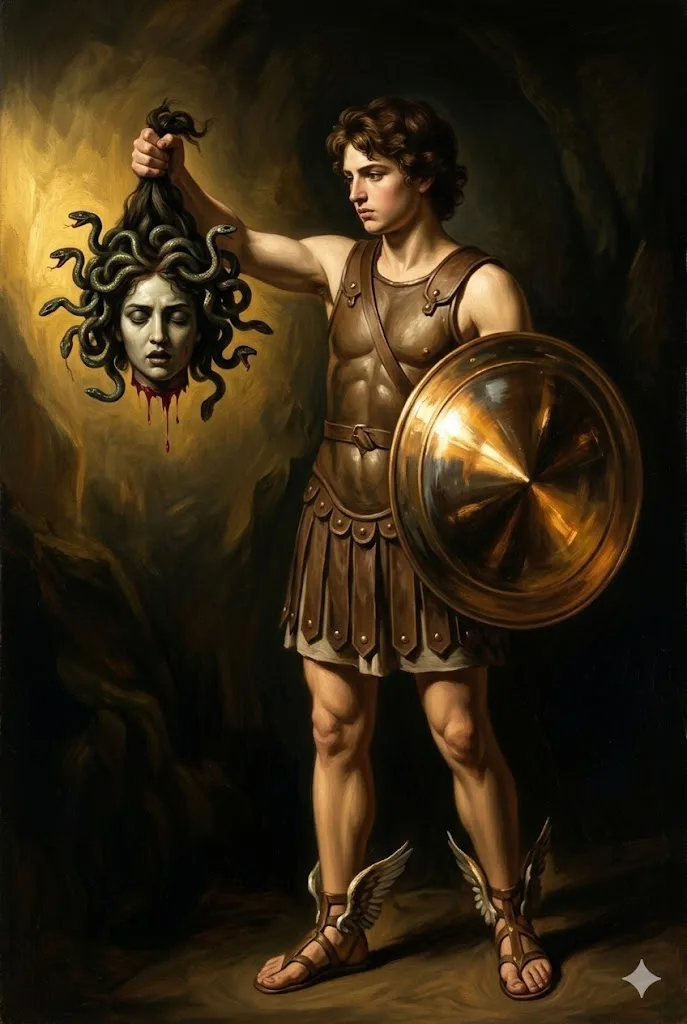
I. Who Was Perseus?
Perseus was one of the greatest heroes of Greek mythology — the slayer of the Gorgon Medusa, the rescuer of the princess Andromeda, and the founder of the city of Mycenae. He was the son of Zeus and the mortal princess Danae, conceived when Zeus visited her in the form of a shower of golden rain while she was imprisoned in a bronze tower by her father Acrisius, who had been warned by an oracle that his grandson would kill him.
Set adrift on the sea in a wooden chest with his infant son, Danae washed ashore on the island of Seriphos, where the fisherman Dictys raised Perseus to manhood. When the island's king Polydectes desired Danae and wanted Perseus out of the way, he challenged the young hero to bring him the head of Medusa — a quest intended to be a death sentence.
II. The Quest for Medusa
Perseus received divine assistance from Athena (who gave him her polished bronze shield to use as a mirror) and Hermes (who, in Apollodorus, gave him an adamantine sickle). He first sought out the Graeae — three ancient sisters who shared a single eye and tooth — and forced them to reveal the way to certain nymphs, who gave him winged sandals, the cap of invisibility, and a pouch (kibisis). In later versions Hermes lends the sandals himself and the Graeae point directly to the Gorgons' lair at the edge of the world.
Approaching Medusa while she slept, Perseus used the shield's reflection to guide his hand and severed her head with a single blow. From her neck sprang Pegasus, the winged horse, and Chrysaor, a golden warrior. Perseus placed the head in his magic bag and fled before the immortal Gorgon sisters could catch him.
III. Andromeda & Legacy
On his journey home, Perseus encountered Andromeda chained to a rock by the sea — a sacrifice to a sea monster sent by Poseidon to punish her mother Cassiopeia's vanity. Perseus slew the creature using Medusa's petrifying head and claimed Andromeda as his bride. They returned to Seriphos, where Perseus turned Polydectes and his court to stone, freeing his mother. He later accidentally fulfilled the prophecy by killing his grandfather Acrisius with a stray discus throw during athletic games — and went on to found the great city of Mycenae. Both Perseus and Andromeda were placed among the stars as constellations.
Danae, the chest, and what the earliest poets say
The earliest sources do not mention a tower. In Apollodorus, Acrisius shuts Danae in a bronze chamber built underground, and Sophocles' Antigone also calls it a bronze-bound room. The tower comes later. One of the most moving surviving fragments of Greek lyric is Simonides' lament of Danae. Adrift in the "well-wrought chest" while the wind howls and the sea heaves, she watches her baby sleep and begs Zeus to change their fate. The Hesiodic Shield of Heracles describes Perseus, carved on the shield, flying away from the Gorgons with the head in his bag (kibisis) and the cap of Hades on his head. The sisters chase behind him with snakes hissing at their belts.
Who gave Perseus his equipment?
The versions disagree, and it is often told wrongly. In Apollodorus, Hermes and Athena guide Perseus to the Graeae, the grey-haired daughters of Phorcys. He takes their one eye and tooth. They do not tell him where Medusa is. They tell him the way to certain nymphs. The nymphs give him the winged sandals, the kibisis and the cap of Hades that makes the wearer invisible. Hermes adds the adamantine sickle (harpe). Athena guides his hand while he looks at Medusa's reflection in a bronze shield. Aeschylus wrote a lost play, Phorcides, about the Graeae episode. Ovid has him first visit Atlas, who refuses him hospitality, and Perseus turns the Titan into the mountain range that bears his name.
Pindar adds two lovely details. In Pythian 12, Athena invents the aulos, the double pipe, to copy the wailing of Medusa's sisters over her corpse. In Pythian 10, Perseus feasts with the Hyperboreans at the edge of the world. Ovid explains that coral was born when Perseus laid the Gorgon's head on seaweed, which hardened at its touch. For the monster herself, see Medusa and the Gorgons.
Andromeda, Phineus, and the return to Argos
Andromeda's father Cepheus had promised her to his brother Phineus, who arrived with armed men to claim her at her wedding to Perseus. Ovid devotes most of Metamorphoses Book 5 to the bloody battle in the banquet hall, which ends when Perseus pulls out the head and turns Phineus and his surviving followers to stone. Euripides' Andromeda (412 BC), now lost, was famous enough that Aristophanes parodied it in the Thesmophoriazusae a year later. In Apollodorus' account, Perseus gives the head to Athena, who sets it in the centre of her aegis, and returns his magic equipment to Hermes, who gives it back to the nymphs.
Apollodorus places the discus accident at Larissa in Thessaly, at funeral games held by King Teutamides. Acrisius had gone there to escape the prophecy. Ashamed to inherit Argos from the man he had killed, Perseus exchanged kingdoms with his cousin Megapenthes, son of Proetus, and took Tiryns instead. He then fortified Midea and founded Mycenae. Pausanias records two explanations of that name: the cap (mykes) of his scabbard fell off there, or, thirsty, he pulled up a mushroom (also mykes) and drank from the water that flowed out of the ground.
Family, cult, and images
His children with Andromeda were Perses, whom Herodotus makes the ancestor of the Persian kings, along with Alcaeus, Sthenelus, Heleus, Mestor, Electryon and a daughter, Gorgophone. Through Electryon's daughter Alcmene, Perseus was the great-grandfather of Heracles. Through Sthenelus he was the grandfather of Eurystheus, who would assign Heracles his labours. Pausanias saw a hero-shrine to Perseus on the road from Mycenae to Argos. Herodotus reports, surprisingly, that at Chemmis in Egypt there was a temple of Perseus where locals said he often appeared and left behind a sandal two cubits long.
A metope from Temple C at Selinus in Sicily (6th century BC) shows Perseus beheading Medusa while Athena watches and Pegasus springs from the Gorgon's body. Benvenuto Cellini's bronze Perseus with the Head of Medusa (completed 1554) still stands in the Loggia dei Lanzi in Florence. One very common mistake: Perseus does not ride Pegasus in the ancient myths. The winged horse belongs to Bellerophon, and the Perseus-on-Pegasus image is Renaissance and modern. The "Kraken" comes from the 1981 film Clash of the Titans. The ancient monster is just a ketos, a sea-beast.
Ancient sources
- Apollodorus, Bibliotheca 2.4.1–5: the fullest account, from Danae's chamber to the founding of Mycenae, including the nymphs and the death of Acrisius at Larissa.
- Simonides, fragment 543 (PMG): Danae's lament in the chest at sea.
- Hesiod (attributed), Shield of Heracles 216–237: Perseus in flight from the Gorgons with the kibisis and cap of Hades.
- Pindar, Pythian 10 and Pythian 12: the visit to the Hyperboreans, and Athena's invention of the aulos from the Gorgons' lament.
- Ovid, Metamorphoses 4.604–5.249: Atlas, Andromeda, the origin of coral, and the battle with Phineus.
- Pausanias, Description of Greece 2.16.3 and 2.18.1: the naming of Mycenae and Perseus' hero-shrine.
Frequently asked questions
Did Perseus ride Pegasus?
Not in ancient sources. Pegasus was born from Medusa's neck when Perseus beheaded her, but the hero who tamed and rode him was Bellerophon.
How did Perseus kill Medusa without looking at her?
He looked at her reflection in a polished bronze shield while Athena guided his hand, and cut off her head with the harpe Hermes had given him.
Is Perseus related to Heracles?
Yes. Heracles' mother Alcmene was Perseus' granddaughter, so Perseus was Heracles' great-grandfather. Both Amphitryon and Eurystheus were also his grandsons.
What happened to Medusa's head?
Perseus gave it to Athena, who put it on her aegis or shield as the gorgoneion. For the whole quest, see Perseus and Medusa.
Explore More Mythology
Get weekly deep dives into the gods, heroes, and myths of ancient Greece.