Patroclus — The Faithful Companion Whose Death Unlea
⚡ Quick Facts
The Bond That Defined Troy
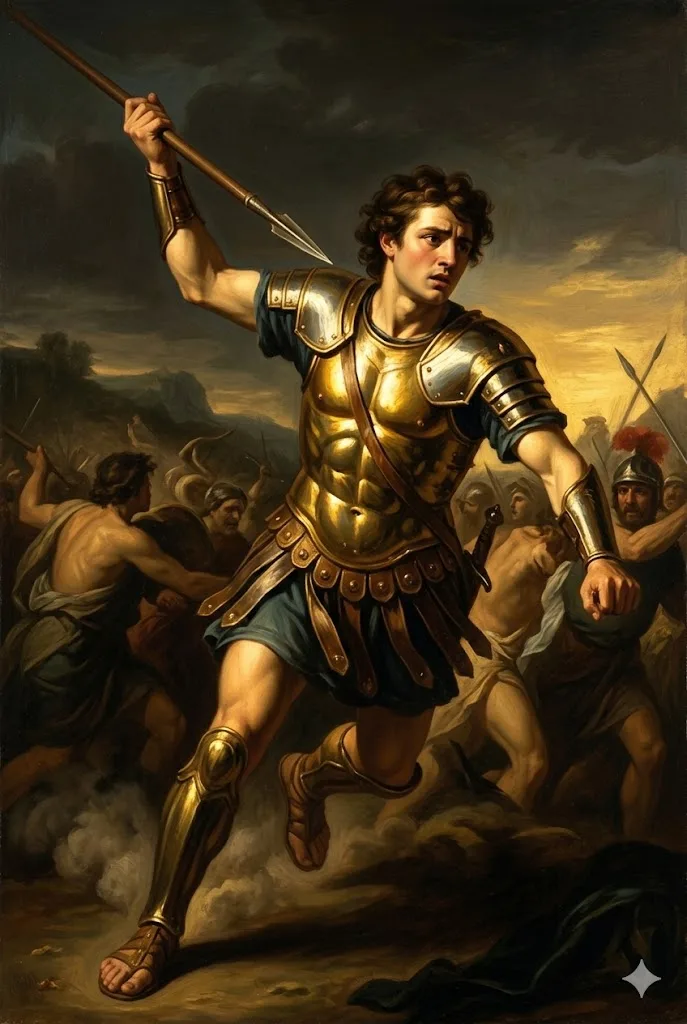
Patroclus is one of the most emotionally significant figures in Greek mythology. His relationship with Achilles — whether interpreted as deep friendship, brotherhood, or romantic love — forms the emotional heart of Homer's Iliad. When Patroclus fell, he didn't just die; he set in motion the chain of events that would bring the greatest Greek warrior back to battle and ultimately doom Troy.
As a young man, Patroclus accidentally killed Clysonymus during a game of dice. His father Menoetius sent him to Phthia, where King Peleus took him in. There he met the young Achilles, and the two became inseparable. When the Greeks sailed for Troy, Patroclus went not as a king or commander but because he refused to be parted from Achilles.
The Fatal Deception
When Achilles withdrew from battle over his quarrel with Agamemnon, the Greeks suffered devastating losses. The Trojans pushed all the way to the Greek ships and began setting them ablaze. Patroclus could not bear to watch his comrades die while Achilles nursed his pride.
He begged Achilles to let him fight, and Achilles agreed — but with a condition. Patroclus could wear Achilles' distinctive armor to frighten the Trojans, but he must only drive them back from the ships. He was not to pursue them to the walls of Troy. Patroclus agreed, but in the heat of battle, carried away by his own success, he charged all the way to Troy's gates.
Apollo himself struck Patroclus from behind, knocking off the divine armor. Stunned and exposed, he was first speared by Euphorbus, then finished by Hector, who boasted over the kill. With his dying breath, Patroclus prophesied Hector's own death at Achilles' hands.
Achilles' Grief and Vengeance
The death of Patroclus shattered Achilles. His grief was so extreme that his mother Thetis heard his cries from the depths of the sea. He refused food, covered himself in ashes, and screamed with a rage that terrified both armies. His mourning was so intense that the other Greeks feared he might take his own life.
But grief became fury. Achilles demanded new armor from Hephaestus, returned to battle, slaughtered Trojans by the hundreds, and killed Hector in single combat. He then dragged Hector's body behind his chariot around Patroclus' funeral pyre — an act of desecration that shocked even the gods.
The funeral games held in Patroclus' honor were among the most elaborate described in ancient literature, featuring chariot races, boxing, wrestling, and javelin throwing. Achilles presided over them with a generosity that contrasted sharply with his earlier pettiness over Briseis.
Legacy
Patroclus embodies the tragic cost of war and the power of personal bonds in Greek mythology. His story raises profound questions about duty, pride, and love. Was his death Achilles' fault for refusing to fight? Was it Patroclus' own hubris in exceeding his orders? Or was it simply the will of the gods?
In the Odyssey, Odysseus encounters Patroclus' shade in the underworld, still beside Achilles — together in death as in life. The ancient Greeks saw their bond as the model of devotion, and Alexander the Great himself visited their shared tomb at Troy before beginning his conquests.
Patroclus before his aristeia
Homer brings Patroclus forward slowly, and in quiet scenes. When the embassy reaches Achilles' hut in Book 9, Patroclus is sitting across from him in silence while Achilles plays the lyre and sings of the glories of heroes. Then he serves the guests meat and bread. In Book 11 Achilles sends him to find out who the wounded man in Nestor's chariot is. Nestor uses the moment for one of the longest speeches in the poem. He reminds Patroclus of their fathers' advice at Phthia: Peleus told Achilles always to be best, while Menoetius told Patroclus that Achilles was nobler but Patroclus was the elder and should guide him with wise words. So Homer makes Patroclus the older of the two. Nestor then plants the plan of wearing Achilles' armour. On the way back Patroclus stops to cut an arrow out of the thigh of the wounded Eurypylus and treat it with a herb, using healing knowledge he learned from Achilles, who in turn learned it from Chiron.
Homer's mother for him is unnamed. Apollodorus records several later candidates: Sthenele, Periopis and Polymele. Homer calls Menoetius a son of Actor. Some later sources give Menoetius the nymph Aegina as mother, which makes him a half-brother of Aeacus, Achilles' grandfather, and so makes the two heroes kinsmen. Homer himself never mentions a blood tie.
The killing of Sarpedon and the fight over the body
Book 16 is Patroclus' aristeia, his great run of glory. His most important victim is Sarpedon, the Lycian king and son of Zeus. Zeus thinks about saving him, and Hera talks him out of it. Zeus instead sends a shower of bloody rain in his son's honour and has Apollo wash the body. Then the twins Sleep and Death, Hypnos and Thanatos, carry it home to Lycia. Patroclus also kills Hector's charioteer Cebriones with a stone and mocks his fall as the dive of a pearl-fisher. Three times he climbs the angle of Troy's wall and three times Apollo pushes him back, until the god strikes him from behind. Homer speaks directly to him at this moment ("then, Patroclus, the end of your life appeared"). That kind of address is rare in Homer, and it marks his special sympathy for the character.
All of Book 17 is the struggle over the corpse. Menelaus defends it first, then the two Ajaxes. Hector strips the armour and puts it on, and Zeus remarks that he will not live to bring it home. Achilles' immortal horses stand weeping and refuse to move.
The ghost, the funeral and the shared urn
In Book 23 the ghost of Patroclus comes to the sleeping Achilles. He asks for quick burial so he can pass the gates of Hades, and he asks that their bones lie together in one vessel, just as they were raised together in Peleus' house. Achilles reaches for him, and the shade vanishes "like smoke" with a squeak. The funeral that follows includes sacrifices of sheep, cattle, four horses, two of Patroclus' dogs and twelve Trojan captives. Achilles cuts off the lock of hair he had been growing for the river Spercheios and places it in his friend's hand. In the Odyssey, the shade of Agamemnon describes what happened later: the bones of Achilles were mixed with those of Patroclus in a golden amphora that Thetis provided, said to be the work of Hephaestus and a gift of Dionysus.
The gentlest tribute comes from Briseis in Book 19. Weeping over the corpse, she remembers that Patroclus comforted her after Achilles killed her husband and promised to make her Achilles' wedded wife. She calls him "always kind".
Friends or lovers? The ancient debate
Homer never describes them as lovers. He presents them as the closest of companions (hetairoi). The question was already being argued in classical Athens. Aeschylus' lost Myrmidons made the bond openly erotic, with Achilles as the older lover. In Plato's Symposium, Phaedrus agrees they were lovers but says Aeschylus got the roles backwards: Achilles was younger and beardless, so he must have been the beloved. Xenophon's Symposium, by contrast, has Socrates insist that Homer shows them only as comrades. Arrian reports that at Troy Alexander crowned Achilles' tomb while Hephaestion crowned Patroclus'. The pairing shaped how Alexander's friendship was described. Madeline Miller's novel The Song of Achilles (2011) brought the romantic reading to a wide modern audience. A famous image of the pair is the Sosias Painter's cup in Berlin (c. 500 BC), where Achilles bandages a wounded Patroclus's arm. For the larger story, see the Iliad summary.
Ancient sources
- Homer, Iliad 11.596–848: Nestor's speech recalling Menoetius' advice, and Patroclus treating Eurypylus.
- Homer, Iliad Book 16: the armour, the killing of Sarpedon, the poet's address to Patroclus and his death at the hands of Apollo, Euphorbus and Hector.
- Homer, Iliad Books 17, 19 and 23: the fight for the body, Briseis' lament, the ghost's request, the funeral and the games.
- Homer, Odyssey 24.71–84: the bones of Achilles and Patroclus mingled in a golden amphora.
- Plato, Symposium 180a: Phaedrus' argument about which of the two was the lover, against Aeschylus' Myrmidons.
- Arrian, Anabasis 1.12: Alexander and Hephaestion honouring the tombs of Achilles and Patroclus at Troy.
Frequently asked questions
Were Achilles and Patroclus lovers?
Homer does not say so. Many classical Greeks, including Aeschylus and the speakers in Plato's Symposium, understood the relationship as erotic, while others, such as Xenophon's Socrates, rejected that reading. The text supports intense love, and its exact nature remains interpretation.
Was Patroclus older than Achilles?
Yes, in the Iliad. Nestor quotes Menoetius saying explicitly that Patroclus was the elder and should advise Achilles.
Who really killed Patroclus?
Three agents in sequence. Apollo stuns him and knocks off his armour, Euphorbus wounds him with a spear, and Hector gives the death blow. The dying Patroclus points this out himself, calling Hector only the third to strike him.
Why did Patroclus wear Achilles' armour?
Nestor suggested it, so that the Trojans would think Achilles had returned and the exhausted Greeks could get some relief. See Achilles.