I. Who Was Pandora?
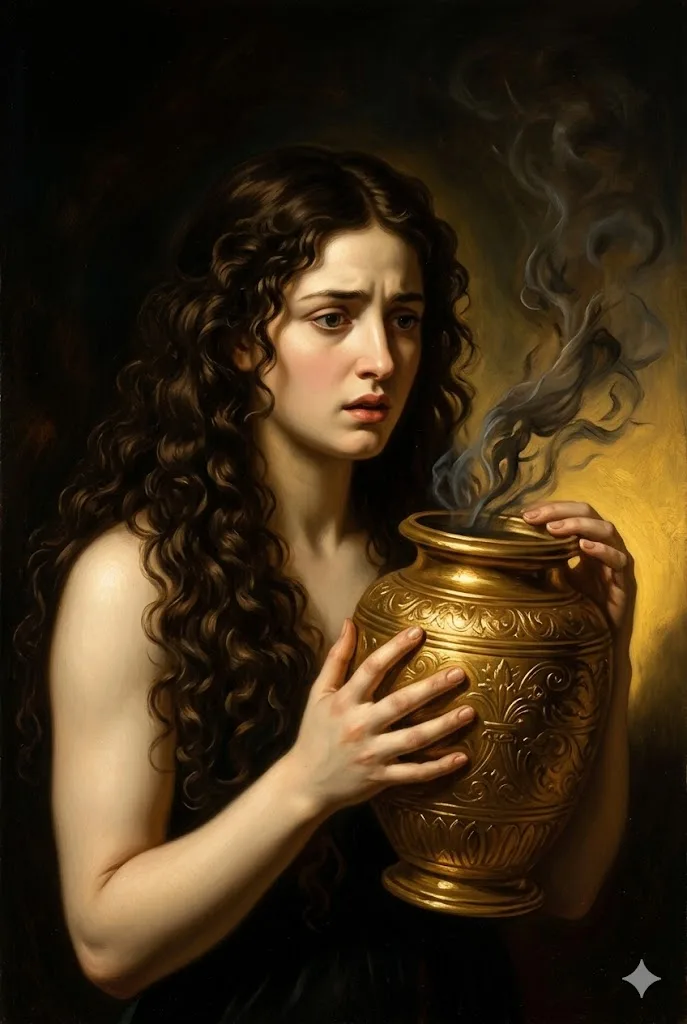
Pandora was the first mortal woman, created by the gods on the orders of Zeus as a punishment for humanity after Prometheus stole fire from Olympus. Her name means "All-Gifted" — because each god contributed something to her creation. Hephaestus molded her from clay and gave her form. Athena dressed her and taught her domestic skills. Aphrodite gave her beauty and grace. Hermes gave her speech, cunning, and a deceitful nature. She was irresistibly beautiful and impossibly dangerous — a "beautiful evil" designed to bring suffering to the world.
Zeus sent Pandora as a bride to Epimetheus (Prometheus's brother, whose name means "Afterthought"). Prometheus had warned his brother never to accept gifts from Zeus, but Epimetheus, enchanted by Pandora's beauty, married her immediately. With her, Pandora brought a sealed jar (often mistranslated as a "box" due to a 16th-century error by Erasmus) containing every evil, disease, hardship, and sorrow that could afflict humanity.
Pandora opened the jar. Hesiod gives no reason; the idea that she was overcome by curiosity comes from later retellings. Out flew plague, misery, famine, poverty, pain, old age, death, and every other affliction. By the time she slammed the lid shut, only one thing remained inside: Elpis — Hope. Whether Hope's imprisonment was a final cruelty (trapping humanity's only comfort) or a mercy (preserving it for when it was needed most) remains one of mythology's most debated questions.
Hesiod's two versions
Almost everything about Pandora goes back to Hesiod, who tells her story twice and not the same way each time. In the Theogony she has no name. Zeus orders a "beautiful evil" (kalon kakon) as the price of fire. Hephaestus shapes her from earth, and Athena dresses her, veils her and crowns her with a golden diadem covered in carved beasts. There is no jar at all. The woman herself is the punishment, and Hesiod says the "race of women" comes from her, comparing women to drones who eat what the bees gather.
The Works and Days gives the fuller story. Here she is named, and the gift-givers grow in number. Hephaestus mixes earth and water. Athena teaches her weaving. Aphrodite pours grace and painful desire over her. The Graces and Persuasion (Peitho) give golden necklaces, and the Seasons (Horai) crown her with spring flowers. Hermes puts in "a bitch's mind and a thievish nature", lies and wheedling words, and gives her a voice. Before her, Hesiod says, men lived without toil or sickness. She lifts the lid of the great jar (pithos), and only Elpis stays inside under the rim, because Zeus had the lid shut in time. The diseases now roam silently among mortals, because Zeus took away their voices.
Hesiod never explains why she opened the jar, and he never mentions curiosity. Curiosity is a later explanation, made stronger by comparison with Eve. Hesiod also never says where the jar came from. Whether she brought it from Olympus or found it in Epimetheus' house is not stated.
"All-gifted" or "giver of all"?
Hesiod explains the name as "all the gods gave her a gift". The Greek can just as well mean "she who gives all". That reading fits an earth-goddess, and Pandora appears as an epithet of Earth in some sources. A white-ground cup in the British Museum from the mid-5th century BC shows Athena and Hephaestus adorning a woman labelled Anesidora, "she who sends up gifts", another earth title. Scholars disagree on whether Hesiod turned an older goddess into the first woman or whether the earth-title link is secondary. Both views are serious, and the evidence does not settle the matter.
Pandora after Hesiod
Athens gave her a remarkable public role. According to Pausanias and Pliny, the base of Pheidias' gold-and-ivory Athena Parthenos in the Parthenon showed the birth of Pandora, with twenty gods attending. That placed the first woman at the feet of the city's goddess. Sophocles wrote a satyr play called Pandora or The Hammerers, of which only fragments survive. The scene seems to have shown her rising from the ground while satyrs strike it with hammers. Several vase paintings show this rising-from-earth scene.
Apollodorus fits her into heroic genealogy. Her daughter with Epimetheus is Pyrrha, who with her husband Deucalion (son of Prometheus) survives Zeus' flood and repopulates the world by throwing stones over their shoulders. So the first woman is also the grandmother of the post-flood human race, and through Pyrrha the grandmother of Hellen, ancestor of the Greeks.
A fable by Babrius turns the story the other way. Zeus gives a man a jar full of good things. The man opens it out of curiosity, the goods fly back up to the gods, and only hope is left. That version supports the reading that the jar's contents and hope's place in it were never fixed.
The Hope problem
What staying in the jar means for Elpis depends on two questions. Is elpis good? In Greek it can mean "expectation", including the anxious or foolish kind, and Hesiod elsewhere in the Works and Days calls the idle man's hope "empty" and "not good". And does being kept in the jar mean kept from humans, or kept for them? If the jar is the human household, hope is the one thing that stays at home with us. If the jar is a prison, Zeus has locked it away. Both readings have long histories, and Hesiod's text does not decide between them. Dora and Erwin Panofsky's study Pandora's Box (1956) traces how Renaissance writers, after Erasmus' switch from pithos to pyxis, reshaped her into an Eve figure. The connection to the theft of fire runs through every version.
Ancient sources
- Hesiod, Theogony 570–612: the unnamed first woman made as the price of fire, and the origin of the "race of women".
- Hesiod, Works and Days 47–105: the named Pandora, the gifts of each god, the opening of the pithos and Elpis left under the rim.
- Pausanias, Description of Greece 1.24.7: the birth of Pandora carved on the base of the Athena Parthenos.
- Apollodorus, Bibliotheca 1.7.2: Pandora as the first woman and mother of Pyrrha, wife of Deucalion.
- Babrius, Fables 58: the variant in which the jar holds good things and a man opens it.
Frequently asked questions
Was Pandora's box really a box?
No. Hesiod's word is pithos, a large storage jar. The "box" (pyxis) comes from Erasmus in the 16th century, possibly through confusion with the story of Psyche's box.
Was Pandora evil?
Hesiod calls her a "beautiful evil", but the trap is Zeus' design, and she is its instrument rather than its author. Hesiod gives her no motive and no speech. Many modern readers see her as the vehicle of a misogynist myth rather than a villain.
Who was Pandora's husband?
Epimetheus, the brother of Prometheus. He took her in although Prometheus had warned him never to accept a gift from Zeus.
Is Pandora the Greek Eve?
The parallels (a first woman, a forbidden act, evil let into the world) led early Christian writers such as Tertullian and Origen to compare the two. But the stories come from different traditions, and Hesiod's Pandora has no serpent, no tree and no moral choice.
For the jar story alone, see Pandora's box.
Explore More Mythology
Get weekly deep dives into the gods, heroes, and myths of ancient Greece.