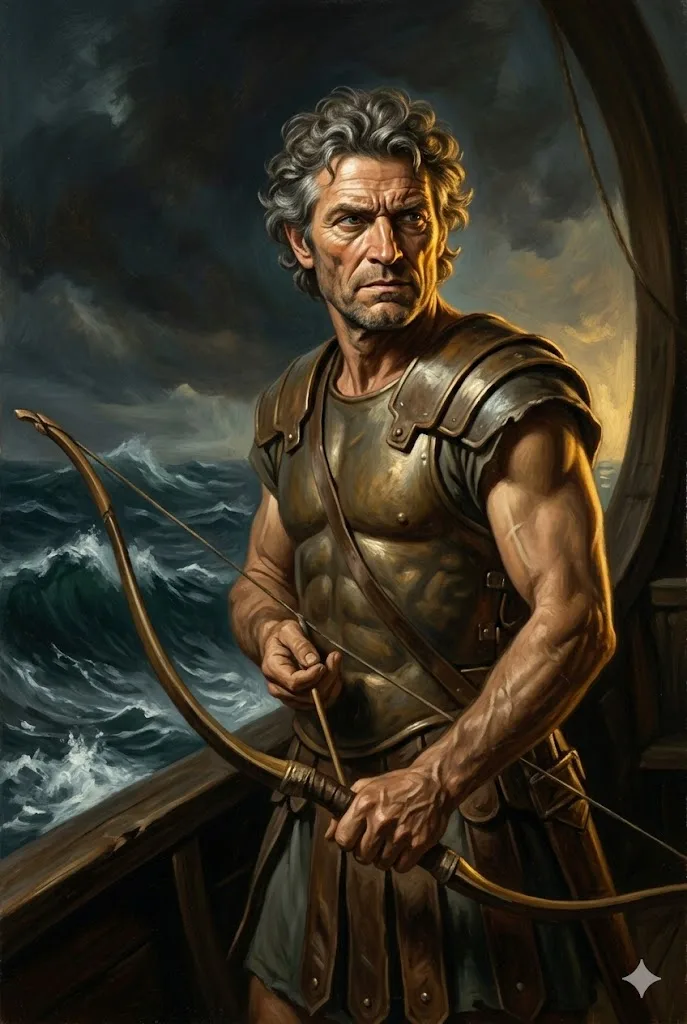
I. Who Was Odysseus?
Odysseus was the king of Ithaca and the cleverest of all the Greek heroes. While Achilles was the greatest warrior and Heracles the strongest, Odysseus won his battles through intelligence, eloquence, and resourcefulness. He was the mastermind behind the Trojan Horse — the stratagem that ended the ten-year siege of Troy — and his ten-year journey home afterward became the subject of Homer's Odyssey, one of the two foundational epics of Western literature.
His patron goddess was Athena, who admired his cunning mind — a quality that mirrored her own. Together, they formed one of mythology's most effective partnerships: the goddess of wisdom guiding the cleverest of mortals through seemingly impossible situations. Odysseus's defining trait, his metis (cunning intelligence), made him the model for a different kind of hero — one who triumphs through brains rather than brawn.
II. The Journey Home
After the fall of Troy, Odysseus set sail for home with his fleet of twelve ships. What should have been a brief voyage became a decade-long ordeal as he faced one supernatural obstacle after another. He outwitted the Cyclops Polyphemus (blinding him and escaping by clinging to the underside of sheep), resisted the enchantress Circe (who turned his men into pigs), sailed past the deadly Sirens (by having his crew plug their ears with wax while he listened, bound to the mast), and navigated between the monsters Scylla and Charybdis.
He descended to the underworld to consult the prophet Tiresias, lost all his ships and men to the wrath of Helios (after his starving crew ate the sun god's sacred cattle), and spent seven years trapped on the island of the nymph Calypso before the gods finally ordered his release. He arrived home to Ithaca alone, disguised as a beggar, to find his palace overrun by suitors vying for his wife Penelope's hand.
III. The Return
With the help of Athena, his son Telemachus, and a handful of loyal servants, Odysseus reclaimed his throne in one of mythology's most satisfying climaxes. He strung his great bow — which no suitor could even bend — and slaughtered the pretenders in his own hall. His reunion with the faithful Penelope, who had waited twenty years for his return, remains one of the most moving scenes in all of ancient literature.
Name, family and the boar scar
Odysseus was the son of Laertes and Anticleia, and the Odyssey explains his name in a flashback. When he was a baby, his maternal grandfather Autolycus, a notorious trickster and thief, was asked to name him and said that because he himself had been "angry at" (odyssamenos) many people, the child should be called Odysseus. Years later, on a visit to Autolycus on Mount Parnassus, the young Odysseus was gashed above the knee by a boar during a hunt. That scar is how his old nurse Eurycleia recognises him when she washes his feet in Odyssey 19.
Not everyone accepted Laertes as his father. Sophocles, in Ajax and Philoctetes, has characters sneer at Odysseus as the son of Sisyphus, the arch-deceiver, who was said to have seduced Anticleia before her marriage. The insult fits a hero whose epithets include polytropos ("of many turns," the first description of him in the Odyssey), polymetis ("of many wiles") and ptoliporthos ("sacker of cities").
Before and during the war
Odysseus did not want to go to Troy. According to the epic Cypria and later mythographers, he feigned madness when the recruiting party came, and Hyginus adds that he yoked a horse and an ox and sowed salt. Palamedes exposed him by placing the infant Telemachus in front of the plough, forcing him to swerve. Odysseus took a terrible revenge at Troy: he planted gold in Palamedes' tent and arranged a forged letter from Priam, and the Greeks stoned Palamedes as a traitor.
In the war itself he ran intelligence operations. In Iliad 10 he and Diomedes capture the Trojan spy Dolon and slaughter the Thracian king Rhesus in his sleep. Later traditions have the same pair steal the Palladium, the statue of Athena that protected Troy. He persuaded or tricked Philoctetes, abandoned on Lemnos with a festering wound, to bring Heracles' bow to Troy, the subject of Sophocles' Philoctetes. After Achilles died, Odysseus won his armour over Ajax, who went mad and killed himself; in the underworld scene of Odyssey 11, Ajax's ghost refuses to speak to him.
The Trojan Horse is not described in the Iliad. It appears in the Odyssey: Menelaus recalls how Helen walked around the horse imitating the voices of the Greeks' wives, and Odysseus had to clamp his hand over a soldier's mouth; and the bard Demodocus sings the story at the Phaeacian court, moving Odysseus to tears.
After the Odyssey: Tiresias' prophecy and the Telegony
Homer's poem does not end Odysseus' story. In the underworld, Tiresias tells him he must one day walk inland carrying an oar until he meets people who know nothing of the sea and mistake it for a winnowing fan; there he must sacrifice to Poseidon. His death, Tiresias says, will come "from the sea" (or "away from the sea"; the Greek is ambiguous), gentle, in a sleek old age.
The lost epic Telegony, attributed to Eugammon of Cyrene and known through Proclus' summary, offered a darker sequel. Telegonus, Odysseus' son by Circe, came to Ithaca looking for his father and killed him without recognising him, using a spear tipped with a stingray spine. Telegonus then took Penelope and Telemachus to Circe's island, where Telegonus married Penelope and Telemachus married Circe.
Romans were less admiring. Virgil's Aeneas calls him "cruel Ulysses" and the inventor of crimes, and Dante places Ulysses among the fraudulent counsellors in Inferno 26, where he tells of a last voyage beyond the Pillars of Heracles that ends in shipwreck. That episode inspired Tennyson's "Ulysses" (1842). James Joyce's Ulysses (1922) and Cavafy's "Ithaka" (1911) carried him into modern literature. There is also evidence that he was worshipped as a hero on Ithaca itself: excavations at a cave at Polis Bay found offerings and a fragment of a terracotta mask inscribed with a vow to Odysseus.
For a structured guide to the epic, see our Odyssey study guide, or explore Ithaca and his encounters with the Cyclopes and Calypso.
Ancient sources
- Homer, Odyssey — the full return; his naming and boar scar (19.392–466), Tiresias' prophecy (11.100–137) and the Trojan Horse recollections (4.271–289, 8.492–520).
- Homer, Iliad 10 — the night raid with Diomedes against Dolon and Rhesus.
- Sophocles, Ajax and Philoctetes — Odysseus as both magnanimous and manipulative, and taunted as the son of Sisyphus.
- Proclus, summaries of the Cypria and Telegony — his feigned madness and his death at the hands of Telegonus.
- Apollodorus, Epitome 3 and 7 — the Palamedes episode, his part in the war and the variant endings of his life.
- Ovid, Metamorphoses 13.1–398 — the debate between Ajax and Ulysses over the arms of Achilles.
Frequently asked questions
How did Odysseus die?
Homer only has Tiresias predict a gentle death in old age. In the lost Telegony, his son by Circe, Telegonus, killed him by accident with a stingray-tipped spear.
How long was Odysseus away from Ithaca?
Twenty years: ten at the Trojan War and ten on the journey home, seven of them on Calypso's island and one with Circe.
Was Odysseus faithful to Penelope?
Not physically. He lived with both Circe and Calypso during his wanderings. His loyalty in the Odyssey is to returning home, and he rejects Calypso's offer of immortality to do so.
What is Odysseus called in Latin?
Ulixes, usually anglicised as Ulysses, the name used by Virgil, Ovid and later writers such as Dante, Tennyson and Joyce.
Explore More Mythology
Get weekly deep dives into the gods, heroes, and myths of ancient Greece.