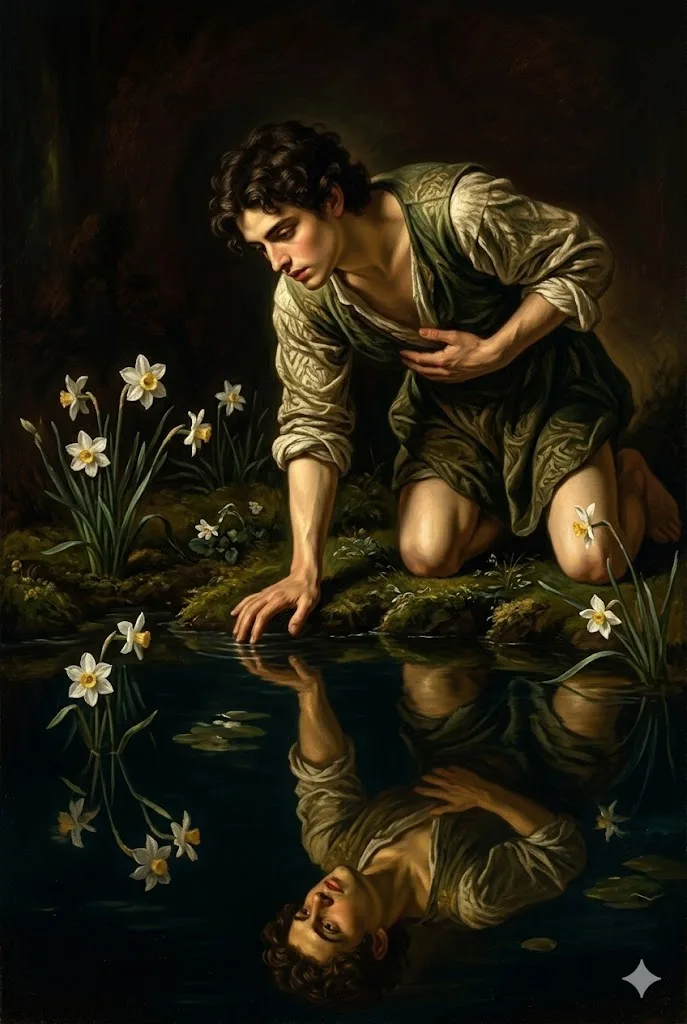
I. Who Was Narcissus?
Narcissus was a youth of extraordinary, almost supernatural beauty — the son of the river god Cephissus and the nymph Liriope. He was so beautiful that everyone who saw him fell in love, but Narcissus was cold and proud, rejecting every suitor with cruel indifference. He scorned the advances of both men and women, including the nymph Echo, who loved him desperately.
Echo had been cursed by Hera to only repeat the last words spoken to her (punishment for distracting Hera with chatter while Zeus pursued other nymphs). When she tried to declare her love to Narcissus, she could only echo his words back to him. Humiliated and rejected, Echo wasted away in grief until only her voice remained — forever repeating the sounds of the world around her.
The goddess Nemesis, hearing the prayers of those Narcissus had spurned, led the youth to a clear, still pool in the forest. When Narcissus leaned over to drink, he saw his own reflection for the first time and fell hopelessly in love with it. He could not tear himself away. He lay beside the pool, gazing at the beautiful face in the water, unable to embrace it, wasting away with longing. Eventually he died — or transformed — and in the place where he had lain, a flower grew: the narcissus, white petals surrounding a golden center, forever bowed toward the water.
The word "narcissism" derives directly from this myth — the pathological obsession with one's own image and self. Sigmund Freud used the myth as the basis for his concept of narcissistic personality, making Narcissus one of the most psychologically influential figures in Greek mythology.
Ovid's version in detail
Almost everything people know about Narcissus comes from one passage: Ovid's Metamorphoses 3.339–510. It opens with a prophecy. When Liriope asks the blind seer Tiresias whether her son will live to old age, he answers, "if he never knows himself." The line inverts the Delphic maxim "know thyself," and the story is built to fulfil it. At sixteen Narcissus is pursued by youths and girls alike; one spurned admirer prays that he may love and never possess what he loves, and Nemesis, called Rhamnusia after her sanctuary at Rhamnous, hears the prayer.
A detail often missed: Ovid's Narcissus does eventually realise the truth. "I am he" (iste ego sum), he cries, recognising that the face in the pool is his own, and the knowledge makes things worse, because now he cannot even hope. Tearing at his chest, he melts away "as yellow wax melts before a gentle flame." Even in the underworld, Ovid adds, he kept gazing at himself in the waters of the Styx. When the naiads and dryads prepared a funeral pyre, the body had vanished and in its place was a flower with a saffron centre ringed by white petals.
The pairing with Echo may also be Ovid's own invention, or at least his signature: no earlier surviving source puts the two together. Elsewhere Echo has a quite different fate. In Longus' novel Daphnis and Chloe, she rejects Pan, who drives shepherds mad so that they tear her to pieces and scatter her still-singing limbs across the earth.
The Greek versions: Thespiae, Ameinias and a twin sister
Narcissus belonged to Thespiae in Boeotia, a city near Mount Helicon best known for its cult of Eros. The mythographer Conon, whose summaries were preserved by the Byzantine scholar Photius, tells a harsher local story. A young man named Ameinias loved Narcissus persistently; Narcissus sent him a sword, and Ameinias killed himself with it on Narcissus' doorstep, calling on the gods to avenge him. Narcissus then fell in love with his reflection in a spring and, in despair, killed himself. The Thespians, Conon says, thereafter honoured Eros more, both publicly and privately.
Pausanias visited the spring, called Donakon ("the reed-bed"), in Thespian territory, and found the reflection story ridiculous: no one old enough to fall in love could fail to tell a man from his reflection. He reports instead a rationalised version in which Narcissus had a twin sister, identical in appearance, whom he loved; when she died, he would look into the spring to see her face in his own. Pausanias also notes that the narcissus flower existed before the boy, citing the early poet Pamphos, and indeed in the Homeric Hymn to Demeter it is a narcissus, grown by Gaia, that lures Persephone to the spot where Hades seizes her.
Plutarch connected the flower's name with narkē, "numbness," because of its heavy scent, the same root that gives English "narcotic." Whether the youth was named after the flower or the reverse, the association with deathly torpor fits both.
In art and modern thought
Narcissus was a favourite subject of Roman wall painting; dozens of examples survive from Pompeii and Herculaneum, usually showing him seated by the water, sometimes with Eros nearby holding a lowered torch, a funerary symbol. Later masterpieces include the painting attributed to Caravaggio in the Palazzo Barberini, Rome (c. 1597–99), John William Waterhouse's Echo and Narcissus (1903, Walker Art Gallery, Liverpool) and Salvador Dalí's Metamorphosis of Narcissus (1937, Tate).
The psychological term came in stages. Havelock Ellis compared a form of auto-eroticism to the myth in 1898, Paul Näcke coined the German term Narzissmus the following year, and Freud's essay "On Narcissism: An Introduction" (1914) made it central to psychoanalysis. Modern readers often reduce the story to vanity, but in the ancient versions the emphasis falls on cruelty to others and its punishment, and in Ovid on the danger of self-knowledge. For more on the theme, see the myth of Narcissus and other transformation myths.
Ancient sources
- Ovid, Metamorphoses 3.339–510 — the full story: Tiresias' prophecy, Echo, the prayer to Nemesis, the pool, the recognition "iste ego sum" and the flower.
- Conon, Narrations 24 (summarised by Photius) — the Thespian version with Ameinias, the sword and Narcissus' suicide.
- Pausanias, Description of Greece 9.31.7–9 — the spring Donakon, the twin-sister version, and the claim that the flower predates the youth.
- Homeric Hymn to Demeter 8–18 — the narcissus flower used by Gaia and Zeus to lure Persephone.
- Longus, Daphnis and Chloe 3.23 — an alternative myth of Echo torn apart at Pan's instigation.
Frequently asked questions
Did Narcissus know he was looking at himself?
In Ovid, yes, eventually. He first takes the reflection for another youth, then realises "I am he," and still cannot stop loving it.
How did Narcissus die?
In Ovid he wastes away beside the pool and his body is replaced by the flower. In Conon's Greek version he kills himself with a sword.
Who cursed Narcissus?
In Ovid, Nemesis, goddess of retribution, answers the prayer of a rejected admirer. In Conon the dying Ameinias calls on the gods, and the Thespians understood Eros as the avenger.
Where was Narcissus from?
Thespiae in Boeotia, central Greece, where Pausanias saw the spring associated with him.
Books to read next
Links go to Bookshop.org, which supports independent bookstores. We earn a small commission if you buy, at no extra cost to you.
Explore More Mythology
Get weekly deep dives into the gods, heroes, and myths of ancient Greece.