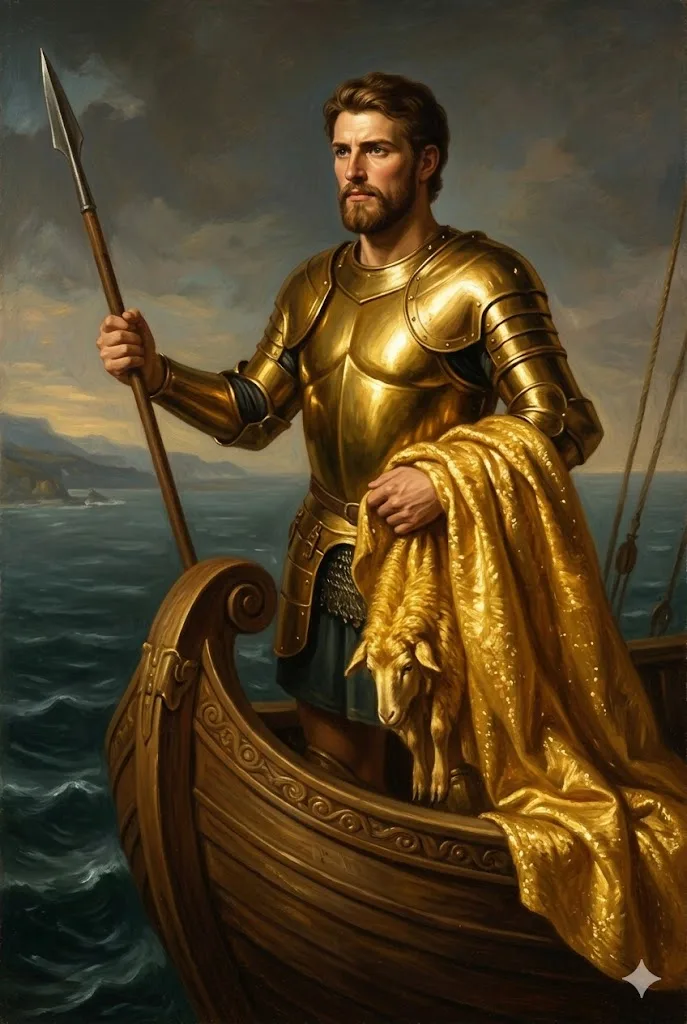
I. Who Was Jason?
Jason was the leader of the Argonauts — the greatest crew of heroes ever assembled — who sailed aboard the ship Argo to the distant kingdom of Colchis to retrieve the legendary Golden Fleece. His quest is one of the earliest and most elaborate adventure stories in Greek mythology, predating even the Trojan War, and it brought together nearly every major hero of the age on a single epic voyage.
Jason was the rightful heir to the throne of Iolcus in Thessaly, but his uncle Pelias had seized power. To reclaim his throne, Jason had to complete an impossible task: journey to the edge of the known world and bring back the Golden Fleece of a magical ram, which hung in a sacred grove in Colchis (modern-day Georgia), guarded by a sleepless dragon.
The Voyage of the Argo
Jason assembled a crew of fifty heroes aboard the Argo — a ship built with a timber from the sacred oak of Dodona, which could speak prophecy. The Argonauts included Heracles, Orpheus, Castor and Pollux, Atalanta, and many others. Their voyage took them through the Clashing Rocks (Symplegades), past the island of the Sirens (where Orpheus's music saved them), and through countless other dangers.
Medea and the Fleece
In Colchis, King Aeëtes set Jason seemingly impossible tasks: yoke fire-breathing bronze bulls, sow a field with dragon's teeth, and defeat the armed warriors that sprang from the soil. Jason would have failed, but the king's daughter Medea — a powerful sorceress — fell in love with him (aided by Aphrodite and Hera). Medea's magic helped Jason complete the tasks, drug the guardian dragon, and escape with the Fleece. Their flight home was harrowing, and the aftermath — Jason's betrayal of Medea for a younger bride and Medea's terrible revenge — became one of the darkest tragedies in Greek literature.
Before the voyage: Chiron, the lost sandal and Hera's grudge
Jason was the son of Aeson, the displaced king of Iolcus, and was smuggled out of the city as a baby to be raised by the centaur Chiron on Mount Pelion. Pindar's fourth Pythian ode, composed in 462 BC and the oldest extended account of the expedition to survive, has him return at twenty, long-haired and wearing a leopard skin, and announce himself to Pelias in the marketplace.
The detail that drives the plot is a single sandal. Pelias had been warned by an oracle to beware a man wearing one shoe. In Apollonius of Rhodes, Jason loses a sandal in the mud of the river Anauros while crossing it; later in the poem Hera reveals that she had been waiting there disguised as an old woman, and Jason had carried her across. Pelias had neglected Hera's honours, and her support for Jason is part of a longer plan: to bring Medea to Greece to destroy him. Read this way, the whole Argonaut saga is the revenge of a goddess, and Jason is its instrument.
The Golden Fleece itself came from the ram that rescued Phrixus and Helle from their stepmother Ino. Helle fell into the strait afterwards called the Hellespont; Phrixus reached Colchis, sacrificed the ram and gave its fleece to King Aeëtes. The full background is told in the story of the Golden Fleece.
Episodes of the voyage most retellings skip
The first landfall was Lemnos, where the women had murdered every man on the island. Their queen Hypsipyle, who had secretly spared her father Thoas, welcomed the Argonauts, and the crew stayed long enough to repopulate the island. Jason fathered Euneus, who appears in the Iliad as the Lemnian king supplying wine to the Greeks at Troy.
In Mysia the young Hylas was pulled into a spring by a water nymph, and Heracles, searching for him, was left behind. Among the Bebryces, Polydeuces killed the boxer-king Amycus. At Salmydessus the blind prophet Phineus was tormented by the Harpies until the winged sons of Boreas, Zetes and Calais, drove them off; in return Phineus told the crew how to pass the Clashing Rocks by first releasing a dove.
The way home is where the sources disagree most. Pindar sends the Argo into the encircling Ocean and has the crew carry the ship overland across Libya. Apollonius takes them up the Ister (Danube), across into the Eridanus and Rhodanus, to Circe's island for purification from the murder of Absyrtus, to the Phaeacians (where Jason and Medea are hastily married), and then into the Libyan desert, where they carry the Argo for twelve days to Lake Tritonis. Off Crete, Medea brings down the bronze giant Talos with the evil eye. The Odyssey already knew the Argo as a ship "on everyone's lips" that passed the Wandering Rocks only because Hera loved Jason.
Jason the hero: what modern readers get wrong
Popular versions present Jason as a straightforward action hero. Apollonius did not. His Jason is frequently amechanos, at a loss, weeping or despairing at moments of crisis, and his successes depend on charm, diplomacy and other people, above all Medea. Some scholars see this as a deliberately modern, unheroic hero; others as a study in leadership by consensus. Either way, he is not a Heracles.
Lists of the Argonauts also vary from source to source. Apollonius' catalogue runs to more than fifty names and pointedly leaves out Atalanta (Jason refuses her for fear of strife among the crew), while Apollodorus includes her. Orpheus, Castor and Polydeuces, Peleus, Meleager and the seer Mopsus appear in most versions.
Art preserves at least one story lost from literature. A red-figure cup attributed to Douris, now in the Vatican Museums, shows a limp Jason being disgorged from the mouth of the Colchian serpent while Athena looks on, implying a version in which the dragon swallowed him. The best-known modern treatment is the 1963 film Jason and the Argonauts, whose stop-motion skeleton warriors are a cinematic version of the men sown from dragon's teeth.
His end was squalid. In Euripides' Medea, Medea predicts that he will die struck on the head by a piece of the Argo, and later sources describe him sleeping beneath the rotting hulk at Corinth when a beam fell on him.
Ancient sources
- Homer, Odyssey 12.69–72 — mentions the Argo as the only ship to pass the Wandering Rocks, helped by Hera because she loved Jason.
- Hesiod, Theogony 992–1002 — Jason completes the labours imposed by Pelias and takes Medea from Aeëtes; their son is Medeius.
- Pindar, Pythian 4 — the one-sandalled stranger, the confrontation with Pelias, the ploughing with fire-breathing bulls, and the return route through Libya.
- Apollonius of Rhodes, Argonautica — the complete Hellenistic epic of the voyage, from the crew catalogue to Talos.
- Euripides, Medea — Jason's abandonment of Medea in Corinth and the prophecy of his death by the Argo's timber.
- Apollodorus, Library 1.9.16–28 — a compact summary of Jason's life, the voyage and its aftermath.
Frequently asked questions
Why did Jason wear only one sandal?
He lost the other crossing the river Anauros, in Apollonius' version while carrying Hera disguised as an old woman. Pelias had been warned by an oracle to fear a one-sandalled man, so the moment he saw Jason he knew the threat had arrived.
How did Jason die?
After losing Medea, his new bride and his children, he is said to have been killed when a rotten timber from the beached Argo fell on him, a death Medea foretells at the end of Euripides' play.
Was Atalanta one of the Argonauts?
Sources disagree. Apollodorus lists her among the crew, but in Apollonius' Argonautica Jason turns her away.
Was Jason a demigod?
No. Both his parents, Aeson and Alcimede (Polymede in Apollodorus), were mortal, which is one reason his success depends so heavily on divine help and on Medea.
Explore More Mythology
Get weekly deep dives into the gods, heroes, and myths of ancient Greece.