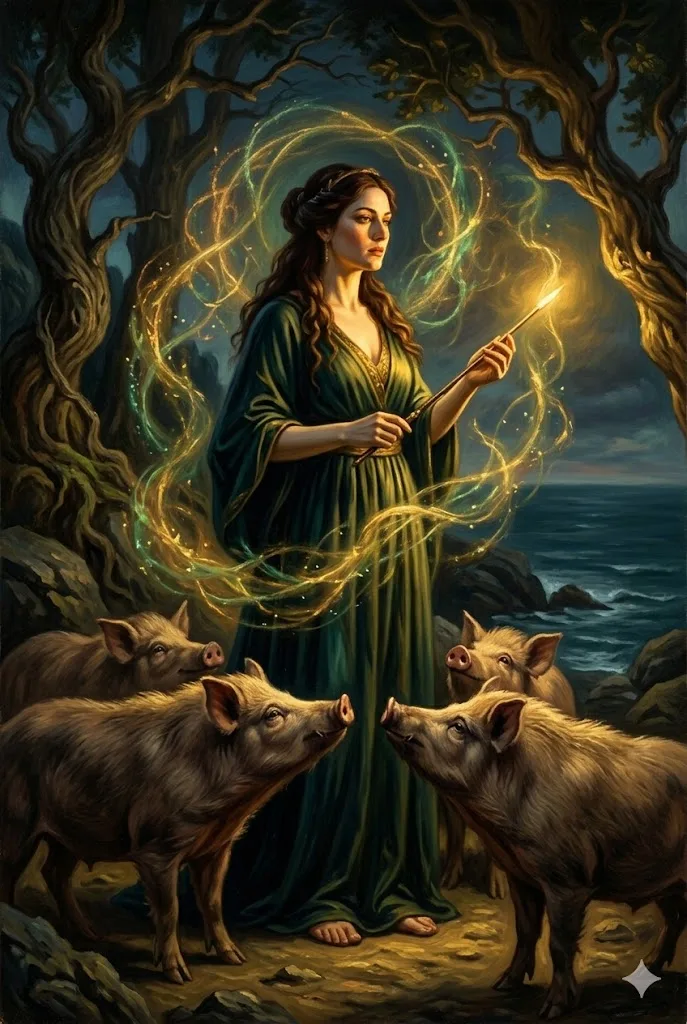
Daughter of the Sun
Circe was a goddess and sorceress of extraordinary power, the daughter of the sun god Helios and the Oceanid Perse. She lived alone on the island of Aeaea, surrounded by wolves, lions, and other wild animals that had once been men. She was the aunt of the equally dangerous sorceress Medea, and together they represent the most powerful practitioners of magic in Greek mythology.
Odysseus on Aeaea
Circe's most famous appearance is in Homer's Odyssey. When Odysseus's crew landed on Aeaea during their long journey home from Troy, Circe invited them to a feast. She mixed a potion into their food and, when they drank it, transformed them into pigs. They retained their human minds but were trapped in animal bodies, fully aware of what had happened to them.
Odysseus, warned by Hermes and protected by the herb moly, was immune to her magic. When Circe's spell failed on him, she was genuinely astonished. No man had ever resisted her. Odysseus drew his sword, and Circe, recognizing his identity (she had been told by Hermes that Odysseus would come), submitted and agreed to restore his men. She then became Odysseus's lover and host for an entire year, during which she proved a generous and knowledgeable ally.
More Than a Villain
Circe is often reduced to the role of villainess or temptress, but Homer presents her as far more complex. After the initial confrontation, she becomes one of the most helpful figures in the Odyssey. She advises Odysseus to visit the Underworld to consult the prophet Tiresias. She warns him about the Sirens, Scylla and Charybdis, and the cattle of Helios. She prepares his crew for the dangers ahead. Without Circe's guidance, Odysseus would never have reached Ithaca.
Modern Revival
Madeline Miller's novel Circe (2018) transformed public understanding of this character. Miller reimagined Circe's story from her own perspective: a goddess born without divine powers who discovers witchcraft as a form of self-determination in a world ruled by male gods. The novel portrays her transformation of men into pigs not as random cruelty but as self-defence against sailors who came to her island to rape and plunder. Miller's Circe became a feminist icon and a bestseller, proving that characters dismissed as minor villains for centuries can become protagonists when someone bothers to tell their side of the story.
Classical Sources
- 📜 Homer, Iliad & Odyssey (c. 750 BC)
- 📜 Hesiod, Theogony (c. 700 BC)
- 📜 Apollodorus, Bibliotheca (c. 1st-2nd century AD)
- 📜 Ovid, Metamorphoses (8 AD)
Cross-referenced with multiple classical sources for accuracy.
Explore More
Odysseus · The Odyssey · Helios · Hermes · Home