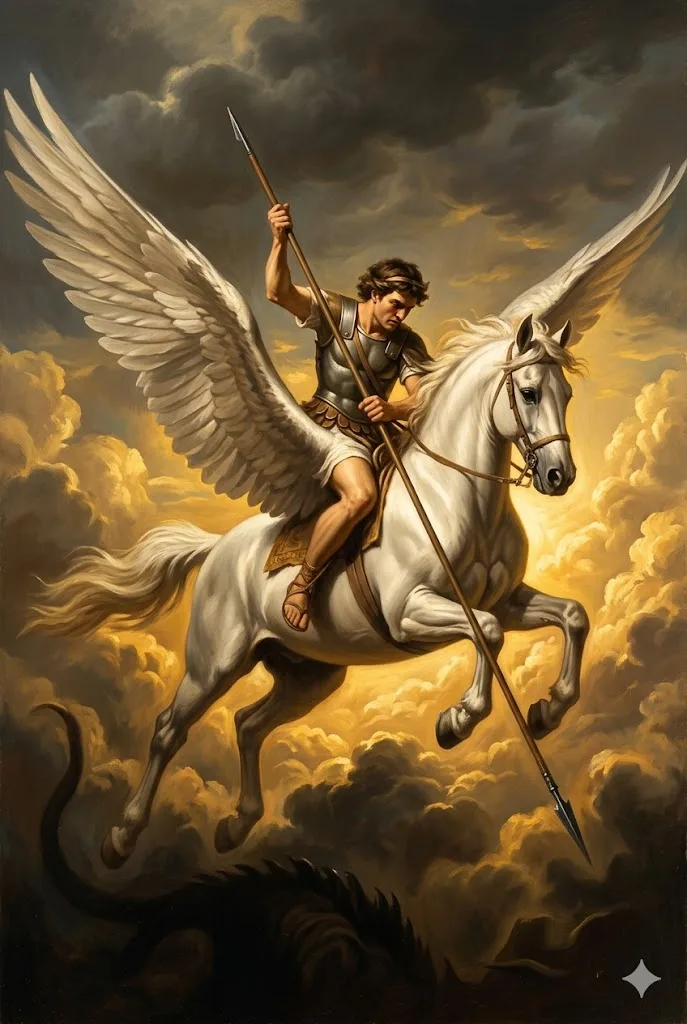
I. Who Was Bellerophon?
Bellerophon was one of the great heroes of Greek mythology — famous for taming the winged horse Pegasus and riding it into battle against the fire-breathing Chimaera. His story follows a classic arc of divine favor followed by catastrophic hubris: blessed by the gods to achieve the impossible, he was ultimately destroyed by his own pride when he tried to ascend to Mount Olympus itself.
Bellerophon was the son of Poseidon (or the mortal king Glaucus) and a prince of Corinth. After accidentally killing his brother, he was exiled and took refuge with King Proetus of Tiryns. The queen, Stheneboea, fell in love with him, and when he rejected her advances, she accused him of assault. Rather than kill a guest (violating xenia, sacred hospitality), Proetus sent Bellerophon to his father-in-law King Iobates of Lycia with a sealed letter requesting his execution.
Iobates, unwilling to kill Bellerophon directly, assigned him impossible tasks instead. First, he was sent to slay the Chimaera — a fire-breathing monster that no warrior could approach on foot. Athena appeared to Bellerophon in a dream and gave him a golden bridle. With it, he tamed the wild Pegasus at the spring of Peirene in Corinth. From the air, mounted on Pegasus above the Chimaera's flames, he killed the monster by thrusting a lead-tipped spear into its mouth — its own fire melted the lead and destroyed it from within.
After further victories against the Solymi warriors and the Amazons, Bellerophon was hailed as the greatest living hero. But success bred arrogance. Believing himself worthy of Olympus, he attempted to ride Pegasus to the home of the gods. Zeus sent a gadfly to sting Pegasus, and Bellerophon was thrown to earth. He survived the fall but was left crippled and blind, wandering the earth alone for the rest of his days — a cautionary tale about the limits of mortal ambition.
Homer's version: a story told on the battlefield
The oldest account of Bellerophon is told in Iliad 6 by his grandson Glaucus, a Lycian ally of Troy, when he meets Diomedes between the armies. Homer's version differs from the later handbook story in several ways. Proetus' wife is called Anteia, not Stheneboea; the Lycian king is unnamed (later sources call him Iobates); and Pegasus is never mentioned. Proetus sends Bellerophon to Lycia with "baneful signs" scratched on a folded tablet, the only reference to anything like writing in Homer. The king sets him three trials, the Chimaera, the Solymi and the Amazons, then sets an ambush of the best Lycian warriors, all of whom Bellerophon kills. Recognising divine favour, the king gives him his daughter and half the kingdom. Their children were Isander, Hippolochus (father of Glaucus) and Laodameia, who bore Sarpedon to Zeus.
Homer's ending is quieter and stranger than a fall from the sky. Bellerophon became "hated by all the gods" and wandered alone on the Aleian plain, "eating out his heart and avoiding the paths of men", while Ares killed Isander and Artemis killed Laodameia. Homer gives no reason. The ride to Olympus, the gadfly and the fall come from later poets; Pindar refers to Pegasus throwing his rider in Isthmian 7. Once Glaucus finishes, Diomedes realises their grandfathers had been guest-friends, and the two swap armour, gold for bronze.
Corinth, Pegasus and the golden bridle
Pindar's Olympian 13, written for a Corinthian victor, gives the fullest early account of the taming of Pegasus. Bellerophon struggles to catch the horse at the spring of Peirene until the seer Polyidus advises him to sleep at the altar of Athena. Athena appears in a dream with a golden bridle; he wakes holding it, sacrifices a bull to Poseidon as Damaios, "tamer", and sets up an altar to Athena Hippia, "of horses". Pindar keeps an awkward silence about the end, saying only that he will not speak of Bellerophon's fate.
His name was explained in antiquity as "slayer of Belleros". Apollodorus says he left Corinth after killing his brother, named Deliades, Peiren or Alcimenes depending on the source, while others said he killed a Corinthian called Belleros. His divine father is Poseidon in several versions, his mortal father Glaucus, son of Sisyphus, which makes the trickster Sisyphus his grandfather.
Corinth claimed him proudly. Pausanias describes a precinct of Bellerophon in a cypress grove at the Craneum outside the city, and a statue group of Bellerophon on Pegasus at a fountain. Corinthian silver coins carried Pegasus as the city's badge for centuries.
Stheneboea's revenge and other episodes
Euripides wrote two tragedies about Bellerophon, now lost but partly known from fragments and summaries. In Stheneboea the hero returns from Lycia to punish the queen who slandered him, takes her up on Pegasus and throws her into the sea. In Bellerophon the embittered hero tries to reach heaven to challenge the gods' justice; Aristophanes parodied the play in Peace, where a farmer flies to Olympus on a giant dung beetle.
Plutarch, in On the Bravery of Women, preserves a Lycian tale. Angered at the king's ingratitude, Bellerophon prayed to Poseidon, who sent the sea flooding over the Xanthian plain. The men failed to stop him, but the Lycian women came out with their skirts lifted, and he turned back in embarrassment, the waters retreating with him. Plutarch gives rationalising versions as well, in which the Chimaera was a pirate captain or a mountain with fire and lions.
Bellerophon is one of Lycia's key heroes, and the Chimaera was linked to Mount Chimaera near Olympus in Lycia, where natural gas still burns from the rocks at the site now called Yanartaş. In art he is almost always shown on Pegasus thrusting down at the Chimaera; the scene appears on Corinthian and Laconian vases and many historians see it as one model for the later Christian image of St George and the dragon.
Many readers assume Bellerophon and Perseus shared Pegasus. In the ancient sources, Perseus beheads Medusa, from whose neck Pegasus springs, but he does not ride the horse; Bellerophon is the only mortal rider. The mix-up comes largely from Renaissance art and modern films. Bellerophon's fate belongs with other cases of divine punishment for overreaching.
Ancient sources
- Homer, Iliad 6.152–211 — Glaucus tells Diomedes of Anteia's false accusation, the tablet of signs, the Lycian trials and Bellerophon's lonely end on the Aleian plain.
- Hesiod, Theogony — Pegasus and Bellerophon together kill the Chimaera.
- Pindar, Olympian 13 and Isthmian 7 — Athena's golden bridle, the dream at her altar, and Pegasus throwing his rider when he tries to reach heaven.
- Apollodorus, Library 2.3 — the killing of his brother, Proetus and Stheneboea, Iobates' tasks, and the marriage to Philonoe.
- Plutarch, On the Bravery of Women — the Lycian flood and the women who turned it back.
- Pausanias, Description of Greece 2.2–2.4 — Bellerophon's precinct and monuments at Corinth.
Frequently asked questions
How did Bellerophon die?
Ancient authors do not agree. Homer has him wander alone, hated by the gods; Pindar and later writers have him thrown by Pegasus while flying toward Olympus, and some say he was lamed or blinded and lived on in misery.
Did Perseus ride Pegasus?
Not in ancient myth. Pegasus was born from Medusa's blood when Perseus beheaded her, but Bellerophon is the hero who tamed and rode him.
Who was Bellerophon's father?
Mortal tradition names Glaucus, king of Corinth and son of Sisyphus. Other versions, including Pindar's hints, make Poseidon his true father.
Where did Pegasus go after throwing Bellerophon?
Pegasus continued to Olympus, where he served Zeus by carrying his thunderbolts, according to Hesiod and later writers.
Explore More Mythology
Get weekly deep dives into the gods, heroes, and myths of ancient Greece.