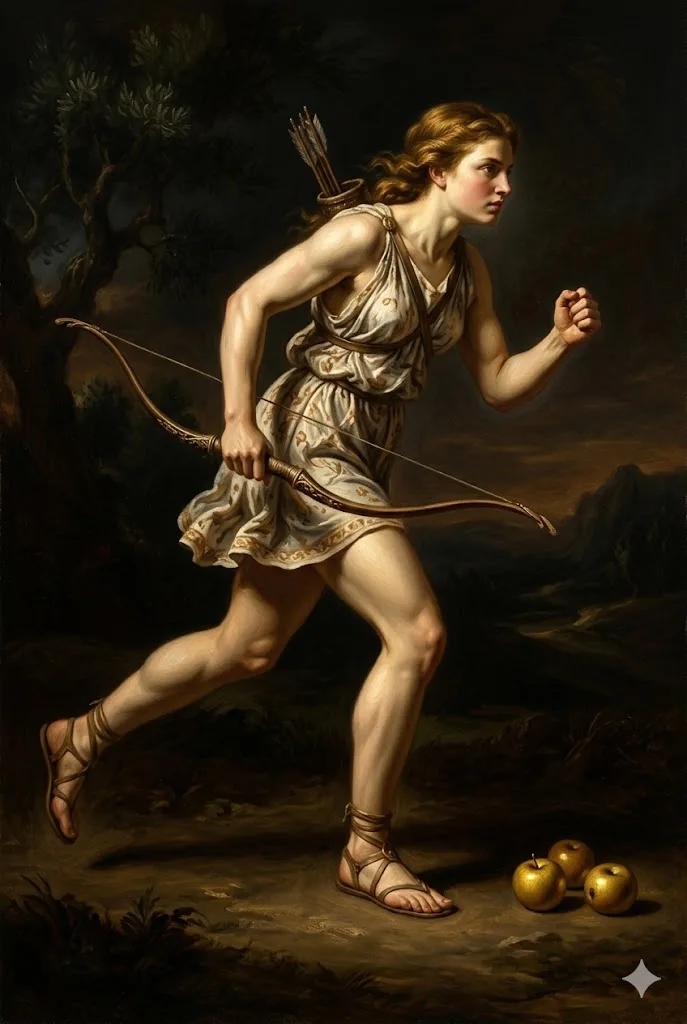
Raised by Bears
Atalanta was one of the most remarkable heroes in Greek mythology and one of the very few women to achieve heroic status in a tradition dominated by men. Abandoned on a mountainside as an infant by her father, who had wanted a son, she was found and nursed by a she-bear sent by Artemis. She grew up wild in the forests, becoming the fastest runner and one of the deadliest hunters in the Greek world. She was devoted to Artemis and swore to remain a virgin, rejecting all suitors.
The Calydonian Boar Hunt
Atalanta's fame began with the Calydonian Boar Hunt, one of the great collective adventures of Greek mythology. When Artemis sent a monstrous boar to ravage the kingdom of Calydon, King Oeneus summoned the greatest heroes of Greece to destroy it. Many of the hunters resented Atalanta's presence, but Meleager, the prince of Calydon who had fallen in love with her, insisted she stay. Atalanta drew first blood, striking the boar with an arrow. Meleager delivered the killing blow but awarded the boar's hide to Atalanta, honouring her skill. This decision sparked a bloody conflict among the hunters that ended in multiple deaths, including Meleager's own.
The Foot Race and the Golden Apples
Atalanta's father, learning of her fame, reclaimed her and insisted she marry. Atalanta agreed on one condition: any suitor must beat her in a foot race, and those who lost would be executed. Suitor after suitor died, because Atalanta was supernaturally fast. Finally, a young man named Hippomenes (or Melanion in some versions) prayed to Aphrodite for help. The goddess gave him three golden apples from the Garden of the Hesperides. During the race, Hippomenes dropped the apples one by one. Atalanta, unable to resist their divine beauty, paused to pick them up, and Hippomenes crossed the finish line first.
The couple married, but Hippomenes forgot to thank Aphrodite for her help. The offended goddess caused them to desecrate a temple of Zeus (or Cybele) by making love inside it. As punishment, both were transformed into lions. According to ancient Greek belief, lions could not mate with each other, so the transformation was a permanent separation, a cruel punishment for a love won through divine intervention.
Classical Sources
- 📜 Homer, Iliad & Odyssey (c. 750 BC)
- 📜 Hesiod, Theogony (c. 700 BC)
- 📜 Apollodorus, Bibliotheca (c. 1st-2nd century AD)
- 📜 Ovid, Metamorphoses (8 AD)
Cross-referenced with multiple classical sources for accuracy.
Explore More
Artemis · Aphrodite · Jason · Home
Two Atalantas, or one?
Ancient writers inherited two overlapping traditions. In the Arcadian version Atalanta is the daughter of Iasus (or Iasion) and Clymene, the huntress of the Calydonian boar, and the man who finally wins her is Melanion. In the Boeotian version, which goes back to the Hesiodic Catalogue of Women, she is the daughter of Schoeneus, a king associated with Boeotia, she is famous above all as a runner, and her husband is Hippomenes. Apollodorus notices the problem and simply reports both fathers; Ovid follows the Boeotian line, with Hippomenes. Some modern scholars think there were originally two heroines who merged; others see one figure with regional variants. Either way, the name Melanion belongs mainly to the hunting tradition and Hippomenes to the running one.
Adventures the hunt and race leave out
Atalanta's career was more crowded than her two famous episodes suggest.
- The centaurs: Apollodorus says that two centaurs, Rhoecus and Hylaeus, tried to rape her in the wilderness, and she shot both dead.
- The Argonauts: Apollodorus includes her among the crew of the Argo. Apollonius of Rhodes, in the Argonautica, disagrees: Jason declines her offer to sail, fearing that a woman aboard would cause quarrels among the men, and she gives him a spear as a guest-gift. Her place in the quest for the Golden Fleece therefore depends on which author you read.
- Wrestling Peleus: at the funeral games for Pelias, Atalanta wrestled Peleus, the future father of Achilles, and beat him according to Apollodorus. The match was a favourite scene on sixth-century Athenian and Chalcidian vases, where she is often shown in a short wrestling garment.
- Her son: Atalanta's son Parthenopaeus, whose name hints at "maiden", was one of the Seven Against Thebes and died in the attack. His father is variously Melanion, Meleager, or even Ares.
The aftermath of the Calydonian hunt also deserves its full shape. When Meleager gave her the boar's hide, his mother's brothers, the sons of Thestius, tried to take it from her, and Meleager killed them. His mother Althaea then burned the log on which the Fates had said his life depended, and he died. In Homer's telling (Iliad 9), which mentions neither Atalanta nor the log, the quarrel becomes a war between the Calydonians and the Curetes, and Meleager sulks out of the fighting until his city is almost lost, a story Phoenix uses to persuade Achilles.
Variants of the race and its punishment
In Ovid's Metamorphoses Book 10, the race is told by Venus herself to her lover Adonis as a warning to avoid lions. Hippomenes forgets to thank her, so she inflames the couple with desire as they pass a shrine of Cybele, the mother goddess, who turns them into the lions that pull her chariot. Hyginus and Apollodorus place the offence in a sanctuary of Zeus instead. The claim that lions could not mate with one another, so that the transformation meant permanent separation, appears in Latin commentators such as Servius; it is a later rationalising detail, not part of the core myth. Some sources say Atalanta allowed suitors a head start and ran armed, spearing those she overtook.
Ancient writers disagree about which apples Aphrodite gave. Ovid says they came from a tree in her sanctuary at Tamasus on Cyprus; the link to the Hesperides' garden is a later and looser association.
Atalanta in cult and art
At Tegea in Arcadia, the temple of Athena Alea, designed by the sculptor Scopas in the fourth century BC, had a front pediment showing the Calydonian hunt with Atalanta and Meleager prominent. Pausanias adds that the Tegeans kept what they claimed were the boar's hide and tusks, until Augustus carried the tusks off to Rome. She appears among the hunters on the François Vase (c. 570 BC), one of the most important early Athenian vases. In later art Guido Reni's Atalanta and Hippomenes (Prado, Madrid) freezes the moment she bends for an apple. Her story is collected with other transformation myths and retold in fuller narrative form in the myth of Atalanta.
Ancient sources
- Apollodorus, Library 3.9.2 — her exposure and nursing by a bear, the centaurs, the Argo, the wrestling with Peleus, the race won by Melanion, and the transformation into lions.
- Ovid, Metamorphoses 8 and 10 — the Calydonian hunt in Book 8; Venus' account of the race with Hippomenes and the punishment in Cybele's shrine in Book 10.
- Hesiodic Catalogue of Women (fragments) — the earliest version of Atalanta, daughter of Schoeneus, and the footrace for her hand.
- Apollonius of Rhodes, Argonautica 1 — Jason refuses to take Atalanta on the Argo.
- Pausanias, Description of Greece 8.45–47 — the Calydonian hunt on the Tegea pediment and the relics of the boar.
Frequently asked questions
Was Atalanta an Argonaut?
It depends on the source. Apollodorus lists her among the crew, but Apollonius of Rhodes, the main ancient poet of the voyage, has Jason refuse to take her.
Who won Atalanta in the race?
Hippomenes in Ovid and the Boeotian tradition, Melanion in Apollodorus and the Arcadian tradition. Both used golden apples from Aphrodite.
Why were Atalanta and Hippomenes turned into lions?
They had sex inside a sanctuary, of Cybele in Ovid or of Zeus in other sources, after Aphrodite stirred them up because Hippomenes failed to thank her.
Did Atalanta have children?
Yes, a son, Parthenopaeus, one of the Seven Against Thebes. Sources disagree on whether his father was Melanion, Meleager or Ares.
Books to read next
- Stephen Fry, Heroes
- Apollodorus, The Library of Greek Mythology (Oxford World's Classics)
- Edith Hamilton, Mythology
Links go to Bookshop.org, which supports independent bookstores. We earn a small commission if you buy, at no extra cost to you.