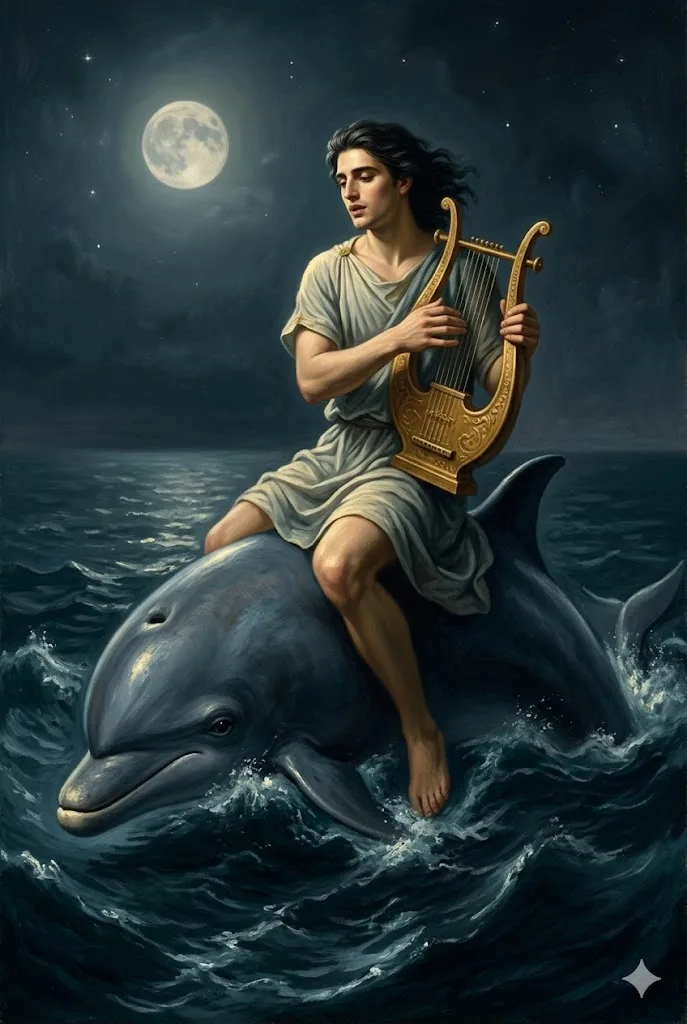
The Greatest Musician
Arion of Methymna was considered the greatest lyre player of his age — perhaps of any age. He lived at the court of Periander, tyrant of Corinth, around the 7th century BCE, and was credited with inventing the dithyramb, the choral hymn that would eventually evolve into Greek tragedy.
His story, recorded by Herodotus, blurs the line between history and myth in the way that the best Greek tales always do.
The Voyage and the Treachery
After earning great wealth performing in Italy and Sicily, Arion hired a Corinthian ship at Taras (Tarentum, in southern Italy) to sail home. But the sailors, eyeing his wealth, decided to rob and murder him at sea. They gave him a choice: kill himself and receive a proper burial on land, or be thrown overboard.
Arion asked for one final request — to sing one last song before dying. The sailors agreed, curious to hear the famous musician perform. Arion dressed in his full musician's regalia, stood at the stern of the ship, and sang a hymn to Apollo with all his heart.
Rescued by Music
His song was so magnificent that dolphins — sacred to Apollo and Poseidon — gathered around the ship. When Arion leapt into the sea, a dolphin caught him on its back and carried him safely to shore at Cape Taenarum (the southernmost tip of the Peloponnese, near an entrance to the underworld).
Arion made his way back to Corinth and told Periander everything. When the sailors arrived, Periander confronted them. They claimed Arion was safe in Italy. Then Arion stepped out, still wearing the same clothes from his final performance. The sailors confessed and were punished.
Legacy
The story of Arion illustrates the Greek belief in the divine power of music — that art could move nature itself to mercy. Apollo and Poseidon honored their sacred animals' instinct to respond to beauty.
In Ovid's telling, Jupiter (Zeus) placed the dolphin that saved Arion among the stars as the constellation Delphinus, ensuring the rescue would be remembered forever.
Quick Facts
Home: Methymna (Lesbos), resident of Corinth
Profession: Lyric poet and musician
Innovation: Invented the dithyramb
Saved by: Dolphins, attracted by his music
Patron: Periander of Corinth
Source: Herodotus, Histories Book I
What Herodotus actually says
The story comes down to us mainly through Herodotus (Histories 1.23–24), who tells it as a digression while describing Periander, tyrant of Corinth. He introduces Arion as a lyre-singer second to none of his time and "the first man we know of" to compose a dithyramb, give it that name and train a chorus to perform it at Corinth. Herodotus adds that the Corinthians and the people of Lesbos both told the dolphin story, so he is reporting a local tradition rather than vouching for the miracle.
A few details differ from popular retellings. Arion had spent a long time touring Italy and Sicily, and it was from Taras (Tarentum) in southern Italy that he set sail, choosing a Corinthian crew because he trusted Corinthians most. The sailors offered him two options: kill himself so that they could bury him on land, or jump straight into the sea. He asked to sing in full costume first, sang the orthios nomos (a high-pitched, solemn kind of song associated with Apollo), and then leapt overboard. Herodotus does not say the dolphins were drawn by the song; he says simply that a dolphin carried him to Taenarum. Periander, doubting Arion's tale, kept him under guard until the ship arrived and then questioned the crew. Herodotus also notes that at Taenarum there was a small bronze offering of a man riding a dolphin, dedicated by Arion himself. Pausanias saw a bronze of Arion on a dolphin there centuries later.
Arion, the dithyramb and the birth of drama
The dithyramb was a choral song for Dionysus, sung and danced by a large circular chorus. Arion's reputation rests on turning it from improvised revelry into a composed, rehearsed choral form. The Byzantine lexicon called the Suda goes further, crediting him with being first to organise a chorus that stood still, to give the dithyramb a fixed name, and to bring in satyrs speaking in verse. If that last claim reflects an older tradition, it links Arion to the satyr-chorus out of which Aristotle believed tragedy developed. The link is plausible but unproven, and scholars debate how much of the Suda's information is genuine.
He belongs to a remarkable musical lineage from Lesbos. Before him came Terpander, credited with the seven-stringed lyre; around his time came the island's great lyric poets Sappho and Alcaeus. His hometown, Methymna, sits on the northern coast of the island. Some later sources call him a pupil of the Spartan poet Alcman, but the chronology is uncertain. A hymn to Poseidon quoted by the writer Aelian as Arion's thanksgiving is almost certainly a later composition.
Later versions and the constellation
The Romans loved the tale. Ovid tells it in the Fasti (Book 2) as the explanation for the constellation Delphinus, rising in early February, and there it is Jupiter who sets the dolphin among the stars with nine of them. The astronomical tradition actually gave two competing origins: in one, Delphinus was the dolphin who found and persuaded the Nereid Amphitrite to marry Poseidon; in the other it was Arion's rescuer. Hyginus records both. See our page on constellation myths for others of this kind.
Hyginus' Fabulae adds that the dolphin, having beached itself, died on the shore, that Arion buried it, and that Periander had the sailors executed at the dolphin's tomb. Plutarch's Banquet of the Seven Sages retells the story as table talk at Periander's court, with a sober discussion of whether dolphins really befriend humans. The Greeks had other dolphin-rider tales too, such as Taras, the founder of Tarentum, whose image on a dolphin appears on the city's silver coins; those coins are sometimes mistakenly identified as Arion.
Arion is often compared with Orpheus: both are musicians whose song sways the natural world. The difference is that Arion is a datable figure placed in a historical court, which makes him one of the rare cases where Greek legend attaches itself to a real person. His story has had a long life since, including Pushkin's 1827 poem "Arion", in which a singer survives a shipwreck that drowns his companions, widely read as a coded reference to the Decembrist uprising.
Ancient sources
- Herodotus, Histories 1.23–24 — the fullest early account: Arion at Periander's court, the voyage from Taras, the song, the dolphin, the bronze offering at Taenarum.
- Ovid, Fasti 2 — a Roman retelling explaining the constellation Delphinus.
- Hyginus, Fabulae 194 and Astronomica 2.17 — the dolphin's death and the punishment of the sailors; the rival origins of Delphinus.
- Plutarch, Banquet of the Seven Sages — the tale told at Periander's table, with discussion of dolphins and music.
- Pausanias, Description of Greece 3.25 — the bronze of Arion on a dolphin at Taenarum.
- Suda, "Arion" — the Byzantine summary crediting him with innovations in the dithyramb and satyr chorus.
Frequently asked questions
Was Arion a real person?
Probably. Herodotus treats him as a historical musician at the court of Periander in the late seventh century BC, though the dolphin rescue is clearly legendary.
Did Arion invent tragedy?
No. He is credited with shaping the dithyramb into a formal choral song, which ancient writers saw as one root of tragedy, but tragedy as a genre developed in Athens a century later.
Which god saved Arion?
Herodotus names no god. Later writers connect the dolphin with Apollo, whom Arion honoured in his song, or with Poseidon, lord of the sea, and Ovid has Jupiter place it among the stars.
Where did the dolphin bring Arion?
To Cape Taenarum, the southern tip of the central Peloponnese, from where he made his way overland to Corinth.